To avoid these ads, REGISTER NOW!

How do I insulate this roof/ceiling?

DistantHorizon

Active member
Joined
Sep 8, 2011
Messages
34
I purchased this house recently, largely because it had this detached garage/shop. Shop is for tinkering and car hobby, bodywork but not paint. Trying to figure out how to insulate the roof deck/ceiling. Fairly set on batts in the walls due to cost.

24'x40', 12' 2x6 walls, tyvek wrapped with some sort of siding. 5/12 roof I believe. Scissor trusses on 24" centers (though they appear to sometimes be a half inch or more off :( ). Trusses taper to only 3 1/2" tall above the walls. Asphalt shingle roof. Ridge vent only. No soffit vents currently installed. Located in south-central Kansas.

I know it's stupid to skimp on insulation, but money is tight, and with the way things have been going, it looks like it will be for some time.

Was planning on 3 1/2" closed cell spray foam on roof deck, but it's looking like $3000-$3500 for only R-20 or R-25. (Contacted 5 places, only 2 ever gave me a rough quote, need to call more) Also, how do I handle the ridge vent in that case? Spray foam does look like it would save some money in that I wouldn't have to finish the ceiling immediately, and wouldn't have to add soffit vents.

Blow-in fiberglass or cellulose? How does it effectively get down to the ends of the trusses if the ceiling is completely tinned or sheetrocked. (Will it blow 20' without getting any underinsulated pockets?) How do you handle access to spray in between each truss in a scissor-truss situation? It's not like an attic where you can walk around. Also hate the idea of it settling and having to add more.

24" wide batts don't seem to be real cheap either - looks like about a thousand bucks in insulation just to go to R-25.

Not sure how I will finish the underside of the trusses (ceiling). Figured on a sheetrock crew.

Do I just bite the bullet and pony up for spray-foam? Any ideas or suggestions would be helpful.

View from under loft:
IMG_1754.jpg


View from loft:
IMG_1757.jpg


Pic from opposite end of garage, looking up at loft and scissor trusses:
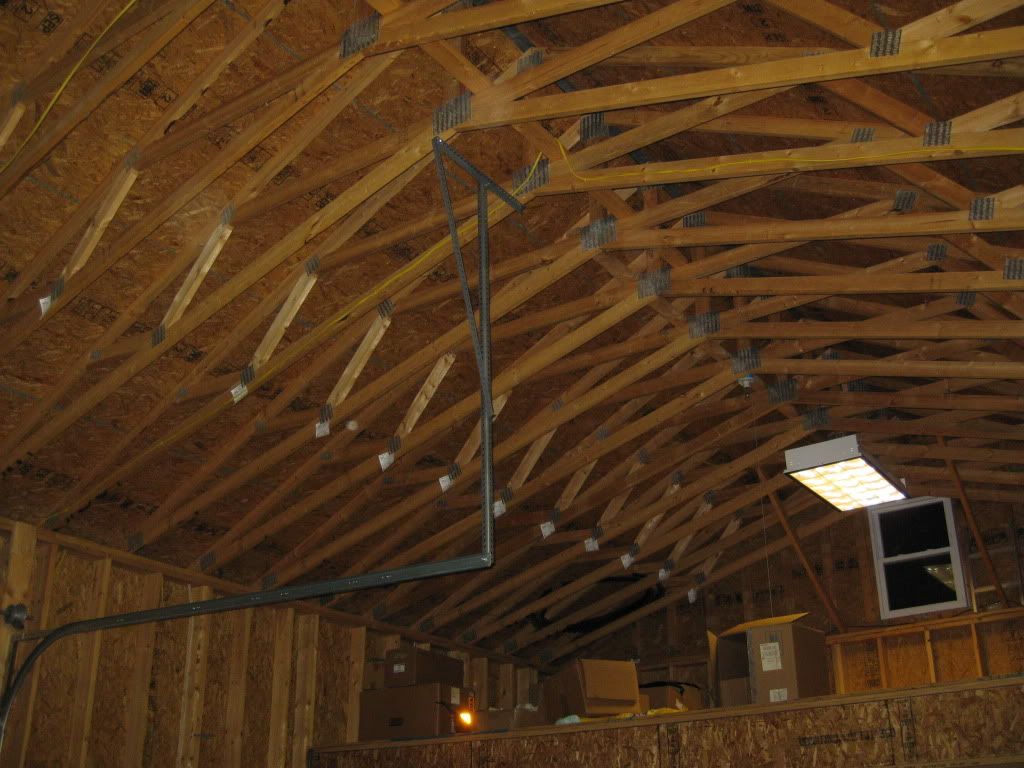
IMG_1756.jpg
 
To avoid these ads, REGISTER NOW!
OP
D

DistantHorizon

Active member
Joined
Sep 8, 2011
Messages
34
Do you need the extra height given by the scissor truss? Have you considered a drop ceiling with bats on top?

The loft part (1/3 of the shop) needs the height. The rest of it doesn't need the height (though it might accommodate a lift in the future).

I didn't know if it was worth the expense and effort to do something like that, and to be real honest, I was under the impression that the scissor trusses wouldn't handle the weight. Maybe they just won't handle a ton of storage? I guess the primary advantage would be that it'd be less volume to heat.

I'll consider that, but am not sure at this point.
 

rsanter

Well-known member
Joined
Dec 22, 2007
Messages
18,505
Location
visalia ca
remember that fiberglass bats only work if they can hold the air still. fiberglass needs 6 sides of contact to work. if you put fiberglass up and leave it open on the back side it has little value

opinion
to me I would get some drywall or other ceiling material up there starting on the low ends and then blow in some insulation. put up some more ceiling and add more insulation

foam is the best but pricy, have you thought about rigid foam that you cut and put between the rafters?

do you need it insulated or can you just crank the heat when you are going to be out there?

bob
 

MrMark

Well-known member
Joined
Jan 25, 2010
Messages
4,626
Location
Southern Cal.
I'm so glad you posted those pictures. We just acquired a house with those same scissor trusses.

We just stripped the sheetrock off the ceiling and the ends of the trusses where it comes to the eve wall were insulated with batts and the rest blown in! This was a tract house built shoddily and cheap as possible. I couldn't figure the insulation set up as I had no experience with the blown in. Now I get it: the blown in is cheap as hell and thus they used that where they could. They couldn't blow in in the narrow ends, thus the more expensive batts.

FYI, there is almost nothing left of the blown in after 20 years. It is compressed to nothing. I wouldn't want anything to do with it. It is a mess and is currently providing essentially zero insulation. The batts were OK. There is a reason they cost more!
 
OP
D

DistantHorizon

Active member
Joined
Sep 8, 2011
Messages
34
remember that fiberglass bats only work if they can hold the air still. fiberglass needs 6 sides of contact to work. if you put fiberglass up and leave it open on the back side it has little value

I guess I didn't understand that. I thought I could staple faced batts to the underside of the rafters and sheetrock later. So the facing would have to be on the top edge of the rafters, with the sheetrock closing off the bottom side?

foam is the best but pricy, have you thought about rigid foam that you cut and put between the rafters?

I am not familiar with it, unless you're referring to the stuff I've seen in thin 4x8 sheets at Menards Lowes etc...

do you need it insulated or can you just crank the heat when you are going to be out there?
bob

I don't know how often I'll be out there, so I figured on making it at least fairly well insulated. I had originally hoped to have the roof at R-30 or better (though I guess I relaxed that to R-25 for the spray foam, since that seems to be what fits flush with the 3.5" top board on the trusses).
 

Falcon67

Well-known member
Joined
Jun 11, 2009
Messages
18,371
Location
Merkel, TX
remember that fiberglass bats only work if they can hold the air still. fiberglass needs 6 sides of contact to work. if you put fiberglass up and leave it open on the back side it has little value

Then how exactly does normal attic insulation work? Because there's air space above every ceiling in every house I've ever been in. And I can fully attest that it works because I could keep my old shop at 75F with a 12K window unit on medium when the roof deck temperatures above the R13 fiberglass batts were 150~160F.

To the OP: I don't think it would cost much - if anything - to get all the dimensions off your trusses and take those to a lumber yard or truss supplier, let them run the numbers and tell you what loads the members can handle. If they will take 5 lbs sq/ft ceiling load then your good for sheetrock and batts.
 
Last edited:

dittle fart around

Well-known member
Joined
Jan 9, 2011
Messages
2,455
Location
Vancouver, Washington, USA
I guess I didn't understand that. I thought I could staple faced batts to the underside of the rafters and sheetrock later. So the facing would have to be on the top edge of the rafters, with the sheetrock closing off the bottom side?

The faced side of batt insulation always face the area you're trying to heat. If you're worried about the insulation falling off the rafters put a plastic sheet vapor barrier up stapled to the bottom of the rafter. Then you could slide unfaced batts over the vapor barrier. Remember to keep the area where your soffit vents are open for air flow. Then mount some vents in the roof near the peak.
 

Highbeam

Well-known member
Joined
Feb 15, 2011
Messages
2,292
Location
Mt Rainier foothills, WA
First step is to provide ventilation at the eave. Soffit vents, bird block holes, whatever but before you close up that ceiling you need to provide for ventilation.

Then put up the faced batts made for this purpose with the faced side facing the garage of course.

Then, maybe after awhile, put up sheetrock to keep the insulation in place. If the insulation sags then you can run string lines or some other restraint across the bottom chord to help keep it up there. Lots of staples during the initial install will help.

This is the kind of attic where blown in isn't wise. Access is too limited.
 

Toolfool

Well-known member
Joined
Aug 22, 2011
Messages
4,981
Location
Tallahassee, FL
From the pics you posted, it looks like you probably have a ridge vent already in place. That would lead me to believe you have soffit vents as well, so the venting issue is most likely covered.
 
To avoid these ads, REGISTER NOW!

70 chevelle

Active member
Joined
Jan 12, 2010
Messages
44
I have the same problem with my 30x40 with scissor trusses cant decide which way to go with insulation, I can get enough 4' wide vinyl back 4" insulation for free and was thinking about cutting in 24" wide and staple between truss and then lay some on top in the opposite direction, but I'm not sure if the vinyl on top of the first layer of insulation would be a problem?
Thanks
Larry
 

rsa

Well-known member
Joined
Mar 3, 2011
Messages
300
Location
Between Raleigh and Fayetteville, NC, USA
There's no one answer. Especially not one, inexpensive answer. You can make lots of different ways work. Don't make a decision before doing a lot of reading. I'm not an expert, but I do hang out at building science sites while planning my garage.

This Joe Lstiburek article about venting also describes your insulation options. Read/listen to him discuss the vented "attic", it'll address your lack of soffit vents.

Do searches on insulating cathedral ceilings and insulating scissor trusses and when you start reading, your find more searches to do. My go-to sites are http://www.greenbuildingadvisor.com (look for the blog postings with lots of discussion), http://buildingscience.com/, and to a lesser extent, http://www.jlconline.com/ (subscription required for most articles, but not the forum). You can do advanced google searches that restrict results to a single site, e.g. vented cathedral ceiling site:greenbuildingadvisor.com

South central KS is in 2009 IECC Climate Zone 4 (R38 ceilings). 2012 will raise the the roof R-Value target for Zone 4 to 49. :eek:

I don't think the below goes too far overboard. You still have issues with the lack of space for conventional insulation around the perimeter. :(

•make sure you had plenty of soffit venting, twice the area that I had at the ridge. Put the soffits vents outboard, away from the wall.
•install site-build vent channels as far as you need to keep your conventional insulation off the roof deck (Lstiburek recommends 2" deep vents, but you've got so little space). I've seen both XPS and polyiso recommended. Seal to prevent air leakage. Alternative to site built are Accuvents (seal them too).
•use closed cell spray foam over the wall top plates where there's so little room for conventional insulation. There are DIY kits. You want the r-value here to at least equal the wall's r-value, but with only 3-1/2" you do the best you can. Alternatively, you could use rigid insulation, individually cut, fit, and sealed instead of closed cell foam.
•R-30 rock wool batts, e. g. Roxwool ComfortBatt in between the bottom chords before attaching the foil-faced polyiso. I personally wouldn't use fiberglass batts after hanging out at building science sites. [Aside: I ****really**** wanted to suggest running the vents all the way to the ridge and filling the truss cavities with cellulose/dense-pack cellulose instead of batts: read this thread, especially reply #6.]
•use 1x4 strapping to attach 2" of foil-faced polyiso to the bottom of the trusses (gives you a thermal break and added insulation—especially where the truss depth is inadequate). Tape and caulk.
•drywall over the rigid foam, making sure it's ***airtight*** from the interior, sealing all penetrations and the wall ceiling interface.
•paint the drywall with a vapor-retarding primer if you didn't use taped, foil-faced polyiso under the rafters. Skip using poly sheeting in both cases.

This isn't for scissor trusses, but shows the basics:
4-00103.preview.png
 
Last edited:
OP
D

DistantHorizon

Active member
Joined
Sep 8, 2011
Messages
34
So, spoke to one guy today who said, $1.25/foot of closed-cell foam would be R-8, but perform like R-20 if I did the whole envelope and sprayed the walls as well. Sounds too good to be true. He said they'd never had issues with shingles curling or deteriorating due to insulated deck.

Another guy said sheetrock it and blow it in with fiberglass. Said it won't settle, and he'd do R-38 for 1.21/foot. He said he has spray foam, but wouldn't recommend it for this application due to shingle warranty issues and overheating/curling shingles.

To the OP: I don't think it would cost much - if anything - to get all the dimensions off your trusses and take those to a lumber yard or truss supplier, let them run the numbers and tell you what loads the members can handle. If they will take 5 lbs sq/ft ceiling load then your good for sheetrock and batts.

Yeah, I don't know why I thought that. I actually have the truss manufacturer's drawing of the trusses, with all the specifications... probably ought to call them.

First step is to provide ventilation at the eave. Soffit vents, bird block holes, whatever but before you close up that ceiling you need to provide for ventilation.

Then put up the faced batts made for this purpose with the faced side facing the garage of course.

Then, maybe after awhile, put up sheetrock to keep the insulation in place. If the insulation sags then you can run string lines or some other restraint across the bottom chord to help keep it up there. Lots of staples during the initial install will help.

This is the kind of attic where blown in isn't wise. Access is too limited.

Your vent/batts/sheetrock plan is what I'd planned on after seeing the price of spray foam, but before I saw the price of batts. Lol! Blown in sure seems to be the easy way to go, but I have the same misgivings - it seems difficult and complicated to do in the small area.

From the pics you posted, it looks like you probably have a ridge vent already in place. That would lead me to believe you have soffit vents as well, so the venting issue is most likely covered.

That's what you'd think, but this property is a mix of well-done and half-assery. When I say there's no soffit vents, I'm serious. There's currently a ridge vent but no soffit vents.
 

Falcon67

Well-known member
Joined
Jun 11, 2009
Messages
18,371
Location
Merkel, TX
That's what you'd think, but this property is a mix of well-done and half-assery. When I say there's no soffit vents, I'm serious. There's currently a ridge vent but no soffit vents.

>a mix of well-done and half-assery

LOL - you are not alone. Our house was built in 2001. We bought it last year as a repo. It had plenty of soffit vents and zero roof vents. Nada, not a single one. It has 5 now with one more to go when I get to it. When I cut the first 10" hole for a vent back in the spring, the hot air coming out liked to knocked me off the roof.
 

b4z

Well-known member
Joined
Dec 31, 2008
Messages
82
Spray foam works great. I would go with that, but let me give you the good and bad.
One of the reasons spray foam works so well underneath the roof deck is because it is a radiant barrier. In the Summer your attic space will not heat up past about 90 degrees and will not radiate that heat as easily down into your garage space.
In SC our attic space would get as hot as 130 degrees prior to the spray foam.

I went with closed cell becuase it has some structural properties. I did not want our roof sheathing to come off in a hurricane nor did i want the roof to leak if the shingles and roofing felt came off. Closed cell will not pass water, open cell will.

Now here's the bad part:
Mine cost $4900 for a 1650 sqft house with 8/12 pitch.
They sprayed my foam light. Which means in some places it is only about an inch thick instead of the 2.5-3" it was supposed to be. I have recorded a 96.6degree temp in the attic when the max was supposed to be 85-90 degrees.
Do not let him tell you that R8 is enough. Bull!

The other bad part. The spray foam is definitely working. Our HVAC system is now oversized. We had to replace our single pane windows with double pane at a cost of over $4200, because the heat was not runniing enough to take the moisture out of the air. We had condensation so bad that our windows got moldy and started to rot. We had to towel off the windows twice a day!

If I were you go with the open cell with at least R20, more is better. You will be absolutely amazed at how well it works.
Even with our's being sprayed on light our heating bills dropped over 30-40% as did out A/C bills.

Awesome stuff.

Wanted to add that with your ridgevent they will staple roofing felt up to it then spray over it, same with your soffits.
When the temp is in the 50s we can literally heat our house with lightbulbs.
The comfort level and eveness of temperature is also better.
 
Last edited:
OP
D

DistantHorizon

Active member
Joined
Sep 8, 2011
Messages
34
Thanks for that reply!

This Joe Lstiburek article about venting also describes your insulation options. Read/listen to him discuss the vented "attic", it'll address your lack of soffit vents.[/IMG]

That's an excellent read, and everything there makes sense. I was not aware that my soffit vents should have more area than the ridge vent.

I don't think the below goes too far overboard. You still have issues with the lack of space for conventional insulation around the perimeter. :(

•make sure you had plenty of soffit venting, twice the area that I had at the ridge. Put the soffits vents outboard, away from the wall.
•install site-build vent channels as far as you need to keep your conventional insulation off the roof deck (Lstiburek recommends 2" deep vents, but you've got so little space). I've seen both XPS and polyiso recommended. Seal to prevent air leakage. Alternative to site built are Accuvents (seal them too).
•use closed cell spray foam over the wall top plates where there's so little room for conventional insulation. There are DIY kits. You want the r-value here to at least equal the wall's r-value, but with only 3-1/2" you do the best you can. Alternatively, you could use rigid insulation, individually cut, fit, and sealed instead of closed cell foam.
•R-30 rock wool batts, e. g. Roxwool ComfortBatt in between the bottom chords before attaching the foil-faced polyiso. I personally wouldn't use fiberglass batts after hanging out at building science sites. [Aside: I ****really**** wanted to suggest running the vents all the way to the ridge and filling the truss cavities with cellulose/dense-pack cellulose instead of batts: read this thread, especially reply #6.]
•use 1x4 strapping to attach 2" of foil-faced polyiso to the bottom of the trusses (gives you a thermal break and added insulation—especially where the truss depth is inadequate). Tape and caulk.
•drywall over the rigid foam, making sure it's ***airtight*** from the interior, sealing all penetrations and the wall ceiling interface.
•paint the drywall with a vapor-retarding primer if you didn't use taped, foil-faced polyiso under the rafters. Skip using poly sheeting in both cases.

This isn't for scissor trusses, but shows the basics:
4-00103.preview.png

I actually kept coming across the R-60 scissor truss thread when googling for scissor truss insulation. I had not seen that picture though... that's helpful.

I don't think what you've suggested there is overkill (I'm sure it would be wonderful - I guarantee my house isn't insulated nearly that well!) But it looks expensive, I figured $3800 just for the batts and foil-faced polyiso. But it does look good too. I am concerned about:
1) closed-cell spray foam compressing the vent baffles
2) I keep hearing people talking about cellulose settling and loosing effectiveness over time.

I will have to do more research.
 
OP
D

DistantHorizon

Active member
Joined
Sep 8, 2011
Messages
34
Spray foam works great. I would go with that, but let me give you the good and bad.....

It sounds like you still have conventional insulation right above your ceiling too? I'd think that'd be a moisture problem in the attic.

I do keep hearing how spray foam performs better than it's R-value indicates... that makes me wonder if just spraying 3 .5" of closed cell against the roof deck would be the way to go (open cell wouldn't be enough R-value for the ends of my trusses). It wouldn't be super-insulated (for Kansas, you're in a different situation in SC) by any stretch, but it might be good enough.

fiberglass blankets with chicken wire or metal banding or nail and large plastic washer..
http://metalbuildinginsulation.com/postframepolebldg.html

All the info there sure seems to indicate it's specialized for metal buildings. We have that at work (bodyshop), but I don't know if it's right for this project.
 

danski0224

Well-known member
Joined
Jan 29, 2005
Messages
13,380
Location
Near Naperville, IL
I do keep hearing how spray foam performs better than it's R-value indicates... that makes me wonder if just spraying 3 .5" of closed cell against the roof deck would be the way to go (open cell wouldn't be enough R-value for the ends of my trusses). It wouldn't be super-insulated (for Kansas, you're in a different situation in SC) by any stretch, but it might be good enough.

Spray foam does 1 thing that fiberglass will not: stop airflow.

Airflow through fiberglass kills the R value.

R value of fiberglass is dependent on temperature.

On a scale of 1 to 4 (worst to best), the majority of fiberglass insulation installations can be graded at 2 or 3.

Best bang for the buck if you have the space will be 1" of foam followed by dense pack blown in cellulose. This works well in walls, not sure how to make it work in your ceiling.

Spray foam can be installed improperly.

If the chemical or surface temperature is off, the foam will not stick to the surface properly.

Not sure how a re-roof will effect roof deck spray foam insulation performance (pulled nails, new nails).

I asked about increased shingle temperature from a foamed roof in a BPI class, and I was told that is incorrect. This is *not* the same as an improperly ventilated attic/roof space with superheated air.
 

rsa

Well-known member
Joined
Mar 3, 2011
Messages
300
Location
Between Raleigh and Fayetteville, NC, USA
I don't think what you've suggested there is overkill (I'm sure it would be wonderful - I guarantee my house isn't insulated nearly that well!) But it looks expensive ... I am concerned about:
1) closed-cell spray foam compressing the vent baffles
2) I keep hearing people talking about cellulose settling and loosing effectiveness over time.

I will have to do more research.
Research is good. :bowdown:

It's easy for me to be seduced into a 100% solution when I read what's available. It's probably more reasonable on a payback basis to make the best of one's situation and budget without resorting to heroics.

The more I think about this, the more I think my polyiso-under-the-trusses suggestion was overkill, especially if you heat and/or air-condition the space conservatively compared to your living spaces.

Here's another diagram from GBA omitting the polyiso under the trusses.

4-00423.preview.png


I'm not sure at all that closed-cell foaming 100% over the top-plates is overkill. I estimate you need 10 cubic feet to do that assuming no waste and no learning curve (a 13 cubic foot kit is $335 at tigerfoam.com). It even seems prudent to spray a couple of inches against the venting, until the space available for traditional insulation opens up (a 50 cubic foot kit is $610 at tigerfoam.com). If it's not in the budget, it's not in the budget.

About your concern that the vent won't stand up to spray foam, Accuvent's manufacturer advertises it as designed for spray foaming. Take a look at this cellulose dense-pack demonstration video to get an idea of how sturdy the Accuvent is. It's also easy to install (saving on labor over site-built rigid foam vents).

I'm also "warming" even more to cellulose. R-49 is about 14" of loose cellulose. Add 2 inches for insulation space lost to the venting. If your roof is 5 in 12 and the bottom cord is 3 in 12 (my WAG from your pictures), you don't get 16" clearance for insulation until you're about 8' into the room. The installer could dense-pack the cellulose in the restricted perimeter area, then transition to loose-fill cellulose when space allows.

Remember Robert Riversong's comments in the "R-60 with scissor trusses?" thread? He writes about blowing more cellulose in the upper parts of the truss roof so that you average your target R-value over the entire ceiling and notes that doing so will put "more insulation in the higher part of the cathedral ceiling where there will be more warm air stratification and more potential heat loss". His comment about possibly needing two insulation contractors is still valid, but for the small amount of spraying foam, you'd spray it yourself, right?

As far as cellulose settling, the EPA says,
Over time, loose-fill insulation can lose its installed R-value because of settling, especially in attic cavities. Cellulose settles more than rock wool or fiberglass—20% compared to 2%–4%. Therefore, if you use cellulose, install 20% more in an attic to offset the settling. Cellulose manufacturers are required by federal law to provide the "settled thickness" on their bags. Some even provide the "installed thickness."

Don't forget to air seal to the best of your ability and that you don't need a vapor barrier, in your climate zone:
No interior attic assembly side vapor control is required or recommended in climate zones other than Climate Zones 6 or higher (see Map 1) for vented attic assemblies (note the distinction, this is not the case for unvented attic assemblies as will be discussed later). With vented attic assemblies moisture that diffuses into the attic space from the conditioned space is vented to the exterior by attic ventilation.
So, I retract that my "vapor-retarding primer" recommendation too. :lol_hitti
 

danski0224

Well-known member
Joined
Jan 29, 2005
Messages
13,380
Location
Near Naperville, IL
Think really hard about those DIY foam kits.

I tried it, did not turn out well.

Similar reviews online.

Chemical temperature during application is critical.
 
To avoid these ads, REGISTER NOW!
Top Bottom