To avoid these ads, REGISTER NOW!

How do I solve this gas plumbing issue?

reader2580

Well-known member
Joined
Dec 31, 2014
Messages
14,518
Location
Minneapolis, MN
I decide to start a new thread since the other one was about fixing a gas valve.

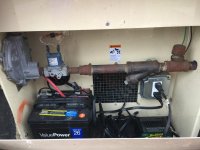
I have a standby generator that basically needs complete replumbing of the gas due to numerous issues with the installation.

Can I put the external regulator inside the generator by the gas valve and the other regulator? It will fit. What about putting the drip leg inside the generator too? To isolate vibration I need to add something like a 12" stainless isolator they make for this situation. Can I run the isolator straight down outside the generator and then make a U shape to get back to copper pipe? I would prefer not doing the U because every joint is a potential leak, but I might not have a choice.

One of the absolutes is that I don't want move the copper pipe if at all possible. It will cost me at least $200 to get a plumber or HVAC guy out to rerun the copper line.
 

Attachments

  • IMG_0527.jpg
    IMG_0527.jpg
    148.6 KB · Views: 117
  • IMG_0652.jpg
    IMG_0652.jpg
    139.7 KB · Views: 120
  • IMG_0653.jpg
    IMG_0653.jpg
    133.7 KB · Views: 108
Last edited:
To avoid these ads, REGISTER NOW!

66cj225

Well-known member
Joined
Nov 4, 2011
Messages
332
Location
NH
Start with the calculations. It takes so many BTU's to make a horsepower. Generator should have an input spec plate and work from there. Lp and natural gas are two different animals as is liquid and gas.
 
OP
R

reader2580

Well-known member
Joined
Dec 31, 2014
Messages
14,518
Location
Minneapolis, MN
Start with the calculations. It takes so many BTU's to make a horsepower. Generator should have an input spec plate and work from there. Lp and natural gas are two different animals as is liquid and gas.

The generator specs are 199,000 BTU/hour. The calculations show that 1/2" copper with 2 PSI gas is just fine.

The generator run fine the way the plumbing is now, but the gas valve leaks so the shutoff at the meter is off right now. It was suggested that I replace all the rusty pipe and add vibration isolation when I replace the gas valve.
 

66cj225

Well-known member
Joined
Nov 4, 2011
Messages
332
Location
NH
Two pressure regulators would raise my eyebrow first. Regulators are vented to prevent line pressure from reaching the flame (or engine in this case) on diaphrm failure. Want vented gas in your enclosure?
The gas valve likely didn't like the torque of the out of cabinet plumbing taking that right turn plus the vibration if it wasn't broken from the lack of a two wrench installation. Rusty pipe is the least of your troubles.
 

zmaxmotorsports

Well-known member
Joined
Jan 11, 2013
Messages
11,948
Location
South of omaha
Why not just repipe it and install a union by the gas valve to make it easier to work on?
I'd leave the regulator where it is.
I can't tell from my phone,but that looks more like a solenoid than a regulator on the inside to me anyway.
 

pstnbly

Well-known member
Joined
Jul 20, 2010
Messages
766
Location
So. Vermont
Putting the regulator on the inside of the cabinet may not be a good idea. The regulator will need an outside vent or a check valve so it does not present an explosion hazard if the diaphragm develops a leak.
 

ForceFed70

Well-known member
Joined
Apr 27, 2010
Messages
3,441
Location
BC, Canada
Two pressure regulators would raise my eyebrow first. Regulators are vented to prevent line pressure from reaching the flame (or engine in this case) on diaphrm failure. Want vented gas in your enclosure?
The gas valve likely didn't like the torque of the out of cabinet plumbing taking that right turn plus the vibration if it wasn't broken from the lack of a two wrench installation. Rusty pipe is the least of your troubles.


Dual regs is common with a 2PSI gas system. Nothing weird there. All regulators are designed so you can vent them externally - while not done in this pic, it's easy and also super common. That enclosure looks pretty well vented to me. It's got a lead acid battery in the enclosue and the enclosure appears to be designed for that purpose. You also need venting in that scenario - I'd be pretty confident that the enclosure meets required venting standards.

OP: I'd leave well enough alone and just replace the valve. Vibration isolation is a good idea but your copper pipe is "sorta" doing that for you and it's an emergency backup generator which I assume is only run for a few days a year.
 
Last edited:

rlitman

Well-known member
Joined
Oct 18, 2010
Messages
24,596
Location
Long Island
... that looks more like a solenoid than a regulator on the inside to me anyway.

There are both. Outside is the regulator that steps down from the 2 PSI copper.
Inside, there is a solenoid safety shutoff valve and the demand regulator that feeds the carburetor.
 
OP
R

reader2580

Well-known member
Joined
Dec 31, 2014
Messages
14,518
Location
Minneapolis, MN
Two pressure regulators would raise my eyebrow first. Regulators are vented to prevent line pressure from reaching the flame (or engine in this case) on diaphrm failure. Want vented gas in your enclosure?
The gas valve likely didn't like the torque of the out of cabinet plumbing taking that right turn plus the vibration if it wasn't broken from the lack of a two wrench installation. Rusty pipe is the least of your troubles.

I have run the generator less than an hour since I got it. The gas valve is bad because it has corrosion inside the body.

This is a used generator. The piping inside the cabinet is original and I paid an HVAC company to do the stuff outside the cabinet.
 
OP
R

reader2580

Well-known member
Joined
Dec 31, 2014
Messages
14,518
Location
Minneapolis, MN
It sounds like I need to leave the regulator outside the enclosure. The generator is going to have to be completely replumbed all the way from the meter then to add vibration isolation.
 
Last edited:

ForceFed70

Well-known member
Joined
Apr 27, 2010
Messages
3,441
Location
BC, Canada
It sounds like I need to leave the regulator outside the enclosure. The generator is going to have to be completely replumbed all the way from the meter then to add vibration isolation.


I don't think you need any additional vibration isolation, but if you think you do - just switch out the copper for flexible gas pipe. Why would you need to replumb back to the meter?

You are thinking about this too much. Replace the gas valve and leave the rest alone. If you find a failure related to vibration, worry about vibration isolation then. There's little benefit to doing it now anyway.

This reeks of wanting to fix something that isn't broken.
 
Last edited:

CNGsaves

Well-known member
Joined
Sep 26, 2012
Messages
13,233
Location
KS and OK
^ ^ ^ This. Now that we know the whole story (ie used genset that had all that pipe setup inside re-used . . . .and HVAC vendor doing the copper for high-pressure 2 psi), everything should work as it sits today.

+1 to replace valve. +1 that reduction regulator needs to stay outside the enclosure for safety if a leak were to occur.

RE old rusty pipe - - Even though that strange steel pipe setup inside the enclosure is unusual, it actually serves as NG "buffer" of volume just before the genset so it doesn't starve from fuel. Even that strange Wye serves somewhat a purpose of capturing debris as NG flows that last horizontal section.

Your only issue is whether the valve can be fixed without removing all the pipes back to the coupling with the copper. If all that gets dis-assembled, then add Union INSIDE the enclosure as ZMax suggests to make any future maintenance much easier.
 
To avoid these ads, REGISTER NOW!
OP
R

reader2580

Well-known member
Joined
Dec 31, 2014
Messages
14,518
Location
Minneapolis, MN
Since there is no union I will have to disconnect the copper and remove all of the remaining pipe to replace the gas valve. It doesn't make sense to just reinstall all that rusty ****.
 
OP
R

reader2580

Well-known member
Joined
Dec 31, 2014
Messages
14,518
Location
Minneapolis, MN
I don't think you need any additional vibration isolation, but if you think you do - just switch out the copper for flexible gas pipe. Why would you need to replumb back to the meter?

You are thinking about this too much. Replace the gas valve and leave the rest alone. If you find a failure related to vibration, worry about vibration isolation then. There's little benefit to doing it now anyway.

This reeks of wanting to fix something that isn't broken.

Wouldn't switching out the copper mean replacing the pipe all the way to the meter since the copper goes all the way to the meter? What flexible pipe to replace the copper is rated for outdoor use? Doesn't CSST need to be sleeved outdoors? Is CSST any more flexible than copper?

This really wasn't done properly from the start and if I have to remove all the pipe to replace the gas valve I want to do it right. I really don't want to wait until the copper breaks to fix it after I have another gas leak.
 

brewchief01

Member
Joined
Nov 18, 2015
Messages
14
Unhook the copper and everything should spin around to replace the gas valve, small can of black Rust-Oleum will fix the rust, that much copper is probably going to work fine it keep any vibration at bay. Even adding a vibration isolator will only do so much as there is really not a good way to do it.

Sent from my XT1254 using Tapatalk
 

sms1974

Well-known member
Joined
Jul 9, 2014
Messages
210
Location
Grafton Ohio
replace the gas valve and let it run....
while its ugly and not how I would do it there is nothing really "wrong" with it. Gas valve failures become more common every year. It used to be a couple a year now it a couple a month, they don't build nothing like they used to....
 

ForceFed70

Well-known member
Joined
Apr 27, 2010
Messages
3,441
Location
BC, Canada
OP: I hope you just let this vibration isolation thing drop. It's not needed and a waste of time and money IMO.

But anyway - Quality CSST is UV protected and suitable for outdoor use. It's used outdoors all of the time. Here's a datasheet for one of the most common brands: https://www.gastite.com/downloads/pdfs/gastite_di_guide.pdf

Just add a section between the copper and the black iron piping if you are worried about vibration. You are not replacing the copper, just adding a flexible section to provide vibration isolation. Although it doesn't look like the meter is all that far away, and replacing the entire piece of copper with CSST may be the cleanest way to do it.
 
Last edited:
OP
R

reader2580

Well-known member
Joined
Dec 31, 2014
Messages
14,518
Location
Minneapolis, MN
I thought that CSST is supposed to be sleeved outside for physical protection? Actually, doesn't copper require that too technically? I looked at using a product called Gasflex, but it needs to be sleeved outdoors.
 

ForceFed70

Well-known member
Joined
Apr 27, 2010
Messages
3,441
Location
BC, Canada
I haven't seen a need to sleeve. But it's not a bad idea and cheap/simple to do. If you're concerned about it - go ahead and sleeve it. Grab some "flexible conduit" from a local electrical supplier.
 
OP
R

reader2580

Well-known member
Joined
Dec 31, 2014
Messages
14,518
Location
Minneapolis, MN
I haven't seen a need to sleeve. But it's not a bad idea and cheap/simple to do. If you're concerned about it - go ahead and sleeve it. Grab some "flexible conduit" from a local electrical supplier.

I think it is a requirement to protect CSST from physical damage outdoors. I doubt that flexible conduit would be enough protection unless maybe you get the flex conduit that has metal in it.

Here is something I found online:

5.14 Outdoors
When installed outdoors, CSST shall be protected from mechanical damage. A conduit or chase is required for installations in exposed unprotected areas within 6 feet of grade. Conduit shall be supported with proper size pipe hooks, pipe straps, bands, or hangers.

Protective coating must remain intact outdoors. Mechanical joints and associated exposed metal tubing shall be wrapped or protected by shrink sleeves. Appropriate measures must be taken to shield CSST from corrosive environments such as exposure to acid or chloride based cleaning solutions for brick or masonry.
Where passing through an outside wall, CSST shall be protected. CSST must be sleeved where passing though
 

ForceFed70

Well-known member
Joined
Apr 27, 2010
Messages
3,441
Location
BC, Canada
Flexible conduit meets those requirements. If it's rated as conduit, then it's conduit. Get the metal stuff if you want. CSST is pretty durable stuff in itself, just as durable as that copper you have unprotected. The conduit is mostly to protect the plastic coating rather than to prevent punctures.
 
OP
R

reader2580

Well-known member
Joined
Dec 31, 2014
Messages
14,518
Location
Minneapolis, MN
I got a new gas valve yesterday. I decided to go with the same gas valve with a 3/4" body instead of a 1/2" body. It seems silly that they adapt from 3/4" to 1/2" at the gas valve and then right back to 3/4".

I am just going to re-pipe everything inside the generator since I have to make changes due to going with a 3/4" gas valve. How do I get the old thread sealant out of the regulator so I don't end up with chunks of old sealant in the regulator?
 

ForceFed70

Well-known member
Joined
Apr 27, 2010
Messages
3,441
Location
BC, Canada
I don't think there's a special trick. Get in there with a dental pick would be my recommendation. One of the reasons I prefer Teflon tape vs a paste-type thread sealer.
 
To avoid these ads, REGISTER NOW!
Top Bottom