To avoid these ads, REGISTER NOW!

How do you run multiple speakers?

3pedal

Well-known member
Joined
Dec 29, 2009
Messages
190
Location
Brighton, CO
I have gotten back into the shop and need to put in some more speakers.

I currently have an old receiver that supports 2 pairs, A and B. :) My sources are the TV, radio and iPhone.

I have one set in the main room and the second pair wired as outdoor speakers by the garage door. I want to add 2 or 3 more pairs of speakers. One pair in a different room and some more outside. I do not expect to ever want to run different sources to different sets of speakers. I just want to be able to hear the same source in different locations as I move around the area.

Given some of the large shops on here, I would assume that someone has already solved this. Of course I want to do this as inexpensively as possible.
 
To avoid these ads, REGISTER NOW!

Brian_WK

Well-known member
Joined
Jun 30, 2015
Messages
1,177
Location
NE South Dakota
Just be careful wiring in more speaking in parallel than the receiver can handle. They usually have a minimum Ohm that they can drive for example if you have two 4 ohm speakers and you wire them in parallel. That is now a 2 ohm load if the minimum it can drive is 3 ohm you'll fry the receiver/amp. If you wire them in series it will add the ohms equaling 8 ohms but will be half the volume at a given preset but the magic smoke will remain intact.

Brian
 

Ray916MN

Well-known member
Joined
Apr 15, 2012
Messages
1,066
Location
Orono, MN
The correct way to do this is to use a speaker switch box so no more than two pairs of speakers, which is what the amplifier was designed to run are running at a given time.

There are two ways to make the connections for extra speakers beyond what the amplifier was built to handle, in series and in parallel.

In series means you run the positive to the positive terminal of the first speaker and then the negative of the first set of speakers to the positive of the second set of speakers and then run the negative back to the negative terminal on the amplifier. The resistance the amplifier sees is R1 + R2. The higher the resistance the lower the maximum power output (amplifier is less able to generate current). Depending on the resistance of the speakers and how many speakers are wired in series and how powerful the amp you might have problems with how loud the speakers will play.

In parallel means you run the positives from the amp to the positives of multiple speakers and the negatives from the amp to the negatives of multiple speakers. When you do this, the resistance the amp sees is the resistance of the first speaker multiplied by the resistance of the second speaker divided by the sum of the two resistances. If the speakers have a resistance of 8 ohms, the amplifier will see a resistance of 4 ohms. Most amps won't have a problem with this and will produce more power to a lower resistance load. If the speakers have a resistance of 4 ohms, the amp will see a resistance of 2 ohms. As speaker resistance is nominal, not absolute this means the amp might see resistance of 1 ohm or below. Most amplifiers are not built to handle these low resistance loads and will either trip their circuit protection or blow up.

How to most effectively hook up more speakers than a receiver was intended to power depends on the resistance of the speakers you want to hook up and what load the receiver can handle without tripping its circuit protection or blowing up as well as how loud you want to play the speakers.
 

Falcon67

Well-known member
Joined
Jun 11, 2009
Messages
18,371
Location
Merkel, TX
Just be careful wiring in more speaking in parallel than the receiver can handle. They usually have a minimum Ohm that they can drive for example if you have two 4 ohm speakers and you wire them in parallel. That is now a 2 ohm load if the minimum it can drive is 3 ohm you'll fry the receiver/amp. If you wire them in series it will add the ohms equaling 8 ohms but will be half the volume at a given preset but the magic smoke will remain intact.

Brian

X2, well documented - can't just hang speakers off an amp.
 
OP
3

3pedal

Well-known member
Joined
Dec 29, 2009
Messages
190
Location
Brighton, CO
The switch box is interesting. I wonder if they make one that is also an amp, to power the speakers.
 

ambenz

Well-known member
Joined
Dec 12, 2010
Messages
4,236
Location
NW Chicago Suburbs
Ah, switch box for speakers...I still miss radio shack in my area!

9995_zoom.jpg


Here's a link....http://www.solidsignal.com/pview.as...tm_term=9995&gclid=CPmK573y79ECFVY8gQoddZUB-w

Just Google speaker selector control box
 

PWC Repair

Well-known member
Joined
Dec 27, 2012
Messages
3,165
Location
Arkansas
Just be careful wiring in more speaking in parallel than the receiver can handle. They usually have a minimum Ohm that they can drive for example if you have two 4 ohm speakers and you wire them in parallel. That is now a 2 ohm load if the minimum it can drive is 3 ohm you'll fry the receiver/amp. If you wire them in series it will add the ohms equaling 8 ohms but will be half the volume at a given preset but the magic smoke will remain intact.

Brian

This^^
You also normally need to find lower wattage speakers so they add up to about what the amp puts out. That way you still get some volume as well.
 

CJ7VFR

Well-known member
Joined
Jan 13, 2015
Messages
2,939
Location
Central New Jersey
Ah, switch box for speakers...I still miss radio shack in my area!

9995_zoom.jpg


Here's a link....http://www.solidsignal.com/pview.as...tm_term=9995&gclid=CPmK573y79ECFVY8gQoddZUB-w

Just Google speaker selector control box

I have this exact speaker selector box hooked up to a small amp and two pairs of speakers. One pair of speakers in my basement and one pair outside on my deck.

What is nice about this speaker selector is that the button shown in the front on the right hand side can be pressed so that incase you have speakers that are different ohm values, the speaker selector will output a constant 5 ohms from the amp, so that you don't fry anything.

It works great, and you can have 4 pair of speakers hooked up to it and with the push of a button you can play any of the sets of speakers you want as long as your amp has enough wattage to do so.

Also, you can buy this speaker selector box directly from Monoprice for a few dollars less than on the link shown. I got mine right from Monoprice, and it cost $18.00.

Jim
 

LS6 Tommy

Well-known member
Joined
Dec 27, 2013
Messages
26,162
Location
Northern NJ
You can just attach the speaker wires to the outputs of the 2 existing pairs. The speakers are attached with speaker wire and not plugs? As long as you don't expect screaming power out of the speakers.

Or you can get one of these:
http://www.a1components.com/Products/Advantage-4-way-Speaker-Selector__ADV4004.aspx

You can't just "add" speakers, especially in parallel. The impedance will drop and if it gets too low you will kill the amp. Wiring them in series will most likely result in less than desirable volume output. Use a speaker selector switch like you posted.

Tommy
 
Last edited:

Specracer

Well-known member
Joined
Nov 12, 2016
Messages
271
An analogy I use with clients, an amplifier pours "water" into a bucket, each pair of speakers you add, punches a hole in the bucket. Bucket runs dry, the amp shuts down/ goes into protection, pops a fuse, etc (however that amp deals with too low an impedance).

As other have mentioned, a speaker selector box will solve the problem. As different speakers have different efficiencies, will have different volumes in different sized spaces (especially outdoors). This version allows you to balance the areas.

https://www.monoprice.com/product?p_id=8232
 

Milton Shaw

Well-known member
Joined
Feb 11, 2011
Messages
4,835
You might consider using PA system style circuit. They output a 70 volt line signal and then each speaker has a transformer to convert it to lower voltage and to the 8 ohm speaker itself. PA systems are designed to run a lot of speakers in a lot of different room. Remember the PA system you heard back in school, speaker in every class room, Gym, cafe etc. Regular Amps are not designed for more than 2 sets of speakers and you will probably fry the system trying to fix anything up unless you use a switch box to switch out so that only 4 speakers at any time are on.
 

PWC Repair

Well-known member
Joined
Dec 27, 2012
Messages
3,165
Location
Arkansas

If you send 100w to a 100w speaker then it's matched up and has the rated power and ability to play LOUD. But if you split that 100w into 2 speakers rated at 100w each then you're only supplying 1/2 the rated power to each speaker which equates to less volume and normally more audible distortion. It would be better to run that 100w to 2 speakers rated at 50w each so they still match up to their rated power. I use to install custom car audio systems and daisy chain amps and speakers all the time.
 

wyliesdiesels

Well-known member
Joined
Aug 14, 2012
Messages
19,983
Location
Modesto, CA
I have gotten back into the shop and need to put in some more speakers.

I currently have an old receiver that supports 2 pairs, A and B. :) My sources are the TV, radio and iPhone.

I have one set in the main room and the second pair wired as outdoor speakers by the garage door. I want to add 2 or 3 more pairs of speakers. One pair in a different room and some more outside. I do not expect to ever want to run different sources to different sets of speakers. I just want to be able to hear the same source in different locations as I move around the area.

Given some of the large shops on here, I would assume that someone has already solved this. Of course I want to do this as inexpensively as possible.

As has been said, speaker selector box is what u need.

You can just attach the speaker wires to the outputs of the 2 existing pairs. The speakers are attached with speaker wire and not plugs? As long as you don't expect screaming power out of the speakers.

Or you can get one of these:
http://www.a1components.com/Products/Advantage-4-way-Speaker-Selector__ADV4004.aspx

negative. Do u want to blow up amps? cause that is how u do it.

This^^
You also normally need to find lower wattage speakers so they add up to about what the amp puts out. That way you still get some volume as well.

Everything u said in red is incorrect. Speakers are rated in RMS and max wattage. This means the speaker can handle the RMS rated wattage for constant period of time. The max wattage rating is max amount of wattage u can pump into the speaker before it will blow up.

U could have 200w RMS rated speakers and power them with a 50w RMS amp. U wont get as much volume as u would with a 200w amp But u dont have to use speakers rated for 50w.
 

American Locomotive

Well-known member
Joined
Jan 8, 2017
Messages
10,929
Location
Rhode Island
Amplifiers are typically rated for 4 or 8 ohm loads. It will tell you on the back, usually. Speakers also usually tell you their resistance as well.

You can have a higher total system resistance than the amp's rating, but going too low of a resistance can overload the amplifier.

Two 8 ohm speakers in parallel have will have 4 ohm total system resistance and play at full volume. Two 8 ohm speakers in series will have 16 ohms combined resistance - but the volume of each speaker will be reduced.

This article gives good insight on how to calculate the resistance of your speaker system (or any resistor network)
https://www.swtc.edu/Ag_Power/electrical/lecture/parallel_circuits.htm
 
Last edited:
OP
3

3pedal

Well-known member
Joined
Dec 29, 2009
Messages
190
Location
Brighton, CO
Looks like the speaker switch may be the way to go at this point. I was hoping for something similar to the switch that also amplified for the extra pairs of speakers, but this looks like a pretty affordable way to get things going.
 

American Locomotive

Well-known member
Joined
Jan 8, 2017
Messages
10,929
Location
Rhode Island
You can get decent, cheap, Class D amplifiers on e-bay for extremely cheap. If your receiver has a "Tape Output" , you can hook the second amplifier up to that output, and it will play whatever input you have selected.
 

Sticks McGee

Well-known member
Joined
Jan 6, 2015
Messages
470
Location
Trail Creek, IN
As has been said, speaker selector box is what u need.


negative. Do u want to blow up amps? cause that is how u do it.


Everything u said in red is incorrect. Speakers are rated in RMS and max wattage. This means the speaker can handle the RMS rated wattage for constant period of time. The max wattage rating is max amount of wattage u can pump into the speaker before it will blow up.

U could have 200w RMS rated speakers and power them with a 50w RMS amp. U wont get as much volume as u would with a 200w amp But u dont have to use speakers rated for 50w.

Right on the money..

Btw..you are better off running a 200 watt amp on 50 watt speakers versus 50 watt amp to 200 watt speakers if you intend to push the volume. Clean amp power is best. More speakers get blown from under power (amp clipping) then over power (to an extent). Speakers will try their best to reproduce the signals sent to them. They work with linear signals well. When an amp clips it sends a distorted non linear signal. This makes trouble for the voice coil. Overheats it and burns it up. Excessive signal pushed hard can do the same thing. Signals are also transient and the full potential of the amps rated watts are not constant unless it is a straight text tone sent. Even a 200 watt rms amp is not continuously putting out 200 watts during let's say a song. Headroom is your friend.
 
To avoid these ads, REGISTER NOW!

Specracer

Well-known member
Joined
Nov 12, 2016
Messages
271
If that is what you want, if your receiver has a "pre out", take that and feed it into a multi channel amplifier. Most multi channel amps will have the ability to adjust outputs of each channel for the balancing of each room. An amp will be much more expensive than the passive selector however.


I was hoping for something similar to the switch that also amplified for the extra pairs of speakers, but this looks like a pretty affordable way to get things going.
 

Marctrees

Well-known member
Joined
Mar 5, 2015
Messages
6,265
Location
TX/LA border - Toledo Bend
So much unneeded rabbit hole extraneous confusion here.

Except the parts about you CANNOT add extra speakers past 2 pair to your stock receiver.

As a generality, that is totally correct.

In 90% + situations, you risk frying the receiver if you do so.


Just get the Monoprice selector box or similar, and you're done.

Then you are totally safe.

And move on.

That's it. Marc
 
Last edited:

Specracer

Well-known member
Joined
Nov 12, 2016
Messages
271
If your comments are directed at me, I'll respectfully point out, that in my opinion, the right way to handle any multiple speaker system is to have dedicated amplifier channels for each speaker, I.E. 6 zones, use a 12 channel amp. The only issue, quickly, becomes cost, where a passive speaker selector, as you, me and others have point out, will suffice.
 

Bert_

Well-known member
Joined
Dec 24, 2016
Messages
9,693
Location
NW Iowa
As others have said you can wire them in parallel as long and you don't drop below your amps minimum impedance usually 4 or 8Ω, Some newer amps can go as low as 2Ω. Yours will say what it's minimum is.

FYI, if you have two 8Ω speakers and wire them in parallel the combined impedance is now 4Ω.
You can also wire speakers in series and the opposite is true, two 8Ω speakers in series will total 16Ω.
You probably don't want to wire in series unless your speakers have a lower wattage ratting then what your amp can deliver.

Several people have mentioned watt=loudness. Well power (watts) is only half the equation. You also need to consider the speakers sensitivity, expressed as db/w/m. the higher a speakers sensitivity the louder it will play with the same power. I would guess an average speaker would be around 90db/w/1m. Small or cheap speakers will be lower. Very efficient speakers can be 100 or more and would be extremely loud with just a few watts.
I am not a fan of high powered amps or speakers. To many issues amps get expensive, power compression, and the fact that speakers can't handle extreme amounts of power for extended periods (even if they claim to).
A couple hundred watts is plenty for any one. There shouldn't be any reason for 1500w nonsense.
 
Last edited:

DenisG

Well-known member
Joined
Jul 14, 2013
Messages
1,278
Location
Milwaukee
You might consider using PA system style circuit. They output a 70 volt line signal and then each speaker has a transformer to convert it to lower voltage and to the 8 ohm speaker itself. PA systems are designed to run a lot of speakers in a lot of different room. Remember the PA system you heard back in school, speaker in every class room, Gym, cafe etc. Regular Amps are not designed for more than 2 sets of speakers and you will probably fry the system trying to fix anything up unless you use a switch box to switch out so that only 4 speakers at any time are on.

I use something like that. I got it from a local restaurant that went out of business. A Paso PA amp (30W, 70V output) with 6 ceiling speakers in parallel.
 

Bert_

Well-known member
Joined
Dec 24, 2016
Messages
9,693
Location
NW Iowa
All the speaker selectors and do-dads are great and all but if the OP can simply wire his speakers in parallel and stay above the min. impedance then thats the simplest option.
 

dogdog

Well-known member
Joined
Nov 15, 2011
Messages
12,711
Is that Leviton device I posted on the previous page not acceptable?

It's not that it is not acceptable (actually that might be the best solution for the OP), its just people are too focus on saying you can't add two speakers in parallel..... if OP would needed more speakers, he would have needed to find either a A/B selector manual or automatic or buy some sort of distribution amps (such and these to handle the impedance(Z) matching).
 

PhysicsDude

Well-known member
Joined
Jan 28, 2013
Messages
805
Location
Dallas, TX
You can wire 4 speakers to have an impedance of 8 ohms. Wire 2 pairs of speakers in parallel and then each combined pair in series, or vice versa. I'll draw a diagram if my description doesn't make sense.

Impedance matching speaker selectors are the best way to go, but if you want the cheap and easy way, I would wire 4 speakers to each amplifier output. You have to have 4 speakers though, cannot do it with 2, 3, 5, etc.
 

Bohdan

Active member
Joined
Feb 5, 2017
Messages
36
Location
Little River, Australia
You can hook up 4 identical impedance speakers to an amp circuit by connecting two sets of two in parallel and then the two sets in series. The resultant load on the amp is the same and each speaker plays at 1/4 power. The only problem is that you can't do any switching and the wiring gets more complicated.

You can hook up 3 by using 2 x 8 ohms connected in parallel with them in series with a 4 ohm speaker but the volume levels get tricky.
 

Sticks McGee

Well-known member
Joined
Jan 6, 2015
Messages
470
Location
Trail Creek, IN
You can wire 4 speakers to have an impedance of 8 ohms. Wire 2 pairs of speakers in parallel and then each combined pair in series, or vice versa. I'll draw a diagram if my description doesn't make sense.

Impedance matching speaker selectors are the best way to go, but if you want the cheap and easy way, I would wire 4 speakers to each amplifier output. You have to have 4 speakers though, cannot do it with 2, 3, 5, etc.

Correct
 

Sticks McGee

Well-known member
Joined
Jan 6, 2015
Messages
470
Location
Trail Creek, IN
You can hook up 4 identical impedance speakers to an amp circuit by connecting two sets of two in parallel and then the two sets in series. The resultant load on the amp is the same and each speaker plays at 1/4 power. The only problem is that you can't do any switching and the wiring gets more complicated.

You can hook up 3 by using 2 x 8 ohms connected in parallel with them in series with a 4 ohm speaker but the volume levels get tricky.

correct. This is done with subwoofers a lot in car audio. Hence the main reason for many subwoofer drivers to be dual voice coil so there can be Series/parallel configurations.

Another thing to remember. OP orignal receiver has A/B outputs. The receiver is two channel and when A & B are both selcted the A/B outputs are paralleled as this is not a 4 channel. So if your receiver says "4 ohm minimum" and the A outputs are 4 and the B outputs are 4 when running at the same time it now creates a 2 ohm load.
 
Last edited:

cort

Well-known member
Joined
May 6, 2011
Messages
71
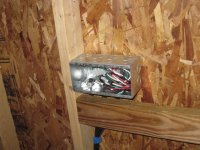
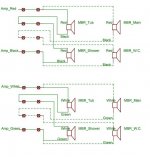
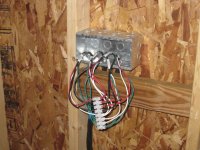
A while ago, I installed 4 dual voice coil ceiling speakers as one zone in the bathroom of a master suite. Load-wise this is like 4 pairs of speakers. A speaker selector box would have been easy, but it is also an unnecessary expense when use of the zone is an "all or none proposition". The speakers were wired in a series, parallel configuration using an Ideal brand terminal block with the connections in a junction box in an accessible area of the attic. Here is the wiring diagram for my project.
 

Attachments

  • MasterBathroom4.JPG
    MasterBathroom4.JPG
    136.4 KB · Views: 26
  • MBRSchematic.jpg
    MBRSchematic.jpg
    34.5 KB · Views: 36
  • Master Bathroom Ceiling Speaker Distribution.jpg
    Master Bathroom Ceiling Speaker Distribution.jpg
    142.5 KB · Views: 31
  • MasterBathroom3.JPG
    MasterBathroom3.JPG
    145.4 KB · Views: 30

Sticks McGee

Well-known member
Joined
Jan 6, 2015
Messages
470
Location
Trail Creek, IN
a while ago, i installed 4 dual voice coil ceiling speakers as one zone in the bathroom of a master suite. Load-wise this is like 4 pairs of speakers. A speaker selector box would have been easy, but it is also an unnecessary expense when use of the zone is an "all or none proposition". The speakers were wired in a series, parallel configuration using an ideal brand terminal block with the connections in a junction box in an accessible area of the attic. Here is the wiring diagram for my project.

excellent...excellent..
 

Two Sheds

Well-known member
Joined
Jan 16, 2014
Messages
100
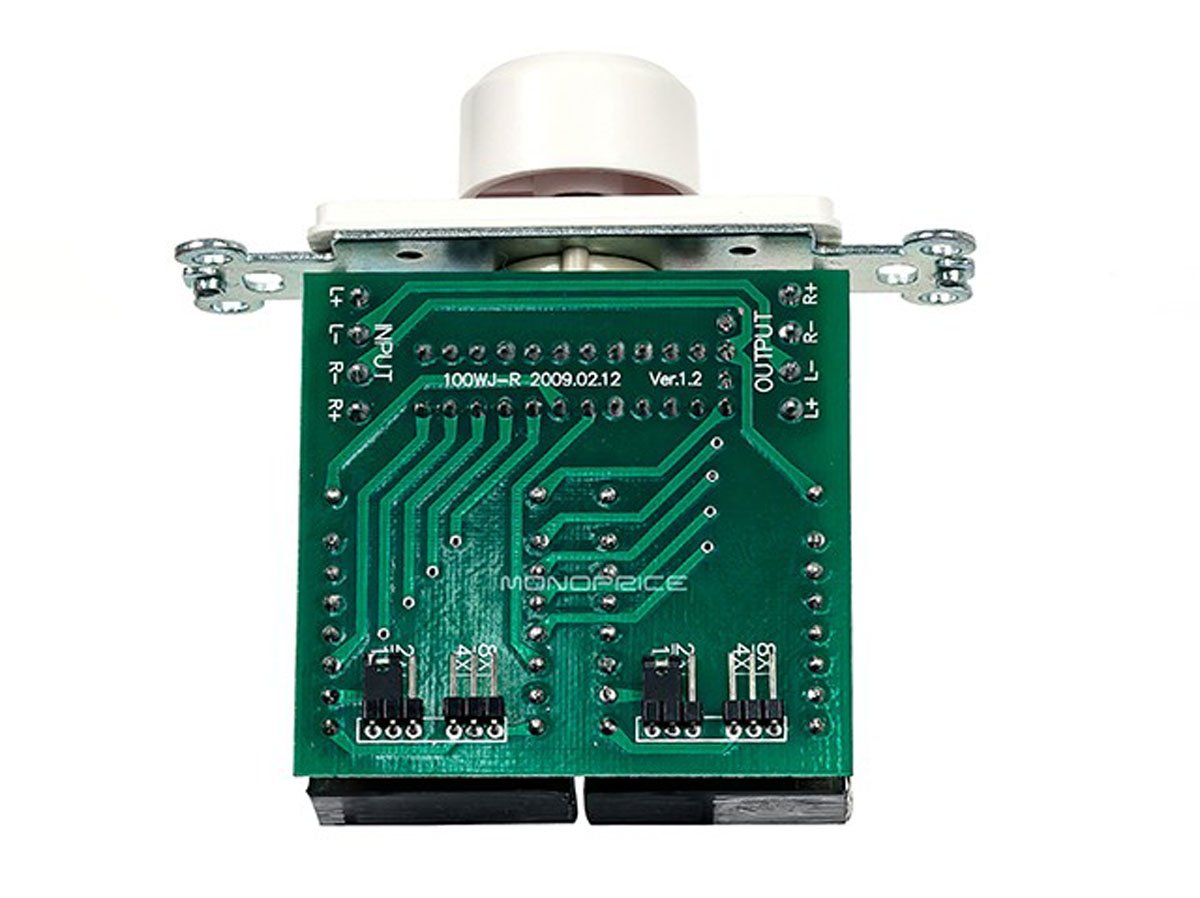
I used these volume controls from Monoprice:
https://www.monoprice.com/product?p_id=8243
They have a built in impedance matching transformer. You just set the jumper for how many of these you have wired in parallel, and it will present an 8 Ohm load to the amplifier. It's cheaper than 70V transformers if you have only a few zones.
82433.jpg
 

Plump

Well-known member
Joined
Dec 22, 2009
Messages
537
Location
SE Wisconsin
Sonos or a Bluetooth receiver (that would work with any BT speaker) would also work. I just wanted to think outside the box of what the others are putting forth as I agree, just adding wires to the back of your stereo sounds like a horrible idea.
 
To avoid these ads, REGISTER NOW!
Top Bottom