To avoid these ads, REGISTER NOW!

How do you use a Tourqometer?

CISO1969

Well-known member
Joined
Aug 1, 2011
Messages
138
Location
West of Philly
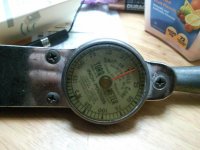
Excuse the spelling. I have seen the name of these Torque wrench/tools spelled different ways.

I have one of these from Matco or maybe Blue Point, but it is essentially the same tool that Snap-on makes.

Looks like a small cricket bat with a meter on top for torque. How the heck do you use this thing?

My guess is to set to sero, then place the scoket onto the nut and turn until the needle hits the right torque? Problem is there are two needles one that gets moved and stays--I'm assuming thats to show what torque it hit if you arent looking?

Does this sound right to those who know how to use this thing?

I bought it because I felt it would be more sensitive when tightening my spark plugs. I prefer to set the torque specs when I know them, nothing drives me nuts more than working with a guy who tightens until it cant be tightened anymore with an impact or ratchet and calls it done. Sometimes that could be quite a few foot pounds more then called for making it hard to remove or messing things up (fatiguing the bolt or stripping threads etc)

Anyway, any insight into this interesting tool much appreciated.

CISO
 
To avoid these ads, REGISTER NOW!

diesel research

Well-known member
Joined
Sep 12, 2010
Messages
5,440
Location
gulf coast, TEXAS
Ya, pretty much what you just said. The other needle is a "tell-tale"

For standard bolts, I don't want to make anybodies OCD'ness paranoid, but torque wrenches in general can be off quite a bit even though they are accurate and calibrated. What I mean is they are measuring turning torque of the fastener, which is NOT the same thing as fastener clamping or preload. Thread friction skews the numbers and throws it off. For example, dry threads vs lubricated vs a different lubricant vs pitch vs hole depth all make the same torque wrench tighten a fastener differently.

translation: don't sweat the small stuff.
 

JASTECH

Well-known member
Joined
Oct 21, 2009
Messages
2,671
Location
Gering, NE
I have a Torquometer 1/4" Drive Snap-On, I think it only has 1 needle "if" remembering correctly.
 

Attachments

  • TQ 12-B 01.jpg
    TQ 12-B 01.jpg
    52 KB · Views: 7
  • TQ 12-B 02.jpg
    TQ 12-B 02.jpg
    53.1 KB · Views: 18
Last edited:

diesel research

Well-known member
Joined
Sep 12, 2010
Messages
5,440
Location
gulf coast, TEXAS
One of the big uses for them is something you as a DIYer would not likely encounter. That is setting bearing preload on gearboxes or pumps (including steering gears and pinion bearings in differentials)

In those cases, it isn't used to tighten the fastener, but rather to measure how much friction and load is on a rotating shaft. The force required to turn said shaft.

Sometimes I have saw manuals suggest using them to measure how much torque it takes to remove a fastener, but I don't recommend that, since break-free torque is not an accurate indication of much of anything.
 

ourkid2000

Well-known member
Joined
Jul 1, 2008
Messages
927
Location
Nova Scotia
A good example of when you would use one of these is to figure out what the "running torque" is.

I can think of a good example. On aircraft engines, there are thermo-couples screwed into the engine case to measure the exhaust gas temps (they kinda resemble spark plugs). In a case where you're replacing them and they have to be torqued to spec, the friction of the threads can throw the torque value off. The manual will usually say things like "torque to 35 in-lbs plus running torque". So you thread the thermocouple in by hand to get it started and you use the torqueometer to crank it in further.....noting the avg torque that is required to spin it. You then add that value to the 35 in-lbs torque that is specified, torque it to the new value and you're done.
 
To avoid these ads, REGISTER NOW!
OP
C

CISO1969

Well-known member
Joined
Aug 1, 2011
Messages
138
Location
West of Philly
A good example of when you would use one of these is to figure out what the "running torque" is.

I can think of a good example. On aircraft engines, there are thermo-couples screwed into the engine case to measure the exhaust gas temps (they kinda resemble spark plugs). In a case where you're replacing them and they have to be torqued to spec, the friction of the threads can throw the torque value off. The manual will usually say things like "torque to 35 in-lbs plus running torque". So you thread the thermocouple in by hand to get it started and you use the torqueometer to crank it in further.....noting the avg torque that is required to spin it. You then add that value to the 35 in-lbs torque that is specified, torque it to the new value and you're done.

So basically for someone like me, it is a cool looking and expensive toy I will never use. LOL

That's cool. I have a lot of stuff I bought cause it was "Shiny" or "cool" and don't do much with. I'll just leave it around for "oooh ahhh" factor.

Thanks guys,

Lee
 

diesel research

Well-known member
Joined
Sep 12, 2010
Messages
5,440
Location
gulf coast, TEXAS
So basically for someone like me, it is a cool looking and expensive toy I will never use. LOL

That's cool. I have a lot of stuff I bought cause it was "Shiny" or "cool" and don't do much with. I'll just leave it around for "oooh ahhh" factor.

Thanks guys,

Lee

What kind of car/trucks do you have and what is your skill level when it comes to replacing or repairing stuff on them? Any other kind of equipment you maintain?
 

Charles (in GA)

Well-known member
Joined
Jan 11, 2006
Messages
12,489
Location
50 mi south of Atlanta
You use it like any other torque wrench. If you want to tighten spark plugs, or other torque critical items, go for it. You can set it to zero and read the torque as you are pulling on it, or you can set it to the torque you are aiming for and watch for it to come to zero meaning you have reached the desired torque. The second needle should be turned against the needle at zero and it will show the max torque you achieved, in case you could not or did not read the dial at the critical moment.

Charles
 
OP
C

CISO1969

Well-known member
Joined
Aug 1, 2011
Messages
138
Location
West of Philly
What kind of car/trucks do you have and what is your skill level when it comes to replacing or repairing stuff on them? Any other kind of equipment you maintain?

I'm the guy who grew up with a bunch of friends who all went to technical/vocational school for auto mechnics and never had an interest in it myself at the time. None of my cars were anything but commuter/beaters and my own interests at that time were militaria and firearms. I did get to ride in some classic US muscle cars though- it was fun (my friends had 'Cudas, Nova SS, etc)

Fast Forward to 2004/5 and I get a Nissan Xterra. Started hanging around forums and seeing what cool mods guys were doing to them. It wasn't until about 2008 that I started to mod mine and at that point began learning at "mod days" from other Xterra owners how to do things. I got bitten by the bug and now attempt to do most work on my own, but it doesnt come naturally, I need to read "How to's" follow online instructions with photos and sometimes throw up a flag and call for help.

I'm probably what you'd consider a hobbyist or newb skill-level wise in auto mechanics.

As far as what else I can work on? Firearms & watches. I am competent at light costruction and home repair as I did do just about any legal job I could growing up to earn money: Landscaping, duct work, piping for fire extinguisher systems, and working in paint and lumber for Channel home centers and doing side jobs with a guy who worked with me at CHC when I could. Also have been a security guard, cashier, and even a telemarketer for like a month :)

My career or "real " job is one that used to keep me in a suit and tie ( we are now business casual) and chains me to a desk, but hey it beats some of the other stuff Ive done.

As for auto mechanics, I'm learning all the time and working on bringing up the skill level. :)

Thanks,

Lee
 
Last edited:
To avoid these ads, REGISTER NOW!
Top Bottom