To avoid these ads, REGISTER NOW!

How does an engineer come up with a wrench length?

To avoid these ads, REGISTER NOW!

F-22

Well-known member
Joined
Jan 23, 2022
Messages
1,830
It's not an "engineered value". It's just a length that is convenient to use or is made according to some standard. For example, the DIN 894 requirements:

1688123138?v=1.jpg


What the engineers do, is decide how thick it needs to be not to flex at the given length.
 

HannibalLecter

Well-known member
Joined
Aug 26, 2023
Messages
402
Well, the design envelope would be as how much force in the end of the wrench would be comfortable and translate to enough torque to unfasten the specific size bolt. Someone designed the standards as well, he should have had this in mind. This of course would be a ballpark, not exact science, different fasteners require different torque, but you have to start from somewhere. Then, there are the variations of that. Short wrenches, longer wrenches etc. Also, one should keep in mind that with enough leverage you can deform the open end of the wrench and not transmit enough torque to the fastener. Now, the question arises, would you like the wrench to be deformed first, or the fastener? Stahlwille for example, the open box 14 are different from the open box 13 in hardness
 

AEAdam

Well-known member
Joined
May 27, 2023
Messages
2,762
Location
SE PA
Good answers. The length of the wrench is based on the predicted torque reqts of the fastener, but also the strength of material of the wrench. Until recently, no one made super long wrenches. Using the materials and processing from years ago, a long wrench would simply fail.

So when a legit manufacturer like Snap On makes a long wrench or ratchet, chances are good they have done the math and testing to ensure that tool will not break itself. Chances are good they are confident with their materials and processing. If you are not confident, you make short clunky tools.
 

AEAdam

Well-known member
Joined
May 27, 2023
Messages
2,762
Location
SE PA
It's not an "engineered value". It's just a length that is convenient to use or is made according to some standard. For example, the DIN 894 requirements:

1688123138?v=1.jpg


What the engineers do, is decide how thick it needs to be not to flex at the given length.
Thickness is also governed by the standard.

Companies like Snap On have exceeded the stds long ago. Snap-on wrenches are longer and thinner than the std, for exampl.
 

F-22

Well-known member
Joined
Jan 23, 2022
Messages
1,830
Yes, that's why I said they use a length that is convenient, and it's also what the standards were based on.

I think the strive towards longer wrenches is more due to "tool culture" and how tools are used today VS how they were used in the past. I doubt manufacturers "hit a wall" 50 years ago in regards to what was possible with the steel at the time. Just that wrenches weren't used in exactly the same use as they are today.

For many cases a standard length wrench (e.g. stahlwille 13) is a good balance between being easy to handle and being strong enough to torque stuff down as hard as needed.
 

RTM

Well-known member
Joined
May 13, 2019
Messages
13,189
Location
SF Bay Area
They survey hundreds of thousands of mechanics, and find the ideal length for a wrench, based on where it will fit, when it will interfere, easy to carry, etc. Then they build it to whatever their accounting group thinks is cheapest.
 

HannibalLecter

Well-known member
Joined
Aug 26, 2023
Messages
402
They survey hundreds of thousands of mechanics, and find the ideal length for a wrench, based on where it will fit, when it will interfere, easy to carry, etc. Then they build it to whatever their accounting group thinks is cheapest.
I really doubt that any company interviews any mechanic about combination wrench. These are pretty figured out nowadays after all these years. They have an r&d department and maybe they get some use input from some mechanics they employ themselves. But that's just my estimate
 
Last edited:
To avoid these ads, REGISTER NOW!

larry_g

Well-known member
Joined
Apr 28, 2007
Messages
16,886
Location
oregon
In my 21st edition of Machinery's Handbook they have the spec's for the working end of a wrench but not the handle length. The section is preceded by the sentence " The listed values were obtained from a composite study of the alloy wrenches that are commercially available and military specifications." I really doubt that any thing more than history details the handle length and then the engineer goes " That seems about right.". It is an educated guess and developed from there. Also referred to Tribal Knowledge.

lg
no neat sig line
 
Last edited:

Samuel D

Well-known member
Joined
Apr 9, 2019
Messages
638
The standards are one thing (DIN 837, to take an example of a pattern I like using when I can), but someone designed the standards.

I find this topic interesting. When I brought up in another thread that wrench length doesn’t scale with torque as you might naively expect, user tamaraw gave a couple of reasons for that here.

They’re good reasons but probably not all the reasons. I think another one is human hand scale. The shorter a wrench gets, the more of it as a proportion of the whole is wasted to the fist’s inability to apply torque to the very end of the spanner. And with a small spanner we often don’t use a forceful fist but a thumb against a forefinger, for example – which in its own way militates against the spanner scaling down in line with torque.

Also, thin wrenches (as used for small fasteners) limit by discomfort the force a hand can bring to bear. So the smaller spanners need to be longer than you’d think for that reason too.

Conversely, effectively all the length of a very large spanner can be used as a lever and, being thick, it doesn’t limit torque by hand discomfort – so the large sizes don’t need to be as much longer than smaller sizes as you’d guess from the intended torque values.

In practice, I suppose manufacturers get it about right. All the same, I’ve switched to a longer pattern for larger sizes in a couple of cases. Maybe just me.
 

AEAdam

Well-known member
Joined
May 27, 2023
Messages
2,762
Location
SE PA
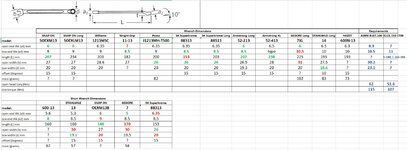
If you look carefully at the chart below, I compared popular US and (long) Euro wrenches to their relevant standards. Color coding is a little cryptic. I was trying to suggest green was best in a category, red was worst.

If you read between the lines, you will see the trend I see. Snap On makes really long thin strong stuff which is pretty awesome. Note that Snap On normal length is longer than the long pattern in the DIN3113 (last column). Snap On long pattern is super long.

I made this chart many years ago. SK SuperKrome was the pre-Ideal SK.


wrenches.jpg
 

AEAdam

Well-known member
Joined
May 27, 2023
Messages
2,762
Location
SE PA
I wish Wright was the same length as Snap-on standard length.
We rave about the strength of WrightGrip open ends, but truth be told some of that strength comes from thickness. Thickest in the pack.
 
Last edited:

LWB

Well-known member
Joined
Oct 6, 2019
Messages
1,231
Location
ON, Canada
Yes, that's why I said they use a length that is convenient, and it's also what the standards were based on.

I think the strive towards longer wrenches is more due to "tool culture" and how tools are used today VS how they were used in the past. I doubt manufacturers "hit a wall" 50 years ago in regards to what was possible with the steel at the time. Just that wrenches weren't used in exactly the same use as they are today.

For many cases a standard length wrench (e.g. stahlwille 13) is a good balance between being easy to handle and being strong enough to torque stuff down as hard as needed.

I mostly use the long "aviation style" DBE wrenches because I bleed a lot less. It keeps my hands away from sharp objects.
 

Samuel D

Well-known member
Joined
Apr 9, 2019
Messages
638
We rave about the strength of WrightGrip open ends, but truth be told some of that strength comes from thickness. Thickest in the pack.
Right. And I think there’s room for a little variety of this sort on the market.

Likewise for handle length. Like most of us, I have a variety of spanner types (head shape, offset, etc.) that coincidentally have different lengths. Sometimes I choose one over another for the length difference.
 
To avoid these ads, REGISTER NOW!
Top Bottom