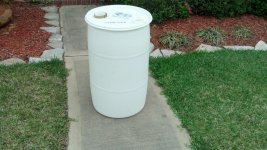
I agree that you should absolutely not send the water softener discharge to the septic but if I was on city sewer then I would dump it there.
What volume of water do you expect from the backwash cycle? It may be too much for a barrel system unless your soils are fantastic and you surround the perforated barrel with lots of gravel.
You do intend to perforate that barrel and use it for infiltration don't you?
As to your question, farther the better. Put that barrel 100 feet away if you can. No foundation system was ever improved by pumping salt water into it.
The salt in the discharge water cause the soild to bond together form a clay like soil that will not drain. It is not reccomended to drain water softener into the septic tank.

Water softeners typically use salt as part of the process to make hard water work better. Water quality and sewage treatment experts have conducted studies on the effects of sodium in wastewater treatment. These experts have come to conflicting conclusions since most studies were carried out in ideal or non-traditional septic system situations. A study from the National Sanitation Foundation that focused on salt-based water softeners emptying into an aerobic septic system found that the sodium introduced into the septic system was not harmful.
Read more: http://www.livestrong.com/article/2...stems-harm-home-septic-systems/#ixzz2RaJ7J4yC
Septic Tanks
Are there harmful effects of water softener discharges on household septic tanks?
Here are the answers to that question and the effects of using a water softener with a septic system.
It is not true that water softener regeneration discharges pose a problem to septic systems or to the leach field. Studies have shown that water softener regeneration wastes do not interfere with the septic tank system drain field soil percolation, but because of the polyvalent water hardness cations in the regeneration discharges improve soil percolation particularly in fine-textured soils.
WQA has research reports by the University of Wisconsin and the National Sanitation Foundation on septic tanks and water softeners. This research was completed in the late 1970s. It was about that time that numerous regulatory agencies were contemplating restriction on the discharge of water softener wastes to private sewage disposal systems.
More recently the U.S. Environmental Protection Agency reviewed this research report, and an expert in on-site waste treatment wrote October 1993 that he “does not believe that the conclusions of the earlier study would change since the chemistry and physics of soils have not. ”He also goes on to say that he knows this work to remain scientifically excellent“.
These studies conclusively show that water softener waste effluents cause no problems for septic tanks.