To avoid these ads, REGISTER NOW!

How many breakers ?

Refuse1

Well-known member
Joined
Feb 25, 2012
Messages
94
Location
Iowa
I am working on 240 wiring for my workshop project. The building is built and I have a space that is 50' x 40'. I am splitting the space down the center to allow for a 25' x 40' woodworking shop and a 25'x 40' automotive shop.

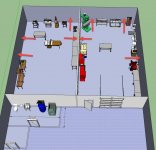
I am planning to have (4) 240 volt outlets in each shop and I'd like them to all be NEMA 14-50. (see sketch)

I have a 200 amp panel in the building.

Obviously its likely that I can't / won't be running more than one thing at a time. On the auto side, there is a welder, lathe, pullmax and a mill. On the wood side, there is a table saw, big radial arm saw and dust collector. I want to have at least 1 extra outlet on each side that I can use for future stuff. The compressor will be in another room with its own dedicated power.

My question is, how many breakers will I need for this setup ?

Thanks
 

Attachments

  • Shop 240 Layout.jpg
    Shop 240 Layout.jpg
    144.7 KB · Views: 47
To avoid these ads, REGISTER NOW!

pattenp

Well-known member
Joined
Jun 4, 2008
Messages
10,175
Location
Virginia - USA
Why 14-50 outlets? What equipment do you have or plan to have that uses both 120V and 240V at the same time to operate?
 

matt_i

Well-known member
Joined
Mar 14, 2008
Messages
10,720
Location
SE Michigan
Minimum 3 double pole breakers, compressor, side 1 shop and side 2 shop. Size the breaker to protect the downstream conductors. I prefer 14-30 twistlocks over those 14-50 oven plugs. You might also run a 4th dedicated circuit for welder only, depending on its ampacity. A Syncrowave claims to draw 100A on 240vac, according to its manual, so having a 100A breaker and wiring with #1 or #2 is going to get a little expensive. Not sure what kind of welder you own. Some single pole 120vac breakers will be needed for internal, external, and 5-15 wall plugs.
 
Last edited:
OP
R

Refuse1

Well-known member
Joined
Feb 25, 2012
Messages
94
Location
Iowa
Minimum 3 double pole breakers, compressor, side 1 shop and side 2 shop. Size the breaker to protect the downstream conductors. I prefer 14-30 twistlocks over those 14-50 oven plugs. You might also run a 4th dedicated circuit for welder only, depending on its ampacity. A Syncrowave claims to draw 100A on 240vac, according to its manual, so having a 100A breaker and wiring with #1 or #2 is going to get a little expensive. Not sure what kind of welder you own. Some single pole 120vac breakers will be needed for internal, external, and 5-15 wall plugs.

So, you are saying its no problem to have the 4 outlets in each room on a single breaker ? (guess that makes sense given that I'll only use 1 machine at a time) Just wanting to make sure I'm not breaking some electrical "best practice".

I'll just be running a millermatic mig and occasionally a small inverter based tig, so big power won't be needed.
 

sberry

Banned
Joined
Jun 18, 2005
Messages
35,747
Location
Brethren, Michigan
Since this involves a little future proofing I might leave means for some expansion but may put a number 6 with a welder plug in, use a 6-50-R and not one you never need. You can buy shorts in wire from a box store just for this and would get a roll of 10/2 for everything else. Put the outlets between machines, there will be something you have but don't always use, plug it when needed.
The 30A are closer to the demands and overcurrent to the rest of the stuff you use.
I have a monster tig, I don't use it so it doesn't count but I don't own a single other thing that would overheat a 10 wire and 14 series plugs are a waste and not correct,,, btw, everything does have a dedicated ground.
Maybe there are more but I can think of only 2 things that use 4 wire, a dryer and contained range.
 
Last edited:

matt_i

Well-known member
Joined
Mar 14, 2008
Messages
10,720
Location
SE Michigan
Its no problem to have several outlets that are "hot" all of the time, each wired to a machine. If you forget and overload the circuit by having a friend multitask with you, then it will trip a breaker.

The key principle is that the breaker protects the downstream conductors, so that sizing needs to be for max ampacity.

The 14-30s may be a waste but not if you are dealing with 3 phase. I also like the fact that a person isn't naturally inclined to put their hand behind the plug trying to rocker it out of the 50A oven plug. The stabs on the male 14-30 plug are much easier to disconnect. That said, you may not be doing a lot of disconnecting.
 
Last edited:

sberry

Banned
Joined
Jun 18, 2005
Messages
35,747
Location
Brethren, Michigan
Depending on the comp might split a chunk of 8 between it and the welder outlet in a home/hobby shop ad more than likely in todays world would wire it all 10 and if I had to for some reason add a bigger wire.
 

sberry

Banned
Joined
Jun 18, 2005
Messages
35,747
Location
Brethren, Michigan
Which Millermatic? Only the 252 needs a big wire and I believe the new 200 synch is an inverter and needs only 10. You can plug it in to circuits to 50A with the mvp plug but a 210 synch only needs 30A service on a 14 wire but sheet, use 10/30 and its all legal on cable. Put one circuit with a welder outlet.
 
Last edited:

sberry

Banned
Joined
Jun 18, 2005
Messages
35,747
Location
Brethren, Michigan
Ok, I looked at the layout a little vs generalizing and I like this. Where is the main at? I might be tempted to add a panel for one room and do all the take off for everything but the lights.
They make an 8 space panel just for this, it would leave 3 240 cicuits and a couple 120V circuits. Put it as close as you can to ganging equipment.
 

sberry

Banned
Joined
Jun 18, 2005
Messages
35,747
Location
Brethren, Michigan
A huge benefit of new equipment is a lot of it now has small electric demands. No point to shop like nuts to save 50$ on a 1000$ welder and toss in a 100A wire you never use. Or more like the 210 synch which probably has a 2K or more ticket price.
This looks like enough of an effort that its not a chronic junk collector shop, you are using the right modern machines and may never need heavy service again.
 

pattenp

Well-known member
Joined
Jun 4, 2008
Messages
10,175
Location
Virginia - USA
I like the 14-50 because they offer a dedicated ground.

What??? A 14-50 has a neutral that in most cases will not be needed. The only single phase 125/250V outlets that don't have a ground are the 10-** series. I believe all you need are the 6-** series which is 3 wire (2 hots, 1 ground).
 

pattenp

Well-known member
Joined
Jun 4, 2008
Messages
10,175
Location
Virginia - USA
So, you are saying its no problem to have the 4 outlets in each room on a single breaker ? (guess that makes sense given that I'll only use 1 machine at a time) Just wanting to make sure I'm not breaking some electrical "best practice".

I'll just be running a millermatic mig and occasionally a small inverter based tig, so big power won't be needed.

You need to check your local codes. If your shop is on residential property it may fall under the International Residential Building Code which does not allow multiple outlets on a single circuit that is greater than 20 amps. I was going to put multiple 30A outlets on one circuit in my shop and the inspector said no. Each outlet needed to be on its own dedicated circuit.
 

FordTruckWench

Well-known member
Joined
Jan 8, 2015
Messages
539
Location
California
I am planning to have (4) 240 volt outlets in each shop

Minimum 3 double pole breakers, compressor, side 1 shop and side 2 shop.

What's the recommended way to daisy chain 30 and 50 amp circuits, i.e. add a pigtail branching off to a receptacle? Are there wire nuts made for the required large wire sizes?

(High current components suggest to me that there should be one breaker, one receptacle, and one wire run with no splices.)
 

theoldwizard1

Well-known member
Joined
Feb 22, 2011
Messages
43,076
Location
SE MI
What's the recommended way to daisy chain 30 and 50 amp circuits, i.e. add a pigtail branching off to a receptacle?

First there is this
I was going to put multiple 30A outlets on one circuit in my shop and the inspector said no. Each outlet needed to be on its own dedicated circuit.
Check with your local building authority.

Are there wire nuts made for the required large wire sizes?
30A would use 10 gauge and they do make wire nuts that large. I would first
zip tie the wires together and then use electrician's pliers to twist them together before applying the wire nut. Probably wrap with electrical tape for good measure.

50A would use 6 gauge (?) wire and you would use with split bolts (double layer of GOOD quality tape; 3M 88) or Polaris connectors (they make doubles, triples, quads, etc)

IT4%5B1%5D.jpg
 
Last edited:
To avoid these ads, REGISTER NOW!

Steve from Socal

Well-known member
Joined
Jan 27, 2009
Messages
3,490
Location
Hutchinson Ks.
The stationary machinery like the Iron worker, lathe, etc, should really be on dedicated circuits. In my little garage I had home runs for my mill,lathe, welder, air compressor etc.

If the machines have disconnects, you could eliminate the plugs and receptacles, that would more than offset the cost of breakers, wire and, pipe.
 
OP
R

Refuse1

Well-known member
Joined
Feb 25, 2012
Messages
94
Location
Iowa
What??? A 14-50 has a neutral that in most cases will not be needed. The only single phase 125/250V outlets that don't have a ground are the 10-** series. I believe all you need are the 6-** series which is 3 wire (2 hots, 1 ground).

I was thinking that I would need a neutral but to your point, I can't think of a good reason that I would.

Soooo, your recommendation of a 3 wire twist lock makes perfect sense.
 

bloomingtonmike

Well-known member
Joined
Dec 1, 2011
Messages
314
Location
Bloomington, IL
In the South wall wood shop side, for single phase larger tools, I did a 8ga dedicated compressor 40amp circuit, a dedicated 10ga cyclone dust collector circuit (also put a 120V close by for my remote), and two 10ga 240V circuits - one to every other outlet. I use L6-30 recepticals in my shop - these are 3hp rated though so be mindful but for the last 10 years I have used them on 5hp tools.

On my North wall I am running a 6ga dedicated welder circuit along with a similar arrangement for the single phase circuits. Have not wired these yet.

My cnc knee mill is VFD powered and works fine off a shared 10ga run. Same with my 1340 lathe. Not sure why folks said run dedicated to those tools. They are motors and no different.

Too me its all about what tools will you use concurrently. (for example my big shaper, its feeder, the dustcollector, and the air compressor (air jigs) might be used at the same time)

Externally mounting the sub panels means I can add whatever later.

I am doing two 1ph panels and two 3ph panels off the rpc.

My 3ph runs get home run dedicated circuits. A RPC powers the main lug only panels. I am running 10ga for these tools and one big one (undecided) that will be for a widebelt on that wall some day by the cnc router.

I am not an electrician and no expert and my shop only has to make me happy so take it for what it is worth.
 

My Old Tools

Well-known member
Joined
Jun 4, 2014
Messages
5,424
Location
Hamrick Lake, TX
The stationary machinery like the Iron worker, lathe, etc, should really be on dedicated circuits. In my little garage I had home runs for my mill,lathe, welder, air compressor etc.

If the machines have disconnects, you could eliminate the plugs and receptacles, that would more than offset the cost of breakers, wire and, pipe.

Why? They can plug in just like anything else. All of mine, 3 phase and single phase have NEMA L6 or equivalent 3 phase plugs. Its a one man shop. The only thing that runs on its own is the compressor. What happens when you want to add another machine? I just plug it in, you have to run another circuit. And no, I don't have an inspector to satisfy.
 

Steve from Socal

Well-known member
Joined
Jan 27, 2009
Messages
3,490
Location
Hutchinson Ks.
Why? They can plug in just like anything else. All of mine, 3 phase and single phase have NEMA L6 or equivalent 3 phase plugs. Its a one man shop. The only thing that runs on its own is the compressor. What happens when you want to add another machine? I just plug it in, you have to run another circuit. And no, I don't have an inspector to satisfy.

The OP asked about "good practice" you can use cords but, particularly in metal working I prefer metal conduit. Hot chips and swarf stick to and burn into rubber and plastic, the conduit also protects the wire from other perils.

Inspector or no inspector using best practices minimizes issues. I moved my machines around in my 20 X 26 garage a lot, several of the circuits were the same 30 amp 240 single phase. I used 3/4 flex and just relocated the drops as needed. I had an open rafter garage,

What do you do when you add anther machine? Add more panels:)
 

Attachments

  • main panel.jpg
    main panel.jpg
    118.3 KB · Views: 21

Norcal

Well-known member
Joined
Mar 16, 2008
Messages
13,751
Using 3 phase devices for single phase or single phase devices for 3 phase is piss poor practice the manufacturers did not build different devices for different voltages/ phases/ampere ratings to get a warm fuzzy feeling.
 

Showkey

"MEMBER EMERITUS"
Joined
Aug 9, 2014
Messages
8,638
Location
Wausau WI
I knew that "best practices" was going to Be an issue...........because ......most often nobody agrees even on the code.......that what makes this entertaining.
 

Jason280

Well-known member
Joined
Mar 4, 2012
Messages
3,157
If its a 200 amp panel, I would imagine it has 40 spaces for breakers.

Here's how I've wired my shop, but I admit I may have went a little overboard. Mine is a 24x32, with a 200 amp panel (although I may not have more than 125-150 amps to the panel). I've run 7 separate 240v plugs, all ranging from 20 to 50 amps. Three of these are run with 10/3, and will be used with my lift and small air compressor (one is an extra). I have two 50a welder style plugs run with 8w3 on 40a breakers, and two with 6w3 and 50a breakers. All are wired individually, and none have been daisy-chained together. In my setup, I may have saved 12-15' of wire connecting the two plugs on 8w3, and there was no way to really run the 6w3 plugs together that would have saved any wiring. I didn't use any conduit, all wiring is run through 2x6 walls and rafters (and will be hidden by plywood walls).
 

offroadsteve

Well-known member
Joined
Apr 28, 2011
Messages
173
Location
Hampton, VA
People that know agree, its the rest that don't.

This. While the code may not always be the easiest thing to read, the intent is clear. For fixed and semi-fixed, high power equipment (anything more than 20A / 120V), dedicated circuits are the requirement. There are no exceptions for a "one man shop" or any other such thing. This is why larger outlets are not designed to be daisy-chained together, they are almost always installed with a specific purpose in mind.

The intent is to provide adequate protection for the building's installed wiring, and to ensure there is adequate circuit capacity available for any combination of machines to be operated at once.

That being said - I fully understand the concept of a "one man shop" (being one myself) and that building in flexibility without adding substantial cost is a desirable. Assuming all of the wiring otherwise meets the proper standards, I don't have a problem with putting multiple 240v outlets on a circuit when there is the potential to save money.
 

ishiboo

Well-known member
Joined
Oct 27, 2010
Messages
9,481
Location
Oshkosh, WI
My cnc knee mill is VFD powered and works fine off a shared 10ga run. Same with my 1340 lathe. Not sure why folks said run dedicated to those tools. They are motors and no different.

Too me its all about what tools will you use concurrently. (for example my big shaper, its feeder, the dustcollector, and the air compressor (air jigs) might be used at the same time)

To most of us, a CNC mill would be capable of some form of autonomous operation, so it sounds very practical to have a different circuit for each. I have had a lot of projects where the mill could be making a part while I was over on the lathe making one by hand.
 
To avoid these ads, REGISTER NOW!
Top Bottom