To avoid these ads, REGISTER NOW!

How many LED shop lights per circuit?

cgv69

Well-known member
Joined
Jan 11, 2012
Messages
1,033
Location
Boone Co., KY
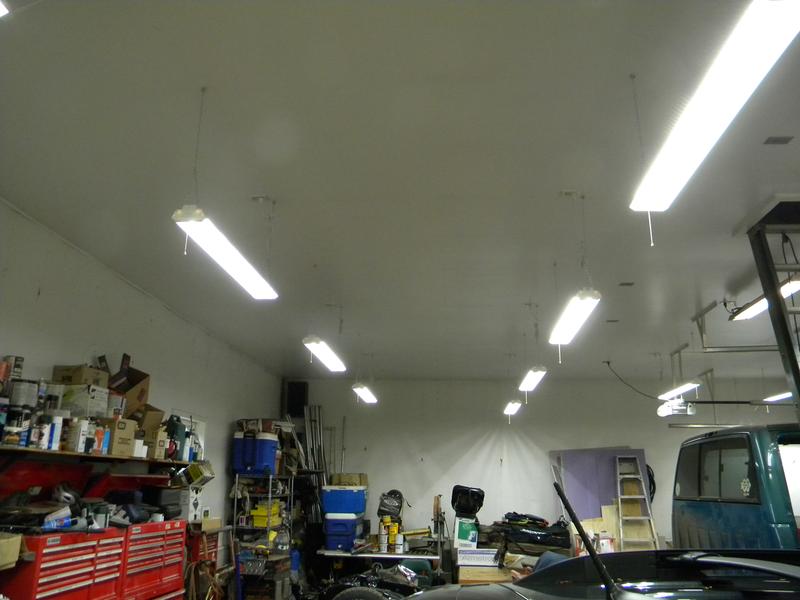
So I'm going to be installing 16 of these Honeywell LED 4' Linkable Shop Lights... https://www.samsclub.com/p/4ft-led-5000l-shop-light/prod22820266?xid=plp_product_1_3 in my workshop and like most of these 4' LED shoplights, the literature says not to link more than 10 of them together but what I'm trying to understand is, is that because of the fixtures themselves or the circuit?

I'm trying to determine if I can link 10 of them together and plug that string into the same duplex receptacle that I have the other string of 6 plugged into (15amp circuit)?

I already tried it, had all 16 lights plugged in and powered up on the same 15amp circuit that already has some others things connect and drawing power from it just to see if it would work and it didn't seem to be an issue?

I know ideally each string would be on it own dedicated 15 amp circuit but that's not an option here. At best I may be able to have all 16 lights on the same dedicated circuit?

The main reason I want to do this (other then not having to run another circuit from a breaker box that is already almost full) is because I want the outlet they are plugged into to be controlled by a 4 way switch. I have 3 entrances into my shop and I want to be able to turn all the lights on or off at the same time regardless of which way I come into the shop.
 
To avoid these ads, REGISTER NOW!

BuffettFan

Well-known member
Joined
Jul 11, 2017
Messages
10,859
Location
Central Illinois
Each unit consumes 50 watts, so 50/110=0.455 amps X 16 fixtures=7.27 amps total.

I would assume the internal wiring of the lights would be the limiting factor.

I have 8 similar lights on one circuit with no issues.
 

BB Sig

Well-known member
Joined
May 16, 2018
Messages
139
Location
Florida
15 amp 120 v circuit ~ 1800 watts.

lights are 50 watts each x 10 = 500 watts.

Description on your link: connect up to 10 lights on single circuit.

I take that to mean 10 daisy chained. I would prefer my lights to be half on one circuit and half on the other but sometimes what we want is not what can be done...
 
OP
C

cgv69

Well-known member
Joined
Jan 11, 2012
Messages
1,033
Location
Boone Co., KY
That receptacle is protected by GFCI, right?
No. I thought GFCI is only for outlets near water (Kitchens, bathrooms, garages, unfinished basements, outdoors, etc.)?

The outlet will be in the ceiling of my shop and my shop is in a (soon to be) finished basement.
 

Bopbop

Well-known member
Joined
May 25, 2016
Messages
180
Location
Savannah,Ga
These are 50 watts each so for 16 that would be 800 watts. A 15 amp 110 circuit can handle 1500 watts. These can be installed on a single 15 amp 110 circuit. I installed some of these same fixtures in my outdoor kitchen. From the installation instructions I had they limited the number or outlets that could be connected together to 10. That is pluging one fixture into the wall outlet and then connecting the end to end with the provided plug in the end. From what I have seen this is about standard for all of these outlets.
I have used these fixtures and I really like them for my usage. They provide a real nice bright light. A friend put them in his 40 x 40 by 14 foot high shop and really likes them.
As for the GFCI outlets when my shop was wired last year all of the outlets are protected by a GFCI outlet. The new code requirements.
 
OP
C

cgv69

Well-known member
Joined
Jan 11, 2012
Messages
1,033
Location
Boone Co., KY
Is your shop a detached space?

For a finished interior space, GFCI is not required unless its by a water source.
 

tfi racing

Well-known member
Joined
Apr 19, 2008
Messages
2,907
Location
Cedar,BC
I would try to avoid linking 10 together, the extra heat will likely kill them off somewhat quicker, other than that to consider you will be ok with your plan.
 

cybrdyke

Well-known member
Joined
Sep 9, 2014
Messages
3,442
Location
USA
Depending on who made this (Honeywell doesnt make these) they use PC boards and/or ultra small wires to feed the power thru. Those internal circuits cant handle very much. It's not like a traditional lighting fixture where you have 14AWG wire jumping from fixture to fixture. That's the reason that these manufacturers send these warnings.
Of course if you plug in too many of them, they'll light up. But for how long? Who knows....
CD
 
OP
C

cgv69

Well-known member
Joined
Jan 11, 2012
Messages
1,033
Location
Boone Co., KY
Depending on who made this (Honeywell doesnt make these) they use PC boards and/or ultra small wires to feed the power thru. Those internal circuits cant handle very much. It's not like a traditional lighting fixture where you have 14AWG wire jumping from fixture to fixture. That's the reason that these manufacturers send these warnings.
Of course if you plug in too many of them, they'll light up. But for how long? Who knows....
CD
That's what I was assuming the issue was but I just wanted you guys to check me. Thanks
 

Platonic Solid

Well-known member
Joined
Nov 29, 2014
Messages
3,587
Location
CT-USA
Not trying to be a smartass, I know nothing.

Why frosted lenses?

As posted in a prior thread -
See result of clear lens on the back wall in this Honeywell shop light customer review picture:

1320c0c0-c887-5632-b70f-8aa4e2e453ea

Frosted lens will even that out nicely.
 

sberry

Banned
Joined
Jun 18, 2005
Messages
35,747
Location
Brethren, Michigan
For those of you that are doing calculations using 110V need to come into todays world and use 120V.
Absolutely a factor.

When I do circuit design simply figure most stuff at 100 watts to the amp.
This is part of the reasoning on using 12 wire for generals. Its kind of a branch and trunk scheme in terms of loading. Load that would be 80% or non continuous,,, in some cases need to be dedicated could be ran 100% on a 12. Also allows for some smaller air conds to share, lets a fridge share some circuits without some concern.
The losses,,,, the losses with multiple loads are similar to smaller 14 wire that are dedicated but when only 1 load is applied the 12 has better performance. Branch and trunk not always designed exclusively for multiple loads but on occasion for other reasons. Some minor simultaneous loss may be irrelevant but the pass thru are very important.
 

Toomanytools?

Well-known member
Joined
Nov 4, 2010
Messages
855
Location
Washington
Where ever you can be less than 6' from water, such as a sink or shower.
Taken from IAEI magazine...
The next big change in GFCI requirements came with the expansion within dwellings. Similar to the measurement clarification, this expansion also has roots in a 2017 revision. For NEC-2017, a revision was made that saw GFCI protection go beyond just 15- and 20-amp, 125-volt receptacle outlets in non-dwelling unit locations. Now dwelling units constructed under the NEC-2020 will require GFCI protection on any receptacle rated 125-volt through 250-volt that is installed in a GFCI-required location and connected to a single-phase branch circuit rated at 150-volts or less to ground. Why the need for the expansion? As a fly on the wall during the committee meetings, I was able to hear first hand many of the reasons that led to this revision. Long story short, what it boils down to is that often a shock hazard exists whether you are using 120-volt equipment or 240-volt equipment.

There were numerous instances of injuries caused by shocks from 240-volt equipment and even a few fatalities that GFCI protection could have potentially prevented. Does this mean that every electric range receptacle outlet needs to be GFCI protected? No, the same rules apply to 250-volt receptacles that we have been used to for years with 125-volt receptacles. However, if the range receptacle is within six feet of the kitchen sink, then it will require GFCI protection.

The bigger impact will be felt in garages, outdoors, laundry areas, and basements. These areas require all receptacles to be GFCI protected regardless of distance. Which leads me to another big expansion in dwellings: basements. It is no longer a judgment call to determine whether or not a basement is “unfinished.” Now any and all receptacles in a dwelling unit basement are required to have GFCI protection, regardless of the state of finishing. This is a considerable change compared to the 2017 NEC. However, there are a growing number of basement areas that are being used in a multitude of ways and the line between finished and unfinished is growing increasingly blurry. Gone are the days of basements being limited to mechanical areas and laundry rooms. Basements have become more and more a staple of the “man-cave” or the game room areas. Many have exposed concrete floors or open ceilings, and inspectors have an increasingly difficult decision to make when calling balls and strikes. So, this takes the guesswork out of it and just requires GFCI for all receptacles.
 
To avoid these ads, REGISTER NOW!

sberry

Banned
Joined
Jun 18, 2005
Messages
35,747
Location
Brethren, Michigan
Its not a bad idea just cost more. So much has changed. I just replaced an outlet in a basement, sold the guy on gfci for it. Anywhere the floors are unfinished, dirt, concrete, now shop walls have steel liner, potential for water is always there. The ultimate is at the panel but grounding tends to assume every step ahead was done to be compliant and uninterrupted, th3e gdci is the ultimate failsafe.
 

MerlinsBeard

Well-known member
Joined
Mar 27, 2020
Messages
397
Location
MD
So, if I want to change my 3 ceiling incandescent light fixtures in the ceiling to outlets to support LED strip lighting in my garage, the outlets should be GFCI? And this is due to water hose fixture (at roughly 30" from floor) being provided in the garage, even though I have 12' ceiling?

If those light fixtures are on the same CB and I convert both of them to outlets, should I try to distribute some strips to the different outlets, or will it not matter?
 

Shiftless

Well-known member
Joined
Mar 9, 2014
Messages
14,519
Location
East Bay SFO
To be code compliant, you need GFCI protection on all 120 V. receptacles but the reset button must be accessible. 12 feet up in the air on the ceiling is not considered accessible. Install a GFCI breaker at the panel for that circuit if you need to be compliant.
 

MerlinsBeard

Well-known member
Joined
Mar 27, 2020
Messages
397
Location
MD
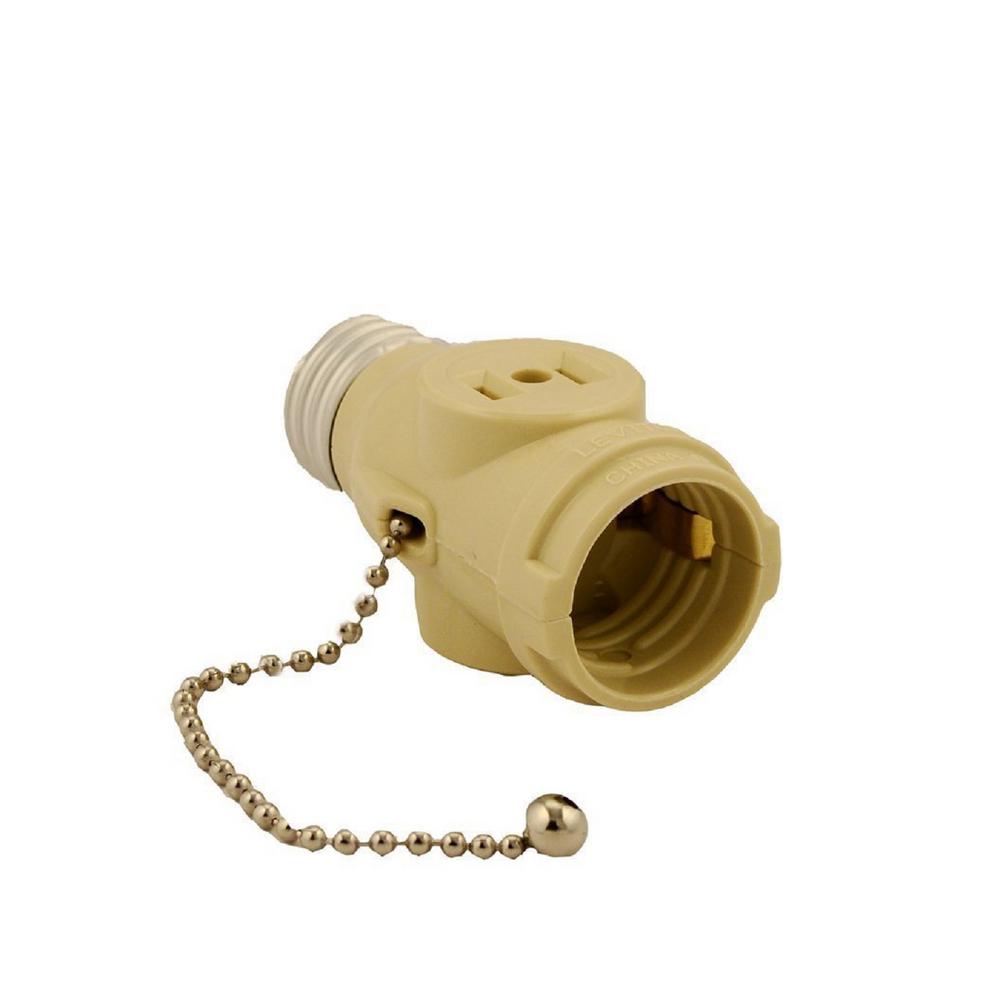
And end result will probably look something like this

I was thinking of something more along the lines of

https://www.kyleswitchplates.com/round-duplex-outlet-cover-wall-plates-white/

Mount a duplex outlet into the box, put a round faceplate on it. The ceiling is finished and painted drywall painted white, but I don't have a good idea how to make the cabling look nice. I don't really want to cut up drywall. Maybe there's some kind of conduit that can mount to the ceiling between LED strips that don't look to bad to hide the cabling.

I noticed that none of my current garage outlets are GFCI, house was build around 2011. CB as far as I can tell is not GFCI either. However, If I turn off the garage CB, one of the GFCI outlets in the basement green light goes out. Seems a bit odd.

I don't want to use an incandescent adapter like that, it looks hideous. I have a little bit more pride than that, but not much.
 

Shiftless

Well-known member
Joined
Mar 9, 2014
Messages
14,519
Location
East Bay SFO
From what you just said, I would suspect that the basement GFCI receptacle feeds the garage off of its LOAD terminals. To verify, press the test button on that receptacle in the basement and see what goes dead in the garage. Lights in the garage? Receptacles in the garage? Overhead garage door opener?
If it all goes dead then you know that your garage circuit is indeed protected by GFCI.
To get power back on, of course you just press the reset button on that GFCI receptacle.

Thanks for not even considering that screw in adapter. :)
 
Last edited:

CJ7VFR

Well-known member
Joined
Jan 13, 2015
Messages
2,939
Location
Central New Jersey
And end result will probably look something like this

leviton-lamp-sockets-holders-1406-i-64_1000.jpg

Yup.

All the 4 foot shop lights in my fathers basement were plugged into those types of adapters whenever he added/wanted more light than just the regular screw-in 60 watt bulb would give. He had a total of eight 4 foot fluorescent shop lights plugged into 4 of those adapters. And they were all powered off of one 20 amp circuit with one light switch.

When we had to sell his house last year after he died, those things were still powering all the shop lights after more than 30 years. His house was built in 1954, with the electrical service being upgraded to 200 amps back in 1987.

Do I use them? No. Did he use them? Yes. Did they work? Yes. Was there ever a problem with them? No. Did we have to remove them for the sale of the house? No. Did the buyers inspector say they violated any codes? No.

I don't know if these types of adapters are against any current NEC codes when it comes to non-permanent lighting using cords with plugs on the end, versus hard wired permanent light fixtures, but if someone out there knows more about it, please let us know.

Jim
 
Last edited:

kroc0005

Active member
Joined
Apr 27, 2020
Messages
27
Location
Plymouth, mn
I'm curious what the final look ends up being. I belong to Costco and checking out their options too.

Sent from my SM-G975U using Tapatalk
 

MerlinsBeard

Well-known member
Joined
Mar 27, 2020
Messages
397
Location
MD
From what you just said, I would suspect that the basement GFCI receptacle feeds the garage off of its LOAD terminals. To verify, press the test button on that receptacle in the basement and see what goes dead in the garage. Lights in the garage? Receptacles in the garage? Overhead garage door opener?
If it all goes dead then you know that your garage circuit is indeed protected by GFCI.
To get power back on, of course you just press the reset button on that GFCI receptacle.

Thanks for not even considering that screw in adapter. :)

Looks like the garage outlets are on one CB with the basement GFCI turning them all on or off. The garage lights are on a different CB with a foyer light. Do you foresee any issues converting to GFCI outlets? Can you terminate multiple ceiling boxes with GFCI if they happen to be in series?

The simplest I could do is flush mount the LED fixtures over the existing ceiling box and I don’t think that needs GFCI. Unfortunately there is a bedroom and bathroom over the garage so I can’t wire in the ceiling. So if I want to flush mount more strip lights I’m not sure how to approach connecting multiple strip light wiring the right way.
 

Shiftless

Well-known member
Joined
Mar 9, 2014
Messages
14,519
Location
East Bay SFO
Looks like the garage outlets are on one CB with the basement GFCI turning them all on or off. The garage lights are on a different CB with a foyer light. Do you foresee any issues converting to GFCI outlets? Can you terminate multiple ceiling boxes with GFCI if they happen to be in series?

The simplest I could do is flush mount the LED fixtures over the existing ceiling box and I don’t think that needs GFCI. Unfortunately there is a bedroom and bathroom over the garage so I can’t wire in the ceiling. So if I want to flush mount more strip lights I’m not sure how to approach connecting multiple strip light wiring the right way.

If you hardwire the fixtures over the existing ceiling boxes there won’t be a receptacle so you don’t need GFCI protection. But if you buy a shoplight style fixture that has a plug and simply cut off the plug, you are violating code with that modification. Will it work? Yes. Is it code compliant? No
So the best thing to do would be to buy a fixture that is designed to be hardwired in. You don’t need access from above to simply connect wires from the box to your fixture.

If you go with receptacle conversion of those garage lights, you have to put in a GFCI breaker in your panel. A GFCI receptacle in the ceiling is not in an “accessible” location so it isn’t code compliant.

If you choose to ignore GFCI requirements you will not be alone.
 
Last edited:

FTG-05

Well-known member
Joined
Oct 11, 2012
Messages
1,528
Location
TN
If you hardwire the fixtures over the existing ceiling boxes there won’t be a receptacle so you don’t need GFCI protection. But if you buy a shoplight style fixture that has a plug and simply cut off the plug, you are violating code with that modification. Will it work? Yes. Is it code compliant? No
So the best thing to do would be to buy a fixture that is designed to be hardwired in. You don’t need access from above to simply connect wires from the box to your fixture.

If you go with receptacle conversion of those garage lights, you have to put in a GFCI breaker in your panel. A GFCI receptacle in the ceiling is not in an “accessible” location so it isn’t code compliant.

If you choose to ignore GFCI requirements you will not be alone.

Why is cutting off the plug non-code compliant? What's the real safety issue?

Thanks for posting that, I had planned to cut some plugs off; now I gotta find Plan B. :headscrat
 

cybrdyke

Well-known member
Joined
Sep 9, 2014
Messages
3,442
Location
USA
Shop lights were not originally for general illumination of shop spaces. They were to use in shops as supplemental lights for benchtops, machine stations, etc. The cord and plug makes them a task light, not a permanently mounted lighting system, so the code is different for the two. The cord used isn't intended for permanent installation, usually being some type of SJ cord.
Cheap LED fixtures have blurred the lines over the last two years. Plus, shady manufacturers calling them "shop lights" fools people into thinking that they must be for "lighting shops".

Plus, modifying the fixture eliminates the UL or CSA rating, if it had one.
 

Shiftless

Well-known member
Joined
Mar 9, 2014
Messages
14,519
Location
East Bay SFO
Thank you cyberdyke.
I will back up on my previous statement that it is a code violation to remove the plug. If somebody can quote a section of the NEC, that would be great.

I don’t think it would be unsafe as long as it’s done in a good workmanlike manner. Some might say that such a modification must be done by a licensed electrician.

Removing the plug would probably void the warranty as well as any UL rating on the fixture. I doubt that Costco or Sam’s Club or anybody else would accept a return on a fixture without the factory molded plug. (Probably not worth worrying about)
I suppose if an insurance adjuster saw that modification in the area of an electrical fire, you might have big problems.

edit:
I found this NEC section...
Assuming that if you cut off a molded plug, you lose the Underwriters Laboratories listing, and since all luminares (light fixtures) must be listed, then it would be a code violation to use a fixture with a missing plug.

To me, this is nit picking but rules are rules.


.
 

Attachments

  • F4F87670-1315-4AB3-8138-298FFB0D3906.jpeg
    F4F87670-1315-4AB3-8138-298FFB0D3906.jpeg
    101.3 KB · Views: 23
Last edited:

MerlinsBeard

Well-known member
Joined
Mar 27, 2020
Messages
397
Location
MD
If you hardwire the fixtures over the existing ceiling boxes there won’t be a receptacle so you don’t need GFCI protection. But if you buy a shoplight style fixture that has a plug and simply cut off the plug, you are violating code with that modification. Will it work? Yes. Is it code compliant? No
So the best thing to do would be to buy a fixture that is designed to be hardwired in. You don’t need access from above to simply connect wires from the box to your fixture.

If you go with receptacle conversion of those garage lights, you have to put in a GFCI breaker in your panel. A GFCI receptacle in the ceiling is not in an “accessible” location so it isn’t code compliant.

If you choose to ignore GFCI requirements you will not be alone.

Thanks for the explanation. I had another question as I'm mentally trying to figure out how to wire these strip lights together.

It seems like there's no issue if I mount a LED strip fixture over the existing ceiling boxes for the incandescent fixtures. If the layout ends up not aligning over those exact locations, is there some kind of faceplate that I could use to daisy chain the power to multiple LED strip lights that wouldn't require some kind of GFCI CB?

I'm considering some kind of raceway to hide the wiring mounted to the drywall between fixtures. Is there anything I should be aware of? Anyone have experience with it? There's EMT but that seems a little heavy handed to what I want to do, and doesn't really match the decor. Been looking at the Wiremold non-metallic raceway stuff.
 

Shiftless

Well-known member
Joined
Mar 9, 2014
Messages
14,519
Location
East Bay SFO
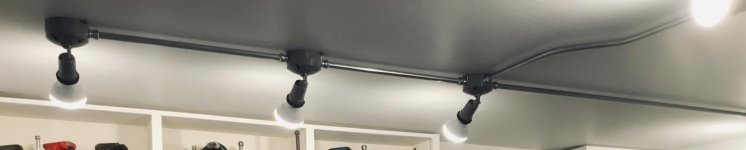
I have a basement room with shelves to display my collection of bench vises. I used EMT conduit over the drywall ceiling to run electricity to my light fixtures.

Here’s how it looks.

I started with a single light fixture mounted over an octagon box in the middle of the ceiling. I attached a new cast aluminum box over that recessed box and ran EMT from there. Lots of options for easy future expansion. Totally reversible too. If I had to, the entire installation could be removed and one ceiling light could go back in. Just a few screw holes to fill, repaint the ceiling and it would be back to a conventional room.

You could paint the conduit if you wanted to. To me, it looks better just clean and new looking.
 

Attachments

  • 922F207F-2A0D-451B-9688-27DEA4F4B619.jpg
    922F207F-2A0D-451B-9688-27DEA4F4B619.jpg
    30.6 KB · Views: 47
Last edited:

MerlinsBeard

Well-known member
Joined
Mar 27, 2020
Messages
397
Location
MD
Thanks for the pic, looks better than I thought it would. And your hobby matches your profile pic too, nice!

Been doing some more reading. Do I need to have this strip LED wiring extensions inspected for this kind of work, and apply for a permit? This would be extending the wiring using the existing fixtures. I've never done any kind of work that required a permit. I don't want to shoot myself in the foot should an electrical issue occur, or worse a fire since I'm not experience, though I try to be careful.
 

Shiftless

Well-known member
Joined
Mar 9, 2014
Messages
14,519
Location
East Bay SFO
You “should” get a permit to extend an existing circuit. With that being said, I’m sure that lots of guys who are familiar with safe wiring practices just go ahead and make such a minor installation to code standards but don’t bother with permits.
 
Last edited:
To avoid these ads, REGISTER NOW!
Top Bottom