To avoid these ads, REGISTER NOW!

How many returns is too many returns?

TT_Vert

Well-known member
Joined
Mar 9, 2018
Messages
1,436
Location
Wauconda, IL.
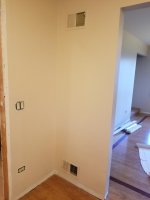
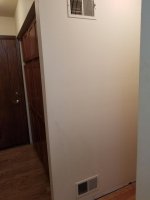
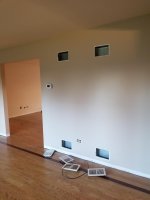
I am not sure if this is by design or someone just likes cutting rectangles in drywall but I have a ton of returns in certain rooms. One high/low sometimes 4 on one wall. Is this something that is supposed to help functionality or is it overkill? I have included a few pics. The furnace is a high efficiency trane xv95. Would it be detrimental to get rid of some of these (Cover them w/ drywall?) The one pic of 4 on one wall 2 joists apart has another two of them on the same wall about 10' down only separated by a partial 3' wall which is perpendicular to the wall the vents are on.

Thanks much,

Dave
 

Attachments

  • 2018-04-28 19.13.42.jpg
    2018-04-28 19.13.42.jpg
    39.1 KB · Views: 86
  • 2018-04-28 19.13.51.jpg
    2018-04-28 19.13.51.jpg
    38 KB · Views: 75
  • 2018-04-28 19.13.24.jpg
    2018-04-28 19.13.24.jpg
    41 KB · Views: 101
  • 2018-04-28 19.13.15.jpg
    2018-04-28 19.13.15.jpg
    61.9 KB · Views: 72
Last edited:
To avoid these ads, REGISTER NOW!

bobbyjean

Well-known member
Joined
Aug 25, 2017
Messages
319
Location
hudson valley n.y.
hi/low stackheads ...i believe is what they are called...
should be adjusted seasonally at the damper on grill
summer-high winter-low
 

justinjoyal

Well-known member
Joined
Apr 30, 2015
Messages
888
Location
Quebec
Looks like the system needed X amount of return and whoever ducted the thing figured it was easier to use the existing wall cavities rather than building larger, single returns, thus resulting in this crappy looking thing (multiple returns side by side)

BobbyJean has a correct explanation for low and high wall registers. Not really needed though.
 
Last edited:

Fixin'Stuff

Well-known member
Joined
Jun 14, 2016
Messages
584
Location
HotterNHellHouston
I've read that you can't have too much return. The blower will only draw what it needs. It's the pressure side that can be affected by too many (or too few) outlets.
 

75gmck25

Well-known member
Joined
Jul 21, 2014
Messages
1,318
Location
Alexandria, VA
In general, more returns help air flow, and a few extra does not hurt. However, the typical solution is to have one moderate size return in each bedroom, and one or two larger ones in the center of the house. You just need to make sure they have the total capacity/size recommended by the HVAC manufacturer, and that they are unobstructed.

I have seen articles suggesting that you need returns at different levels in the winter and summer (usually low for heating, high for A/C), but I've never seen a house where they actually installed dual returns. Unless you can close one vent and open the other based on season, they are not that useful. There is also considerable debate about whether it really makes any difference.

Bruce
 
OP
T

TT_Vert

Well-known member
Joined
Mar 9, 2018
Messages
1,436
Location
Wauconda, IL.
So in my case would you say I need to see the amount or total size of return ducting or ratio to feed ducting by calling trane?

These vents can be closed if need be and I did read on why they do it. Just trying to figure out the repercussions of getting rid of some. It really looks bad and since I'm having the house repainted now is the time to do away w/ them if I can.
 

alexb2000

Well-known member
Joined
Feb 7, 2010
Messages
664
Location
Fort Worth, TX
I just had a bunch of returns added to my house.

If you put in a variable speed system it has many advantages in keeping every room the same temp vs. hot/cold rooms. The returns insure airflow to those rooms, especially if you keep the door closed.

Anyway, my house is now very even temperature, so I'll take the vents over the way it was before.
 
OP
T

TT_Vert

Well-known member
Joined
Mar 9, 2018
Messages
1,436
Location
Wauconda, IL.
I believe this system does have a variable speed system. I guess I just don't understand why there are 4 returns (2 hot/2 cold) 2 joists apart. The room isn't that big to warrant this IMO but I'm not an HVAC guy.

Dave

he XV95 is Trane's current premium two-stage variable speed gas furnace. It boasts an AFUE rating of up to 96.7% along with a DOE Energy Star rating.

The XV95 is made of quality, durable material and consists of superior components adding to its reliability. It includes a variable speed blower, a two-stage gas heating system, a one-piece aluminized steel primary heat exchanger, and an AL29-4C stainless steel secondary heat exchanger.
 

Brian_WK

Well-known member
Joined
Jun 30, 2015
Messages
1,177
Location
NE South Dakota
hi/low stackheads ...i believe is what they are called...
should be adjusted seasonally at the damper on grill
summer-high winter-low

This is correct. You can cover the high if you want just don't shove you couches etc against the low returns. The theory is in the winter you are pulling the cool air from the floor so the warm supply air will be drawn down. In the summer you are trying to remove the warm air from up high and draw the cool air coming from the floor registers up.

Unless your ceilings are 10+ feet high it has very little effectiveness. Proper sizing and register placement is more key.

Brian
 
OP
T

TT_Vert

Well-known member
Joined
Mar 9, 2018
Messages
1,436
Location
Wauconda, IL.
I definitely get the concept of hot air rising I just wasn't sure how many i needed and if having one high/low was of any benefit. If it is I will certainly leave them, they just detract from the look of the house. The ceilings are 9' and there are 2900 sq ft of area.

Dave
 
OP
T

TT_Vert

Well-known member
Joined
Mar 9, 2018
Messages
1,436
Location
Wauconda, IL.
So I just wrote a long winded post but it errored out. I called an HVAC customer of mien and he said the bottoms would be fine and that is how modern systems are laid out. I find it odd Trane would not even recommend a given area for returns per a given square footage . They they would say is contact your HVAC professional. So I'm supposed to call an HVAC tech to come out and call Trane?

What I'm going to do is retain a single lower return in all room with the exception of the largest room (Living room) where I will leave 2 lower vents. I will make a note of the location of the upper vents in the eVENT (Ha ha) that I notice performance issues, I can then begin to put some back.


Dave
 

justinjoyal

Well-known member
Joined
Apr 30, 2015
Messages
888
Location
Quebec
So I just wrote a long winded post but it errored out. I called an HVAC customer of mien and he said the bottoms would be fine and that is how modern systems are laid out. I find it odd Trane would not even recommend a given area for returns per a given square footage . They they would say is contact your HVAC professional. So I'm supposed to call an HVAC tech to come out and call Trane?

What I'm going to do is retain a single lower return in all room with the exception of the largest room (Living room) where I will leave 2 lower vents. I will make a note of the location of the upper vents in the eVENT (Ha ha) that I notice performance issues, I can then begin to put some back.


Dave


Returns (and supplies) are determined by CFM requirements based on the system’s capacity and the load required for each room.

Ducting should be designed accordingly.
 
OP
T

TT_Vert

Well-known member
Joined
Mar 9, 2018
Messages
1,436
Location
Wauconda, IL.
Returns (and supplies) are determined by CFM requirements based on the system’s capacity and the load required for each room.

Ducting should be designed accordingly.
Yes I understand this. Which is what I was asking them. They have to have some cubic volume guideline they could give me. but they chose not to. I was not asking them to design my ducting system I was looking for some guideline as to the area of return for a given volume of air.

when I installed new hvac ad new ductwork in my house we did the hi-low returns. I think they work as intended helping to remove the hotter air at the ceiling.

Why do you think they work as intended? Did you do any type of
before/after calculations? In reality you had no controlled testing correct since you not only changed the unit but the ducting?

Dave
 

justinjoyal

Well-known member
Joined
Apr 30, 2015
Messages
888
Location
Quebec
Yes I understand this. Which is what I was asking them. They have to have some cubic volume guideline they could give me. but they chose not to. I was not asking them to design my ducting system I was looking for some guideline as to the area of return for a given volume of air.


Well they did not install your system so how would they know what you need?

For example, you can have a 3-ton system that only puts out 1000cfm instead of the 1200 you would get from going by the 400cfm per ton rule of thumb. How would they know that?

How would they know that your master bed needs 90 cfm and your office needs 65 cfm ? They don’t have the calculations.

The person who installed and commissioned your system is the one who could/should provide answers to your questions.
 
Last edited:
To avoid these ads, REGISTER NOW!
OP
T

TT_Vert

Well-known member
Joined
Mar 9, 2018
Messages
1,436
Location
Wauconda, IL.
I told them the unit I had. Isn't there a rule of thumb here? IE, a 8x10 return duct can provide return air for a 500 sq ft room, etc?

I just purchased the house and have no prior information and the furnace is new w/o any HVAC company info on it.
 

JJ13

Well-known member
Joined
Nov 20, 2016
Messages
350
Location
Twin Cities, Minnesota
This is correct. You can cover the high if you want just don't shove you couches etc against the low returns. The theory is in the winter you are pulling the cool air from the floor so the warm supply air will be drawn down. In the summer you are trying to remove the warm air from up high and draw the cool air coming from the floor registers up.

Unless your ceilings are 10+ feet high it has very little effectiveness. Proper sizing and register placement is more key.

Brian

I had one of these dual returns in the wall cavity in my lower level. Changing them seasonally didn't make any difference in the actual feel in the main room it was in. When That room became my small, home theater/TV room, I removed the upper adjustable vent and filled the hole leaving only the lower vent.

My output vents are in the ceiling if that makes any difference. I wish the were closer to the floor but that would have required many to be run down external 2x4 walls which would drastically cool the air in winter (drops to -20F in Minnesota) so I understand why they are in the ceiling.
 

JJ13

Well-known member
Joined
Nov 20, 2016
Messages
350
Location
Twin Cities, Minnesota
I just had a thought that blower speed and air turnover might make a difference as well. I have a dual speed setup. On high, you can feel the air movement and it's a little louder than I'd like but it isn't like my brother's house where you can barely tell the heater is on and there are cold spots and more temperature variance than there should be. He's played with the dampers and it didn't help much. Duct sizing, blower speed, and dampers all make a difference with air exchange.

I also missed the 10+ feet comment. My ceilings are just under 8' in my lower level, maybe closer to 7'6". Maybe that's why the dual return didn't seem to help. The air turnover rate is already really good so it mixes and doesn't need to rely on pulling air from high/low.

If you put the fan on, can you feel the air movement? If so, I'd say you could get rid of some of them IF you leave the other grille open. I would even remove the adjustable grille and replace it with an open grille as part of the patch job so nobody can totally close them off in the future overworking the blower motor.
 

Dagny

Well-known member
Joined
Jul 25, 2014
Messages
2,984
Location
Northern Wi.
Where this method excels is in 2 story homes made long ago. It is very difficult to cool the 2nd floor without removing the very hot air at the ceiling.
 
OP
T

TT_Vert

Well-known member
Joined
Mar 9, 2018
Messages
1,436
Location
Wauconda, IL.
Thanks guys. I can feel air movement. This furnace is also variable speed. It is only myself and my wife, nobody will touch the vents but there are no less than 10 bottom vents in this house. It's crazy.
 

themiller

Well-known member
Joined
Apr 24, 2012
Messages
4,805
Location
Seattle Suburbs
Yeah, having lived in homes with 1 return vs. returns in every room - I'd take as many returns as possible. Annoying as all get out to have every room a different temperature.
 

justinjoyal

Well-known member
Joined
Apr 30, 2015
Messages
888
Location
Quebec
Rules of thumb usually provide inferior results, so I don’t recommend going by them.

What is the model number of your air handler and what sizes are your main supply and return ducts?
 

eddieK

Well-known member
Joined
Mar 2, 2017
Messages
695
Location
Nampa Idaho
I am not sure if this is by design or someone just likes cutting rectangles in drywall but I have a ton of returns in certain rooms. One high/low sometimes 4 on one wall. Is this something that is supposed to help functionality or is it overkill? I have included a few pics. The furnace is a high efficiency trane xv95. Would it be detrimental to get rid of some of these (Cover them w/ drywall?) The one pic of 4 on one wall 2 joists apart has another two of them on the same wall about 10' down only separated by a partial 3' wall which is perpendicular to the wall the vents are on.

Thanks much,

Dave

Never too many...keeps system quiet and helps circulate air evenly. High and low in BOTH seasons. It is a forced air system, heat rising is NEVER an issue. Keeps air pressures even throughout.
 
Last edited:
OP
T

TT_Vert

Well-known member
Joined
Mar 9, 2018
Messages
1,436
Location
Wauconda, IL.
Rules of thumb usually provide inferior results, so I don’t recommend going by them.

What is the model number of your air handler and what sizes are your main supply and return ducts?

Ok so if there is no spec how is anyone supposed to design a ducting system? You can't run ducts, test it and then add more ducts if need be after for every install can you? There has to be some type of specification when designing/implementing these systems right? Surely Trane has an idea of how many returns or surface area for returns is required when installing ducting in certain rooms based on duct size (Volume). I will get specs when I'm back over there.


Never too many...keeps system quiet and helps circulate air evenly. High and low in BOTH seasons. It is a forced air system, heat rising is NEVER an issue. Keeps air pressures even throughout.

Curious how having two ducts separated by one joist and then mirrored directly below would help circulate that much more air unless they were tiny ducts or a huge room. I'm getting a bit of conflicting info here. I Just know having 22 return grates on the walls seems a bit excessive for a 2600 sqft home.
 

ZX3ST

Well-known member
Joined
Jun 6, 2015
Messages
162
Location
STL
^^^ Maybe they needed a return that occupied 2 stud bays, but the middle one had an obstruction such as electrical or plumbing?
 
OP
T

TT_Vert

Well-known member
Joined
Mar 9, 2018
Messages
1,436
Location
Wauconda, IL.
I suppose that is possible in one room. When speaking to one of my HVAC customers he advised me that all modern systems use low cold air return, not high. Is this factual or no?

Dave
 

Ohmthis

Well-known member
Joined
Jan 20, 2013
Messages
3,009
Location
Outside of Louisville KY
Ok so if there is no spec how is anyone supposed to design a ducting system? You can't run ducts, test it and then add more ducts if need be after for every install can you? There has to be some type of specification when designing/implementing these systems right? Surely Trane has an idea of how many returns or surface area for returns is required when installing ducting in certain rooms based on duct size (Volume). I will get specs when I'm back over there.


Curious how having two ducts separated by one joist and then mirrored directly below would help circulate that much more air unless they were tiny ducts or a huge room. I'm getting a bit of conflicting info here. I Just know having 22 return grates on the walls seems a bit excessive for a 2600 sqft home.

I'll do my best to answer your question without getting too detailed or long winded. We start with a load calculation for the house and or room by room. From there this tells us the heat lose/heat gain of the home. With this info we can use the btu lose or gain to size the furnace and AC. Say we need 3 tons of cooling per calculation. This will be roughly 1200 cfm of air (400 cfm per ton). We then need to know how much air each room needs from our calculation. So if a bed room needs 120 cfm we size that duct to flow enough per a certain air speed (velocity). Same goes with the return for that room. We size the duct and opening for the needed air flow per its velocity (which is different than the supply). After all of these are found we can then design the trunk line to do two things. One flow the needed air to the rooms and two flow the needed air for the total air flow the blower makes. Hope this helps you a little.
 

justinjoyal

Well-known member
Joined
Apr 30, 2015
Messages
888
Location
Quebec
I'll do my best to answer your question without getting too detailed or long winded. We start with a load calculation for the house and or room by room. From there this tells us the heat lose/heat gain of the home. With this info we can use the btu lose or gain to size the furnace and AC. Say we need 3 tons of cooling per calculation. This will be roughly 1200 cfm of air (400 cfm per ton). We then need to know how much air each room needs from our calculation. So if a bed room needs 120 cfm we size that duct to flow enough per a certain air speed (velocity). Same goes with the return for that room. We size the duct and opening for the needed air flow per its velocity (which is different than the supply). After all of these are found we can then design the trunk line to do two things. One flow the needed air to the rooms and two flow the needed air for the total air flow the blower makes. Hope this helps you a little.


There you have it. :)
 

oltruckag

Well-known member
Joined
Aug 10, 2007
Messages
171
Location
*******, GA
Was there a wall between the registers in the room previously? Looks like large room that was likely two rooms at one time... Not enough photos to tell, but I've seen that in old houses here.

Tyson
 

Renfrick

Active member
Joined
Jun 17, 2015
Messages
25
I'll do my best to answer your question without getting too detailed or long winded. We start with a load calculation for the house and or room by room. From there this tells us the heat lose/heat gain of the home. With this info we can use the btu lose or gain to size the furnace and AC. Say we need 3 tons of cooling per calculation. This will be roughly 1200 cfm of air (400 cfm per ton). We then need to know how much air each room needs from our calculation. So if a bed room needs 120 cfm we size that duct to flow enough per a certain air speed (velocity). Same goes with the return for that room. We size the duct and opening for the needed air flow per its velocity (which is different than the supply). After all of these are found we can then design the trunk line to do two things. One flow the needed air to the rooms and two flow the needed air for the total air flow the blower makes. Hope this helps you a little.


That’s pretty good

But nobody mentioned that if you reduce the returns the duct work will **** in and out making noise
Return air is your friend.


Sent from my iPhone using Tapatalk
 
OP
T

TT_Vert

Well-known member
Joined
Mar 9, 2018
Messages
1,436
Location
Wauconda, IL.
Was there a wall between the registers in the room previously? Looks like large room that was likely two rooms at one time... Not enough photos to tell, but I've seen that in old houses here.

Tyson

Sorry been busy working at the new house. Yes it was two rooms at one point.
I also have a suspicion this duct system was designed for the old non high efficiency/variable blower motor system.

Dave
 
To avoid these ads, REGISTER NOW!
Top Bottom