To avoid these ads, REGISTER NOW!

How much can I reduce the temp inside detached garage?

FredWanaker

Well-known member
Joined
Mar 27, 2021
Messages
1,470
Location
NorCal
I am puzzled by folks who don't understand insulation. It simply slows the transfer of heat. But since it is not always 110F outside, meaning it cools down at night, the actual temperature inside the space is more an averaging of the daily hi and lo temps. With good insulation the day heat comes thru late in the evening and at night, and the cool of the evening comes thru in the morning and early afternoon. It also slows the transfer of heat between a conditioned space and the outside. Think dual or triple pane window vs single pane. Think holding a hot pan with a towel or pot holder. It why race car drivers wear Nomex and why in a fire in a race car driver you never spray the driver with water - it instantly will conduct the existing heat and burn the driver.
 
To avoid these ads, REGISTER NOW!

finn

Well-known member
Joined
Mar 27, 2005
Messages
16,383
Location
The UP, God's country
Insulation is not climate control. It cannot make it colder or warmer.

It can only so the movement of heat to a cooler space
Not true. My shop is well insulated, and very comfortable to work in this time of year. Outside temperatures are typically in the upper seventies to mid or upper eighties in the daytime.

The shop has an enclosed, uninsulated lean to addition on the north wall that is uncomfortably hot because of thermal loading from the sun beating down on the green steel roof. The ceiling is vented, but with no fan, convection alone doesn’t help enough to make it pleasant.

That same uninsulated space has been measured at -16 degrees in the winter on days that my insulated garage a mile away is around freezing.

Insulation can moderate your space from day / night swings, and reduce swings from solar radiation.

Insulation is a good investment.
 

WisJim

Well-known member
Joined
Dec 20, 2010
Messages
2,308
Location
Menomonie, WI
My shop is insulated with spray foam. I live in western Wisconsin where we get minus 20F in the winter a lot, and occasionally down to minus 40 and it gets down to freezing inside only after weeks of the really cold weather, and then only for a short time. In the summer, it slowly up but isn't close to the outside temperature at the end of the summer. This year we have had weeks of highs in the upper 80s and low 90s, but my shop areas are still in the low 70s. I feel that the spray foam made the building much tighter than other types of insulation would have done, and lower infiltration has helped maintain the inside temperature. If I start spending a lot more time in the shop, I plan to install a minisplit for heating and cooling, but so far don't feel the need for it.
If this building were uninsulated, I am sure that my inside temps would be following the outside temp very closely, and would be unpleasant to work in during the summer.
 

kj_mustang

Well-known member
Joined
Feb 9, 2011
Messages
1,213
Location
Harrisonburg, VA
10 degree heat difference from insulation only sounds like the stuff legends are made of. There are a few studies you can google that show temps with insulation and without, spoiler alert.... not 10 degrees.

My spray foamed building will generally hold the temperature about 20F warmer in winter and cooler in summer than the outside temperature before I had the HVAC running. But, it takes other factors to do that, doors not being opened, sun blocking curtains on south facing windows opened or closed.
 

Kpaige

Well-known member
Joined
Aug 12, 2015
Messages
751
Location
Big Lake Minnesota
Proper soffit and roof vents combined with attic and wall insulation will drastically reduce your heat as long as you keep the doors shut. It is currently running 90 plus degrees here and my garage is much cooler. Now dee point matters you may see moisture on your floor etc as the moisture in the air will condensate when it hits the colder surfaces so moisture sprays/oiled tools and surfaces to keep rust off etc.
 

dcg9381

Well-known member
Joined
Jun 20, 2018
Messages
11,927
Location
Austin, TX
My spray foamed building will generally hold the temperature about 20F warmer in winter and cooler in summer than the outside temperature before I had the HVAC running. But, it takes other factors to do that, doors not being opened, sun blocking curtains on south facing windows opened or closed.
Exactly. I have a foam insulated shop too. Yesterday it was 103 or so till early evening. I went down to the shop in the late evening, outside it was high 80s, the shop was in the 90s. Insulation works both ways... How you use it, when you use it, and your climate are major factors.
 

duneslider

Well-known member
Joined
Jan 20, 2013
Messages
2,272
Location
Riverton, Utah
Like has been said, insulation doesn't create or remove heat. Just like my fancy Yeti cooler. Its been up on the shelf for 6 months, if I pull it down it isn't going to magically be hotter or colder inside than the temp of the garage. It will be nearly the same temp as the garage. If I put ice in, it will keep that ice cold for several days but eventually the ice melts and the water will become the same temp as the garage.

Insulating a garage is NO DIFFERENT. Insulation just slows the transfer of heat. Eventually, it reaches equilibrium. No, there are other factors at play in a garage. For example, in the winter in my attached garage that is insulated there is some heat that escapes from the house as well as hot cars brought into the garage. These are heat sources that add heat to the garage and actually keep my garage pretty nice in the winter. In the summer, pulling a hot car into the garage and shutting the door warms the garage up more and makes it less pleasant.

In general, I think insulating spaces is a good idea and slows the transfer of heat. If you have enough insulation and enough of a temp swing during the day and night the insulation might be enough to keep the area pleasant if you takes some steps to allow the cool in while its cool and then hold the cool in once the temps start going up. Again like my cooler, if I put ice in in the morning and close the lid there is still ice that evening and if I add a little more ice the next morning it will still have ice the next evening.
 
OP
F

five_one_oh

Member
Joined
Jun 21, 2023
Messages
12
Location
Bay Area, CA
You must be east bay? Cause the coldest place I've ever been is San Francisco in the summer!

I think a wall unit/window unit is your best bet - it takes down the humidity and if you get one with a heat strip you can warm the garage/music room up in winter too.

My garage/shop is somewhat insulated but in hot, muggy Kansas summers it got too hot to work in there, and too cold in winter. I put a big ol window unit in ($600 on Amazon) and it works a treat, since it also has the heat strip. It adds about $20 in the summer to my electricity bill, less in winter because our other electrical use is far lower since we aren't running the whole house A/C too.

Edit: One like this requires 220V and about 30 amp service
Yes, I'm in the East Bay. But even the East Bay has huge climate differences. Meanwhile SF and the Peninsula barely get a summer at all--there are always some nice days in the fall but June-July are often cold (by CA standards), windy, and gray.

I'll consider wall/window AC. Seems like insulation and building the attic floor, and ventilation, will be my first step and I'll see how much of a difference that makes.
 
OP
F

five_one_oh

Member
Joined
Jun 21, 2023
Messages
12
Location
Bay Area, CA
Can you install a 120v powered gable type fan, the kind with a built in thermostat? home depot has them, I put one in a metal shed with 3 walls that covers some electric motors and VFDs, a white roof also helps.

One of our conex storage containers I installed a solar powered vent fan, and also applied snow roof up top. helps a lot.
Are these something like what you're talking about?

This

or this?
 

Kpaige

Well-known member
Joined
Aug 12, 2015
Messages
751
Location
Big Lake Minnesota
Realize that also the slab will actively transfer ground temp. It will slowly heat up but in my experience if properly insulated and ventilated and the doors are kept shut the garage inside will remain cooler in the summer than outside. But this also depends on your slab insulation.
There are alot of variables dew point etc. but if you properly vent the attic with soffit and roof vents then properly insulate the attic and walls it will help and it will relieve stress off your roof materials etc.
 

finn

Well-known member
Joined
Mar 27, 2005
Messages
16,383
Location
The UP, God's country
Realize that also the slab will actively transfer ground temp. It will slowly heat up but in my experience if properly insulated and ventilated and the doors are kept shut the garage inside will remain cooler in the summer than outside. But this also depends on your slab insulation.
There are alot of variables dew point etc. but if you properly vent the attic with soffit and roof vents then properly insulate the attic and walls it will help and it will relieve stress off your roof materials etc.
My experience, too. I shut off the boiler for the radiant heat in late March, after the snow is mostly gone. The insulated slab slowly cools, and, I believe, still helps moderate summer temperatures in the shop until late July or August.

the reverse is true in the fall. The somewhat warm slab mass keeps the shop relatively warm until early November. I can get by with an overhead heater until we leave for the winter and set the boiler to the low forties for freeze protection.

Well insulated walls and ceiling go hand in hand with the insulated slab mass.
 

firebirdparts

Well-known member
Joined
Jun 8, 2016
Messages
10,676
Location
Kingsport, TN
My answer is I don't know. The effect of solar radiation will be reduced quite a lot by the ceiling and ceiling insulation. Based on that, I do think your average temperature could be lower. The ground is good to you.

It'll take longer to heat up in the morning and it might take a little longer to cool down at night (I'd bet not much).

I don't really want to get into arguments amongst people who don't know what they don't know about heat transfer. There are lots of variables.
 

Kpaige

Well-known member
Joined
Aug 12, 2015
Messages
751
Location
Big Lake Minnesota
What's interesting is that here in the south I've never seen an insulated foundation. Probably because ambient ground temperature is a good thing.
It’s actually code in the north. Usually rigid insulation put down before the concrete and a vapor barrier. The ground temp in the warm months is good not so much a 0 degrees 😁
 
To avoid these ads, REGISTER NOW!

Kpaige

Well-known member
Joined
Aug 12, 2015
Messages
751
Location
Big Lake Minnesota
I am puzzled by folks who don't understand insulation. It simply slows the transfer of heat. But since it is not always 110F outside, meaning it cools down at night, the actual temperature inside the space is more an averaging of the daily hi and lo temps. With good insulation the day heat comes thru late in the evening and at night, and the cool of the evening comes thru in the morning and early afternoon. It also slows the transfer of heat between a conditioned space and the outside. Think dual or triple pane window vs single pane. Think holding a hot pan with a towel or pot holder. It why race car drivers wear Nomex and why in a fire in a race car driver you never spray the driver with water - it instantly will conduct the existing heat and burn the driver.
Not really how insulation works. If properly done for the materials, temperatures, dew points, and perm ratings It works by trapping air and creating a buffer between the inside and outside so it can’t transfer. The studs and sheathing etc is where the transfer happens. Knowing the dew point and perm rating of all your materials will give you what thickness you truly require and what mill vapor barrier you need.
All that being said this is a garage don’t over think it. Ventilate, insulate do it correct and you will be Ofer from it
 

HPRifleman

Member Emeritus
Joined
Nov 18, 2019
Messages
767
Location
Wayne, IL
My garage has in-floor heat but no active cooling. While our house is very shaded, the garage roof is exposed to the sun.

On hot days (85º+F) I am amazed at how much cooler the garage is compared to outside air temperature. The interior is typically about 5º (or more) cooler than the exterior temperature. This is provided I keep the doors and windows closed.

The garage is insulated with R-21 in the walls and R-49 in the ceiling. You can see photos of the insulation in my build thread link in my signature.
Here are some measurements I took today.

Air temperature in my area: 88ºF
Shaded air temperature next to house: 83ºF
Interior garage temperature: 79ºF
 
OP
F

five_one_oh

Member
Joined
Jun 21, 2023
Messages
12
Location
Bay Area, CA
No, you want the foil on the inside and have air space. That's what I understand. They make a foil based osb board for roofing and you want the foil facing down into the attic space if using it that way. It has to have air space.
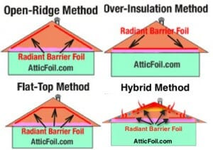
I've looked into it a bit, and it seems like there are multiple ways you can do the barrier--on the attic ceiling, floor, or both...when I said "on top of the attic floor", what I mean is it would go like the "Over-Insulation Method" in the pic below:

1687556284836.png
 

Kpaige

Well-known member
Joined
Aug 12, 2015
Messages
751
Location
Big Lake Minnesota
I've looked into it a bit, and it seems like there are multiple ways you can do the barrier--on the attic ceiling, floor, or both...when I said "on top of the attic floor", what I mean is it would go like the "Over-Insulation Method" in the pic below:

1687556284836.png
No matter what you do you do not want the insulation tight against the roof boards

IMG_3608.pngIMG_3607.jpeg
 

jonesg

Well-known member
Joined
Mar 15, 2010
Messages
1,698
Location
northern Maine/
I installed a window AC unit in my garage, it keeps sweat from running into my eyes when working on the car, it doesn't cool the garage like it would if it was in the house but I'm not interested in doing all that insulation just for a garage.
If I want a cool place to hang out I go down the basement of the house, thats appreciably colder.
 

couch67

Well-known member
Joined
Mar 18, 2016
Messages
1,410
Location
Ontario Canada
There are two veins of truth in these posts - 1) insulation will only slow the transfer of heat to/from a structure; and 2) a slab will absorb / provide heat to a structure.

My well insulated, attached garage is proof of both statements. In the summer, the slab is a great heat sink that keeps the garage cooler than outside when everything is closed up. Unfortunately, the same is true in the winter when the heat is on.

In my case it really doesn't matter, since I hate working with the doors closed in summer unless it is brutally hot out and I'm not making dust or sparks in the garage, so normally everything is wide open.
 
Last edited:

mikegt4

Well-known member
Joined
Sep 12, 2005
Messages
3,277
Location
sw ohio
My detached garage is 26x48 railroad style, doors on the narrow end instead of on a long side. I put doors on both ends for access reasons and found that opening at least one on both ends made working inside even on the hottest days relatively comfortable. I assume putting a door on the opposite side to get some cross ventilation going would be an advantage on any garage.
 

Kpaige

Well-known member
Joined
Aug 12, 2015
Messages
751
Location
Big Lake Minnesota
My detached garage is 26x48 railroad style, doors on the narrow end instead of on a long side. I put doors on both ends for access reasons and found that opening at least one on both ends made working inside even on the hottest days relatively comfortable. I assume putting a door on the opposite side to get some cross ventilation going would be an advantage on any garage.
Air flow is a huge help I also have doors on both ends and ceiling fans
 

rockettauto

Well-known member
Joined
May 12, 2023
Messages
745
The largest difference you'll see is the drop down to ambient as its likely your roof and possibly even the space inside gets well above ambient currently just from radiant heat.

I could have a 95 degree day where my roof is easily 130.

I would guess from your description if you just insulate and add attic ventilation you'd be unlikely to ever see indoor temps over 80 in your space.

Towards your roof youre likely easily seeing 110 degree temps on a 90 deg day. And 95+ in most of the space.
 

aggie113

Well-known member
Joined
Jul 22, 2015
Messages
477
Location
San Antonio, TX
I have 2" of closed cell on all walls and ceiling (18ft high) on the garage and a 2 ton mini split (set at 76) kept it around 80 this Saturday when it was over 100 out when me and four others were working on a heatsoaked jeep that drove in for a lift install.
 

Kpaige

Well-known member
Joined
Aug 12, 2015
Messages
751
Location
Big Lake Minnesota
The entire reasoning for correct ventilation is to reduce the chance radiant heat from the roof transferring its energy down into the habitable area. Proper ventilation picks up the heat energy then moves it out through the roof vents while the insulation and vapor barrier confine it to the attic.
The goal is to have the attic area the same ambient temp as outside.
 

jonesg

Well-known member
Joined
Mar 15, 2010
Messages
1,698
Location
northern Maine/
I cut a hole in the wall , installed a small A/C window unit, it blows on me when I'm working on the car in the summer, it keeps sweat from running into my eyes. It might cool the whole garage, I don't know or care. ...as long as I'm cool.
 
To avoid these ads, REGISTER NOW!
Top Bottom