To avoid these ads, REGISTER NOW!

How my compressor is wired

John Timmins

Well-known member
Joined
Sep 1, 2008
Messages
857
Location
Flagler Beach, FL
The 240 volt breaker in my panel box of my workshop for the air compressor is 30 amp. The air compressor motor is 3 HP, single phase, 240 volts, 1750 rpm.
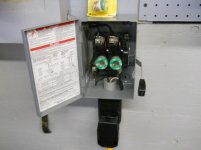
The circuit breaker feeds a knife switch which has two 30 amp glass fuses. Closing the knife switch allows power to a 240 volt outlet made for a dryer or stove.

The air compressor motor leads go from the motor pecker head to the pressure switch. A length of 10-3 goes from the pressure switch to the male 240 volt plug which plugs into the wall outlet under the knife switch.

I leave the circuit breaker on in the panel box and turn the compressor on and off with the knife switch. The knife switch and glass fuses cost about $25-30 at Lowe's.

The air compressor tank gets bottled up when I shut it off. Usually the next time I use it, there is enough pressure in it from last time to not start running.

If I had a larger motor and commercial use of this compressor I would probably buy a magnetic contactor with the heaters and all that or a PLC .

The commercial use days of this 1936 Fero Air Pump are over. :beer:

It came from a GULF station in Palatka, Florida, and I have owned it for the last 28 years. I had to replace the motor and renewed the discharge line and check valve. The compressor turns 350 RPM. The pressure switch is a Furness brand. I believe it is ready for another 75 years of service ! :thumbup:

I have rolled the compressor out of the way of the outlet for these pictures.
 

Attachments

  • Ford GT May 1, 2012 011.jpg
    Ford GT May 1, 2012 011.jpg
    37.3 KB · Views: 185
  • Ford GT May 1, 2012 012.jpg
    Ford GT May 1, 2012 012.jpg
    29.7 KB · Views: 205
  • Ford GT May 1, 2012 013.jpg
    Ford GT May 1, 2012 013.jpg
    37.7 KB · Views: 179
To avoid these ads, REGISTER NOW!

Fred43

Member
Joined
Apr 20, 2012
Messages
14
Location
Bellingham, MA
John,
Basically what you describe is somewhat safe but not according to the National Electrical Codes (NEC).

The wiring, if done properly is protected but the 3 hp, 240 v, 30 amp motor is left unprotected. A motor starter rated double pole safety switch with the appropriately sized heater elements at the least or a magnetic starter with a built-in stop / start station is necessary to protect the motor from drastically overheating, burning the motors components and / or possibly flaming up. This could happen if the compressor froze, a belt tangles or a motor bearing is wearing unevenly. It could also happen if the safety devices on the air tank malfunction and the motor runs under a very excessive load condition.

Think insurance. If this situation caused a fire, your insurance MAY not cover any damage to the unit or the building. This is most prevalent in states that require wiring permits.

For those people that are unsure of methods or the laws governing the use of electrical instalation materials would be better off calling an electrician for safety's sake. Good luck.
 

Norcal

Well-known member
Joined
Mar 16, 2008
Messages
13,750
The use of Edison base (Plug Fuses) is prohibited in new installations, type S adaptors are required. See NEC section 240.51

Edison-Base Fuses.
(A) Classification. Plug fuses of the Edison-base type
shall be classified at not over 125 volts and 30 amperes and
below.
(B) Replacement Only. Plug fuses of the Edison-base type
shall be used only for replacements in existing installations
where there is no evidence of overfusing or tampering.
240.52 Edison-Base Fuseholders. Fuseholders of the
Edison-base type shall be installed only where they are
made to accept Type S fuses by the use of adapters.
240.53 Type S Fuses. Type S fuses shall be of the plug
type and shall comply with 240.53(A) and (B).
(A) Classification. Type S fuses shall be classified at not
over 125 volts and 0 to 15 amperes, 16 to 20 amperes, and
21 to 30 amperes.
(B) Noninterchangeable. Type S fuses of an ampere classification
as specified in 240.53(A) shall not be interchangeable
with a lower ampere classification. They shall
be designed so that they cannot be used in any fuseholder
other than a Type S fuseholder or a fuseholder with a Type
S adapter inserted.
 

coolreed

Well-known member
Joined
Apr 10, 2012
Messages
595
Location
Oklahoma City, It's a Windy Heat.
I would suggest you consult an electrician. You are not operating within the
NEC as stated previously. In fact your service looks barely adequate. It looks like you need a larger panel that will allow more 220 VAC breakers so you can isolate your compressor circuit and your washer/dryer circuit from each other and safely operate according to the NEC.

I cannot tell for sure if you have 100 , 150, or 200 Amp service to you home. It kind of looks like 100 A service. If that is so you need to upgrade your service and get a larger breaker panel.

Good Luck and Be Safe.
 

Charles (in GA)

Well-known member
Joined
Jan 11, 2006
Messages
12,489
Location
50 mi south of Atlanta
I would suggest you consult an electrician. You are not operating within the
NEC as stated previously. In fact your service looks barely adequate. It looks like you need a larger panel that will allow more 220 VAC breakers so you can isolate your compressor circuit and your washer/dryer circuit from each other and safely operate according to the NEC.

I cannot tell for sure if you have 100 , 150, or 200 Amp service to you home. It kind of looks like 100 A service. If that is so you need to upgrade your service and get a larger breaker panel.

Good Luck and Be Safe.

He never said he was connected to the same circuit as the dryer, just that the plug was the same type, a three prong 30 amp.

He has a dedicated 30 amp 240v breaker supplying the knife switch, from a "shop" panel. Never claimed it was the house's only panel. Might be a detached shop for all we know.

While Edison fuses are not supposed to be used, there is a 30 amp breaker protecting the circuit. so even if he used fuses with copper pennies underneath them, it really would not have any affect on the circuit.

Edit: I do agree, the motor needs thermal protection. I do not see a thermal overload reset button poking out of the back of the motor, so it probably needs an external thermal overload protection.

Charles
 
Last edited:
OP
J

John Timmins

Well-known member
Joined
Sep 1, 2008
Messages
857
Location
Flagler Beach, FL
I have recently been reading and bookmarking topics related to magnetic contactors on the Garage Journal. I will likely install a magnetic contactor in due course. I appreciate the safety factor and thoughts about code.
My house was upgraded to 200 amps by a licensed electrician who pulled a permit. When that was done, 50 amp service was also run to my workshop, a seperate outbuilding. That is my workshop panel in that picture which runs a radio, small refrigerator, some lights, sometimes a tool on a power cord outside that makes sawdust, and sometimes the air compressor.
Last week, a licensed electrician pulled a permit again to install a gfci outlet on my dock from the workshop. At that time I asked him to wire up the knife switch. He didn't seem to have a problem with it.....but he was VERY wary of our new building inspector - heard he was a ball buster. The outside work was inspected and signed off after he tested the GFCI and inspected the water resistant PVC and boxes.

If this was all new construction, the inspector probably would have red flagged that knife switch but why should he ? My 220V A/C compressor has a knife switch disconnect to the air handler and compressor. The hot water heater is wired straight from the circuit breaker. Electrically it's the same principle right?

I'm not trying to argue here, just learn something. Is the SIZE of the air compressor motor the problem (potential hazzard?) Thanks in advance, John
 
To avoid these ads, REGISTER NOW!

mm08822

Well-known member
Joined
Jan 13, 2012
Messages
5,841
Location
NJ
From what the pictures don't show us is where the most concern is. Does your motor have overload protection? This is different from overcurrent protection for the conductors in the circuit. OL protection is specifically sized for the respective motor at the end of the line. If your motor does not have the typical red reset button, it probably doesn't exist.
You could remove the knife switch and replace it with a manual motor starter (on/off mechanical buttons) but it would include an overload heater element that would be sized according to the motor full load amps. Consider Grainger #1H416 or similar. Otherwise, one day your motor might become toast!
 

Fred43

Member
Joined
Apr 20, 2012
Messages
14
Location
Bellingham, MA
To All,
Your evaluations of the code and operation and materials are all in line with installing motor overload heaters, whether in a motor rated double-pole switch or another approved starter. That is a good thing, but any motor 1 hp or larger is required by NEC code to have exterior heaters. If there is a built-in overload it is automatically resetable when the motor cools. It will cause more trouble to find problems as there are no resets on 1 hp motors that I recall having seen in 47 years in the electrical trades. As long as both hot wires are opened simultaneously it does not matter if there are or are not any fuses in the switch. The wiring should be properly sized from the source and protected by the proper circuit breaker which can be sized 125% over the wire rating. As for the edison base fuses being 30 amp - The type "S" fuse are to keep someone from upgrading the fuses to a larger size. Thirty amp plug fuses are the largest made therefore there is no danger in their use. Might not be legal though.
3 hp @ 240 v = 3 x 743 Watts (2229 w / 240v = 9.3 amps) Check motor name plate for actual motor statistics. 1 hp = 743 watts single phase
Fred
 

mm08822

Well-known member
Joined
Jan 13, 2012
Messages
5,841
Location
NJ
Fred, article 430.32 (A)(2) of 2011 NEC says it a little differently about requirements for ol protection, but we all agree to the fact that it is needed. Just b/c a motor has internal ol protection does not mean it is of the automatic reset type. 1 HP is not a breakppoint in the code for external heater requirements.
My suggestion of the manual starter eliminated the disconnect, fuses, and the pvc conduit connector used as a chase ****** and the chance to apply the correct value of ol protection. SO the OP needs to provide all of the nameplate data if he wants further help to get this corrected.
 
OP
J

John Timmins

Well-known member
Joined
Sep 1, 2008
Messages
857
Location
Flagler Beach, FL
I will supply the motor nameplate data to continue this conversation...and so we can determine what is really needed. I am intersted in the safety aspect.

With that said, I would probably invest in a normal motor controller with the heaters and all that and the correct overload protection.

I take it that the motor controller with a push button start would be LVP as well ?

Finally, I have a Grainger account. Perhaps somebody could suggest what model of motor controller I should get from them...or another source.

To answer that question above, this motor does not have any protection on itself, that is, there is no motor protection with the heaters or reset buttons or anything like that. There is just the circuit breaker in the panel box and the knife switch on the wall.
 
Last edited:
OP
J

John Timmins

Well-known member
Joined
Sep 1, 2008
Messages
857
Location
Flagler Beach, FL
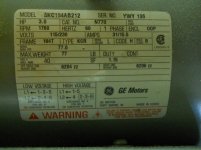
Here is the nameplate of my 3 HP motor. If someone would kindly tell me what kind of magnetic contactor motor control box I need and where to buy it on line or Grainger etc., I would appreciate it.

Eventually this compressor might get a single phase 5 HP motor. If possible I would like a controller that would work with 3 or 5 HP.

One last thing, about how much should I expect to pay for this controller ?
 

Attachments

  • boat ride May  12, 2012 007.jpg
    boat ride May 12, 2012 007.jpg
    37.7 KB · Views: 19
To avoid these ads, REGISTER NOW!
Top Bottom