To avoid these ads, REGISTER NOW!

How should I finish this workbench?

JasonB.

Active member
Joined
Dec 29, 2020
Messages
38
Location
North Alabama
I put together a top for my "fab bench" out of some old oak barn wood I had laying around. This will be home to my drillpress, grinder, vise, etc. I am a hobby mechanic, so oil, grease, transmission fluid, antifreeze, etc. are all possibilities. I'd like to finish it with something that won't detract from the beauty of the wood, but that would give me enough time to grab a towel and wipe up if something gets spilled on it. Thoughts?
 

Attachments

  • 20210218_183518.jpg
    20210218_183518.jpg
    129.5 KB · Views: 290
To avoid these ads, REGISTER NOW!

Black300zx

Well-known member
Joined
Apr 8, 2019
Messages
782
Location
Elkton, Md
I guess it also depends on how "perfect" you want to keep it. If you want to keep it looking pristine, a coating with some thickness that you can sand down occasionally, such as epoxy bar top resins might be an option.

If you're just looking to keep liquids from soaking in, I used a few coats of oil-based poly on my oak plywood bench. Sharp corners of heavy parts will dent it and punch through it, but lets me wipe up fluids without them soaking in. It keeps it looking like a nice, but used, workbench.
 

slowtwitch73

Well-known member
Joined
Apr 18, 2019
Messages
5,876
Location
Hellgate
Just leave it. If you could find oak boards that had years of stains etc on it would fetch a premium. Start building character/patina.
 

bad_idea

Well-known member
Joined
Jun 11, 2011
Messages
4,332
Location
Pasquotank, NC
I put oil based poly on mine this past summer. Easy to apply. It will get crummy looking and grubby in another 10 years, will sand it all off and reapply then.
 

lbhsbz

Well-known member
Joined
Jan 13, 2010
Messages
1,172
Location
Long Beach CA
I would use that wood for something else and get a steel workbench for actual work. It would be a shame to destroy the wood.
 

jives

Well-known member
Joined
Jan 4, 2013
Messages
2,804
Location
Central NY
I would use that wood for something else and get a steel workbench for actual work. It would be a shame to destroy the wood.

I agree with this. Not to be a naysayer, but all those cracks, holes, worm holes and other imperfections are just nooks and crannies for metal shavings, grease, and more. You could epoxy it to create a smooth surface, but why go to all that effort when the top could now be used as a cool farm table.
 

Sevenhills1952

Well-known member
Joined
Aug 30, 2018
Messages
1,750
Location
Virginia
I agree with above two replies, 7 & 8. That would be good for something else but not a workbench. It looks like it may be 3/4" thick.
You need something really strong, and knots, holes will be a pain. One bench I use a lot I covered it with sheet galvanized steel I marked and a friend used a brake to bend it.
It cleans easily, anything I take apart all little pieces are easy to find.
It will have years of abuse hammering stuff on it, holding an engine block, etc.
What you have could be made into a coffee table, a rustic door, etc.

Sent from my SM-S205DL using Tapatalk
 
OP
J

JasonB.

Active member
Joined
Dec 29, 2020
Messages
38
Location
North Alabama
65ranchero, I've read that epoxy resin will crack. That's part of why I asked the question here. I wanted to get some input from people with experience. Preferably some that have been in service several years.

gmyers, I've read some about that and it was on my list. I wasn't sure how it would do if I accidentally spilled a solvent on it.

Black300zx & bad_idea, That’s also on my list. I know it will yellow in time, but it shouldn’t be a big deal to sand and reapply.

Slowtwitch73, I’ve thought really hard about this. That’s actually the main reason I still haven’t pulled the trigger on anything. My biggest concern with this it that it is crazy how quickly this old oak burns. Some of these boards are close to 100 years old. I’ve used the scraps for kindling and I can literally start it with a match. So I’m not sure I want to have it soaked in solvents and petroleum. 😊

jives & lbhsbz, The wood isn’t really all that great. I’ve already epoxied all of the cracks and holes. This is my trial run for the farmhouse table. 😊

Sevenhills1952 & ZRX61, I planed it to about 1” thick. Being aged oak, it is very strong. Also, it will set down in a frame that is cross-braced. I’m not worried about the strength. I also have a really heavy from that I plan to move into the shop as soon as I can get the loader running. I’m going to put a steel top on it and use it for a teardown table. This on will be more for general maintenance work like transmission fluid and oil changes.

Thanks for all the input, all of you. If anyone has pictures of cool old wood shop benches with years of use, post them up and let me know what (if anything) you used on them.
 

ZRX61

Well-known member
Joined
Aug 15, 2006
Messages
28,716
Location
Solar Blight Valley, SoCal
Sevenhills1952 & ZRX61, I planed it to about 1” thick. Being aged oak, it is very strong. Also, it will set down in a frame that is cross-braced. I’m not worried about the strength. I also have a really heavy from that I plan to move into the shop as soon as I can get the loader running. I’m going to put a steel top on it and use it for a teardown table. This on will be more for general maintenance work like transmission fluid and oil changes.

Thanks for all the input, all of you. If anyone has pictures of cool old wood shop benches with years of use, post them up and let me know what (if anything) you used on them.
Mine is built from a WWII Hamilton Standard propeller stand... the top is 2 by's from the stand, topped with plywood & then 1/4in masonite (coated with poly) so the old wood used to the top is hidden. I'm a big fan of wooden bench tops being at least 2.5in thick no matter how much bracing there is under it.
If that were mine they're be 2 layers of 3/4in ply under it, not one, I thought it was thicker when I said one layer in the previous post... Then I'd face the edges with some more of the oak cut down the 2 1/2 x 1/2 to hide the plywood.
I wouldn't put ply or masonite on top of the wood you have. I'd want to see it... & use BLO to protect it. I wouldn't worry one bit about it getting damaged. It would just add character.
 

CombatNinja

Well-known member
Joined
Aug 24, 2013
Messages
1,456
I would go with the K.I.S.S. principle. A nice matte finish water based poly and call it done. Too easy to scuff with some 180 grit and recoat every couple of years.
 
To avoid these ads, REGISTER NOW!

tcttcf

Member
Joined
Feb 26, 2021
Messages
6
Location
Virginia
I finished mine with 15 coats of polyethylene 6 years ago. There is wear, sure, but it still looks presentable.
 
OP
J

JasonB.

Active member
Joined
Dec 29, 2020
Messages
38
Location
North Alabama
If that were mine they're be 2 layers of 3/4in ply under it, not one, I thought it was thicker when I said one layer in the previous post... Then I'd face the edges with some more of the oak cut down the 2 1/2 x 1/2 to hide the plywood.
I wouldn't put ply or masonite on top of the wood you have. I'd want to see it... & use BLO to protect it. I wouldn't worry one bit about it getting damaged. It would just add character.

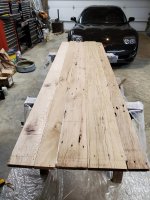
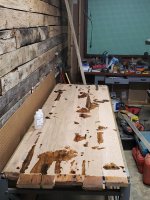
Here is a shot of it in the frame. I went over it one last time with some epoxy to make sure I got all of the cracks and holes filled well. Once I sand that down and get the frame squared I will be ready to cut the ends.

I also included a picture of some of the boards before I started. This whole thing was really just a trial run for me to learn some new skills and see if I might want to undertake a farmhouse table for the wife some day. I had never jointed and and trued boards, glue boards along edges, filled wood with epoxy, or used a hand plane. It isn't completely flat, as the old boards had some bows and twists that I wasn't able to get completely out. I decided to tongue and groove the edges and clamped them flat using steel angle when I glued them as an experiment to see if the glue would hold. As a result, the whole thing "rippled" a little when I let the pressure off it. But, the glue held. :rocker:

I was able to get it pretty smooth this weekend with a belt sander. I might go ahead and screw some plywood to it before I'm done. You can also see in the picture that I tested the end with some clear poly. It looks pretty good, but I think I will go ahead and finish it with an oil like you suggest. The great thing about it is that years down the road I can still take it off and make a couple of coffee tables if I want. Ones with stories and character. ;)
 

Attachments

  • fence boards.jpg
    fence boards.jpg
    119 KB · Views: 62
  • 20210301_064427.jpg
    20210301_064427.jpg
    129.4 KB · Views: 71
OP
J

JasonB.

Active member
Joined
Dec 29, 2020
Messages
38
Location
North Alabama
I picked up some BLO and put 3 coats on the top. I'm pretty happy with the results. I think this is going to serve the intended purpose well.
 

Attachments

  • 20210303_182624[1].jpg
    20210303_182624[1].jpg
    147 KB · Views: 74

wolfhawk73

Well-known member
Joined
Aug 27, 2016
Messages
164
Location
Eastern North Carolina
Polyurethane without a doubt. I did it on a plywood worktop, and it worked great. My first couple of coats tended to be about 2:1 thinner/poly to help it soak in and harden the surface a bit. l added a coat per day until it had 7 coats. Nothing ever stained it. Dents? Yeah, but it was a workbench.
 
OP
J

JasonB.

Active member
Joined
Dec 29, 2020
Messages
38
Location
North Alabama
I just wanted to do a quick follow-up on this bench. After putting 3 coats of BLO on it and allowing that to cure, I put the bench in service. Then I had a conversation with a friend that I hadn't talked to in a while who works for an industrial coatings company. He told me about a product they manufacture that is geared toward preventing graffiti and has silicone in the coating. After talking it over with him, I decided I would give it a try.

I went over the bench with some 0000 steel wool and then wiped it down with alcohol and followed with a tack cloth. Then I rolled the clear coat. It seems to be tightly adhered and unaffected by the previous BLO treatment. I'll give this a week or so to cure good and then I'll do some testing to see how it does.
 

Attachments

  • 20210429_064254[1].jpg
    20210429_064254[1].jpg
    64.1 KB · Views: 44

Firebrick43

Well-known member
Joined
May 12, 2015
Messages
13,992
Location
West central Indiana
I think you mean polyurethane. Polyethylene is plastic.

Polyurethane is a plastic as well. But yes, polyurethane can be formulated as a finish where polyethylene is typically formulated as a solid sheet.


To the OP, possibly put some 1/8 or 1/4 lexan on top? It would be somewhat expensive but would protect the wood while showing the beauty
 
To avoid these ads, REGISTER NOW!
Top Bottom