To avoid these ads, REGISTER NOW!

How strong is a rivnut???

Motofixxer

Well-known member
Joined
Oct 10, 2009
Messages
681
I was recently using rivet nuts (rivnuts) for the first time, after hearing about them for years...debating between the steel or alum. Then after I got done I got to thinking which one is stronger...or what can they hold.

So I jump on the ole YT and hey there's a vid showing the aluminum. So I'd assume the steel are stronger and hold more but at least gives me an idea.

 
To avoid these ads, REGISTER NOW!

WildBill

ALLIANCE MEMBER
Joined
Aug 20, 2021
Messages
1,976
Location
PNW
The stainless ones I use seem to break a lot easier than regular steel or aluminium ones, which makes sense. But they all hold pretty darn well, I have some steel ones in 1/4 20 size that I've repeatably torqued to around 50 ft/lbs without issue. Like in this video its usually smaller bolts that break when using them, or they rip the metal. I love them for dashboard and under the hood mounting points on older cars. And I use them to bolt stuff to the metal framing in my shop.
 

TurnipTruck

Well-known member
Joined
Aug 28, 2005
Messages
1,550
Location
Southcentral Alaska
I found empirically that a steel 5/16” rivnut rear sway bar mount will pull out of the frame on a 1968 Camaro while road racing, so I don’t use them on life critical automotive applications.
 

speed bump

Well-known member
Joined
May 28, 2008
Messages
6,317
Location
Butte Montana
They aren't particularly hard to make spin in bigger sizes. We have a dust collector at work that uses them to retain the bag cages to the tube sheet and every time we work on them we end up replacing several.

For the right application they are handy though.
 
To avoid these ads, REGISTER NOW!

no704

Well-known member
Joined
Apr 27, 2016
Messages
5,203
Usually plenty strong in a tension load. Not great in shear.
 

danielbuck

Well-known member
Joined
Apr 15, 2014
Messages
916
to keep from spinning, I put some red locktite around the barrel before squeezing it in. not really ever had a problem with them spinning in general (I use the ones with serrations along the barrel), but I figure it can't hurt.

I use rivet nuts quite alot. everything from 6-32 to 3/8". almost always steel.

Sacrifice a few of the rivet nuts on the bench with some scrap material to understand how much pressure it takes to properly seat them before you start using them in real world situations. If you're installing them with pneumatic or electric tools, you can write down how much PSI for pneumatic and what clutch setting on an electric drill. that way you know what settings you used the last time you used that size.

I used to be skeptical about how well they would hold up, but even in vehicle projects where there's alot of vibration they seem to hold up really well. Although I still sort of go by the "safety in numbers" mentality, and space them closer together than I would regular nuts and bolts... juuust to be sure :D
 
Last edited:

rlitman

Well-known member
Joined
Oct 18, 2010
Messages
24,576
Location
Long Island
to keep from spinning, I put some red locktite around the barrel before squeezing it in. not really ever had a problem with them spinning in general (I use the ones with serrations along the barrel), but I figure it can't hurt...
Loctite makes stud cement (mine's green) that's more appropriate than a thread locker. But you'll also want to use the primer, since rivnuts are generally plated with stuff that's not compatible with direct application of anaerobic thread locking compound.

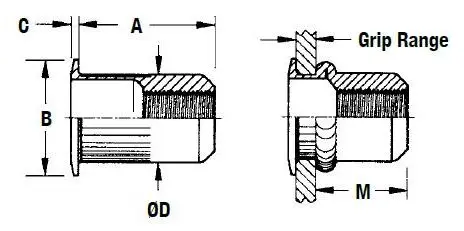
As for spinning, there are a number of styles of rivnuts, and you need to be cognizant of the "grip range". The "one piece" style for example, like this:
60c117d85b68858e0efeae6141f58afd.thumb.webp

has knurling behind the flange, but that's meant to hold against the back-side of the sheet, and if you look closely at the diagram, you should note how the insert does not expand into the hole, so if you try to use this style with a thin sheet (the minimum is often >1/8"), you increase the likelihood of spinning.

The "two piece" style like this:
lor&trimcolor=FFFFFF&trimTol=15&ixlib=csharp-3.2.1.jpg
snaps into two pieces as you begin pulling, driving the rear cone section into the front, and causing the front to expand outwards all the way up to the flange, grabbing the hole by the bore. This is less likely to spin when used on thin sheet metal.

There are also ones with hexagonal bodies, but darned if I know where to get the matching punch (for an amount I can afford).
 
OP
M

Motofixxer

Well-known member
Joined
Oct 10, 2009
Messages
681
The "two piece" style like this:
lor&trimcolor=FFFFFF&trimTol=15&ixlib=csharp-3.2.1.jpg
snaps into two pieces as you begin pulling, driving the rear cone section into the front, and causing the front to expand outwards all the way up to the flange, grabbing the hole by the bore. This is less likely to spin when used on thin sheet metal.

There are also ones with hexagonal bodies, but darned if I know where to get the matching punch (for an amount I can afford).

That's cool, didn't realize there was another style
 

rlitman

Well-known member
Joined
Oct 18, 2010
Messages
24,576
Location
Long Island
That's cool, didn't realize there was another style
Yep. The two-piece are awesome in sheet metal in a not too corrosive environment (these only come in plated steel). They pull about as easily as an aluminum rivnut, but with the all the benefits of steel threads (I've had too many aluminum ones strip out with repeated use). I've done a handful of one-piece stainless rivnuts with good success, but they require SO much force to pull that I'm always afraid something's going to break.

There's also the plusnut style that splits open wide like a molly, meant for use in plastic, or perhaps wood. Ideal for holding license plate bolts into a plastic bumper. And on that note, with the right mandrel, you can even use a rivnut tool to set mollys in drywall.
 
To avoid these ads, REGISTER NOW!
Top Bottom