To avoid these ads, REGISTER NOW!

How to balance a mA meter

MBfreak

MEMBER EMERITUS
Joined
Dec 10, 2010
Messages
2,301
Location
Linkoping , Sweden
Hi.

I am in the process of repairing a 70´s tachometer for a DeTomaso Pantera .
It is a Darsonval meter and has a 270 degree deflection. I want to keep the scale as is since it has a DeT logo and also text on it.
The meter coil was open circuit and I have rewound it, which was easy. But of course, the weight has changed and the movement needs to be statically rebalanced.
As long as the meter axis i vertical all is well, but when i turn it to be horizontal there is a shift of about 1/15 scal length in zero value. I balanced that out using tin based conduvtive paint and it now reads exactly zero both in hor and vert position.

With the meter axis vertical it is perfectly linear, buth when i turn it horizontal ( as it will be in the car) it becomes quite( >15%) unlinear, although the zero and full scale value are spot on. Is there a good write up on this somewhere? I am at a loss to understand the inaccuracy.

And no, I do not even consider sending it out for repair. Self repair is what counts to me! If it is a conked out washing machine or a ma-meter does not really matter. I repair things!, or try to at least.

All help much appreciated.

Ola
 
To avoid these ads, REGISTER NOW!

Greatbear

Well-known member
Joined
Jan 17, 2008
Messages
1,702
Location
Columbia/Fulton, MD
Not knowing how the movement is designed, I can only give some basic advice. With the meter movement "flat" (pivots vertical to the floor) balance does not play any part. In any other position, and especially with the axis parallel to the floor, any imbalance with the pointer and/or coil will affect your accuracy and zero positions.

Checking balance is easy. Zero the meter with the face horizontal, pivots vertical. Now, with the meter facing you, held with the face perpendicular to the floor, hold the meter so the pointer is vertical, pointing up. Note any drift from zero. Now turn the movement 180 degrees so the pointer is pointing straight down. Note any drift. If there is drift, it should be equal, but in an opposite direction. Now hold the meter with the pointer horizontal to the floor, pointing to the left. Again, note any drift from the set point. Turn the movement 180 degrees so the pointer points to the right. Any drift should be equal and opposing.

Most better d'Arsenval movements have a means to balance the movement. Where the pointer is attached to the coil, there is also three protruding arms, one opposite the pointer, and two perpendicular to it. Depending on how the meter is made, the coil can align perpendicularly with the axis of the pointer, parallel with it, and sometimes in some odd angle. Since you say you've rewound the coil, this will affect the balance in line with the coil axis. The weight of the wire, the lacquer used to seal it to the bobbin and any soldering at the pivots will affect the balance. Most of this type meter will have balance weights in the form of tiny coiled springs wrapped around each of these balance arms. These weights can be moved along the length of the balance arms to correct the balance.

To balance a meter, first determine that the pointer is straight and aligned to the coil/bobbin. Correct this first by gently tweaking with two sets of tweezers, one to hold the pointer and/or balance arms near the pivot, and another two "squeeze" the element at the bend area in the right direction. Try not to put any pulling or twisting force on the pivot, it can damage the pivot or pull it off of the coil assembly.

If the pointer is straight, go through the balance check exercise above. Balance in the "up-down" orientation is controlled by the weights on the arms perpendicular to the pointer. Balance in the "left-right" orientation is controlled by the tail weight opposite the pointer. It is very possible to have no change in one orientation and a drastic change in the other, or a change in all four orientations.

Let's say, for example, when the meter is held with the pointer up, the needle drifted slightly to the right (of scale) and to the left of scale when pointed down. The pointer is actually tending to the right physically when in either position. If you look at the two perpendicular arms, you can see that too much weight exists on the arm on the right when the movement is held pointer-up. Likewise, this can also be caused by too little weight on the left side arm. You can decrease the weight on the right arm by sliding the balance weight (the little coiled spring) towards the pivot centerline, or increase the weight on the left arm by sliding the weight away from the pivot. I lieu of sliding weighs, some meters use daubs of glyptal on the arms or coil bobbin, making rebalancing a bit of a pain.

Balancing the pointer in the left-right orientation is a bit more straightforward. If the pointer dips down , increase the weight of the tail balance by sliding the spring away from pivot center and retry until you've achieved balance in both directions. If the meter had its pointer repainted, the added weight of the paint will require more weight on the opposing balance arm. After correcting the balance in one axis, check the axis 90 degrees away, correct as necessary. If correcting balance in one axis (up-down or left-right) spoils the balance in the other, this indicates a bent pointer or balance arms that are not exactly 90 degrees apart.

I hope I made some sense here. I've been doing this sort of work for over 30 years, and it's a dying art. With instrumentation going digital or using stepper motors instead of repulsion movements, there's no more balancing acts to perform. Back when most test equipment had some manner of analog meters, this was part of normal performance testing and repair.
 

Thruxton

Well-known member
Joined
Dec 30, 2010
Messages
767
Location
Virginia
Greatbear, that is some amazing information! I have worked on my Porsche 928 instrumentation, and wish I had this in front of me at the time. Next time this will help me correct a small but nagging problem. Permanent file - many thanks.
 
OP
M

MBfreak

MEMBER EMERITUS
Joined
Dec 10, 2010
Messages
2,301
Location
Linkoping , Sweden
Greatbear!

Thanks a lot for the excellent information and a very well written write up "how to" .
I will spend some time this weekend trying to follow it and hope all will be well.

Again, thanks a lot!

Ola
 

jonee138

Member
Joined
Nov 13, 2012
Messages
5
Here is a good information about the relevent topic from also with research .
Ma Gauge Analogue, Resource Ma Gauge Analogue Items at Receptors, ...
DH sequence Electronic Current and Ampere meter and Can you get the leader to stability by going the money so they are not the same ... yards away from the fulcrum and the level of resistance one meter away....
 
OP
M

MBfreak

MEMBER EMERITUS
Joined
Dec 10, 2010
Messages
2,301
Location
Linkoping , Sweden
Thanks to GreatBear, the Pantera now has a tacho that is spot on!:rocker:

I used his excellent writeup and after some hours of work ( had to substitute the original Pantera movement with a 1976 KYORITSU 1 mA part, which took some time) only final assembly now remains.

Using GreatBears excellent write up worked perfectly. The remaining unlinearity is less than 1 % and since the meter is Class 1,5, I am more than satisfied!

GJ rox!

Ola
 

Attachments

  • mini-Pantera tacho-tweak balancing.jpg
    mini-Pantera tacho-tweak balancing.jpg
    53.9 KB · Views: 28
  • mini-Pantera tacho-tweak curve and weight.jpg
    mini-Pantera tacho-tweak curve and weight.jpg
    47.1 KB · Views: 21
To avoid these ads, REGISTER NOW!

ddawg16

Well-known member
Joined
Jul 11, 2008
Messages
21,005
Location
S. California
Greatbear...good rightup....

Balancing needle movements is becoming a lost art.....I used to do it all the time....circa Simpson 260 VOM's.
 

Greatbear

Well-known member
Joined
Jan 17, 2008
Messages
1,702
Location
Columbia/Fulton, MD
Glad I could be of some help! MBFreak, great work!

ddawg, back when I started in metrology/calib, I would probably be into the guts of various meters balancing them about 4-6 times a week, the majority of the better taken care of instruments wouldn't need a lot of balancing tweaks. The 260s and 269s, of which there were hundreds at the facility, would sometimes come in after being dropped or hit with a very large off scale input, sometimes bending the pointers so bad they'd read half scale just sitting there. Some of the sticky meters would need the pivots and jewels cleaned, a process that used some alcohol and pithwood slices and orangewood sticks carved to a sharp point. The pith wood was soft, like balsa or cork, and you basically pressed it onto the pivot tip until it stuck into it, spinning it to polish off residues and such. The sharp orangewood was poked into the recesses of the jewels and spun the same way. Not sure exactly was the orangewood was, except that it was free of sap or other residues, it was stuff already in the lab that predated me by 20-30 years or more. It was actually rather fun, and it became a bit of a spectator sport for other in the lab and visitors watching this huge powerlifting kinda guy hunched over these tiny mechanisms like a watchmaker.

Sadly, just about all of those old meters became obsolete and were dispositioned, including most of the old VOMs. Everyone wanted a Fluke handheld or an HP bench DMM. It was the old school guys as well as the savvier engineers and techs that held onto their Simpsons. I would find VOMs at hamfests and such for a song in need of some TLC, fix them up, calibrate them and give them to friends or sell them for a few bucks. I'd also fix up old automotive instruments, dash stuff as well as diagnostic stuff for restos as well. It can be tedious, but when approached with the right frame of mind and not rushed, it can be an almost zen-like exercise in patience and accomplishment.

The digital instruments these days, with their cold accuracy and repeatability are great, don't get me wrong, but there's something to be said going completely old-school and analog. It's also a surprise to find some new piece of gear that is old-fashioned at heart. I got one of those HF 500 amp battery load testing boxes not long ago, the one with two big meters for voltage and current. It's faithful to the original design that is at least 30 years old, the meters are well made and accurate, there is even internal calibration trimpots for keeping it tuned up. Out of the box it was pretty much dead on. The only thing that load box needed to make it really good was going through it and tightening up every single bolt and nut, especially on the current carrying terminals.

he other day a friend called me to tell me that he had gotten one of those cheap load testers with the single meter that have been around in one form or another forever. He told me he took it out of the box, hooked it up to a car battery close at hand and everything worked. He peeled the protective plastic film off the meter face and the meter got stuck somewhere at mid-scale, all screwed up. He exchanged the thing, came home, repeated the process with the same result. He asked me what would cause the meter to go bad peeling the plastic off. I told him to breathe on the meter face like trying to fog a mirror. "Huh?" Just do it. "Hey, it's fixed, wtf?" Static electricity on the plastic meter face so strong that it would attract the pointer to it and make it point like a compass at a magnet. Another common problem even with glass lenses and metal or bakelite cased meters.

Some stuff is practically lost to the ages these days. :lol:
 
OP
M

MBfreak

MEMBER EMERITUS
Joined
Dec 10, 2010
Messages
2,301
Location
Linkoping , Sweden
A bit off topic, but since the Pantera tacho now is reunited with its donor vehicle ( which sist ready to disgorge a crate 427 once it arrives thru customs) here is my take on multimeters.

In all of my hobby electric/tronic repair activities I use FLUKE 87 for more or less everything.
I also have a FLUKE handheld scope, 2 channels, but that mostly sits in a box.
Scoping is done with a TEKTRONIX 465 on the bench jobs.
The menu tree , or rather forest, on the fluke scope is so extensive that I have to think more of how to navigate in it than what I actually try to measure. But on the go, I use it.

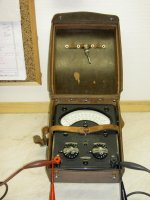
Multimeters with movements? Yes, I grew up and went thru school with them. Used AVOmeter 8 and various UNIGORs up until 75, then it was digital and AVOs. Since 90, I use an AVOmeter 8 just for fun on and off.

But, they certainly look cool. A Simpson 260 is high on my list of nostalgia must haves!

The coolest meter I have is a Weston Electrodynamic Wattmeter from 1927. Works perfectly, cl 0,5 AND RECENTLY CALIBRATED, and is a real beauty. Have used it ONCE, when load testing the FUTURLINER 9,5 kVA generator after completion.
 

Attachments

  • PICT1054.jpg
    PICT1054.jpg
    138.7 KB · Views: 8
To avoid these ads, REGISTER NOW!
Top Bottom