To avoid these ads, REGISTER NOW!

How to do plumbing stub outs?

Innovate1

Well-known member
Joined
Jul 28, 2014
Messages
4,300
Location
Illinois near St. Louis, Missouri
Planning to do PEX for a half bath and a run to an outside faucet on the other side of the building. Haven't worked much with PEX and planning to use the crimp rings. Have seen the shut offs that go directly on PEX but was thinking I wanted something a little more solid although not sure I need it. So my choices for termination seem to be. Opinions on these?

Drop ear elbow. Good support but requires some extra parts.

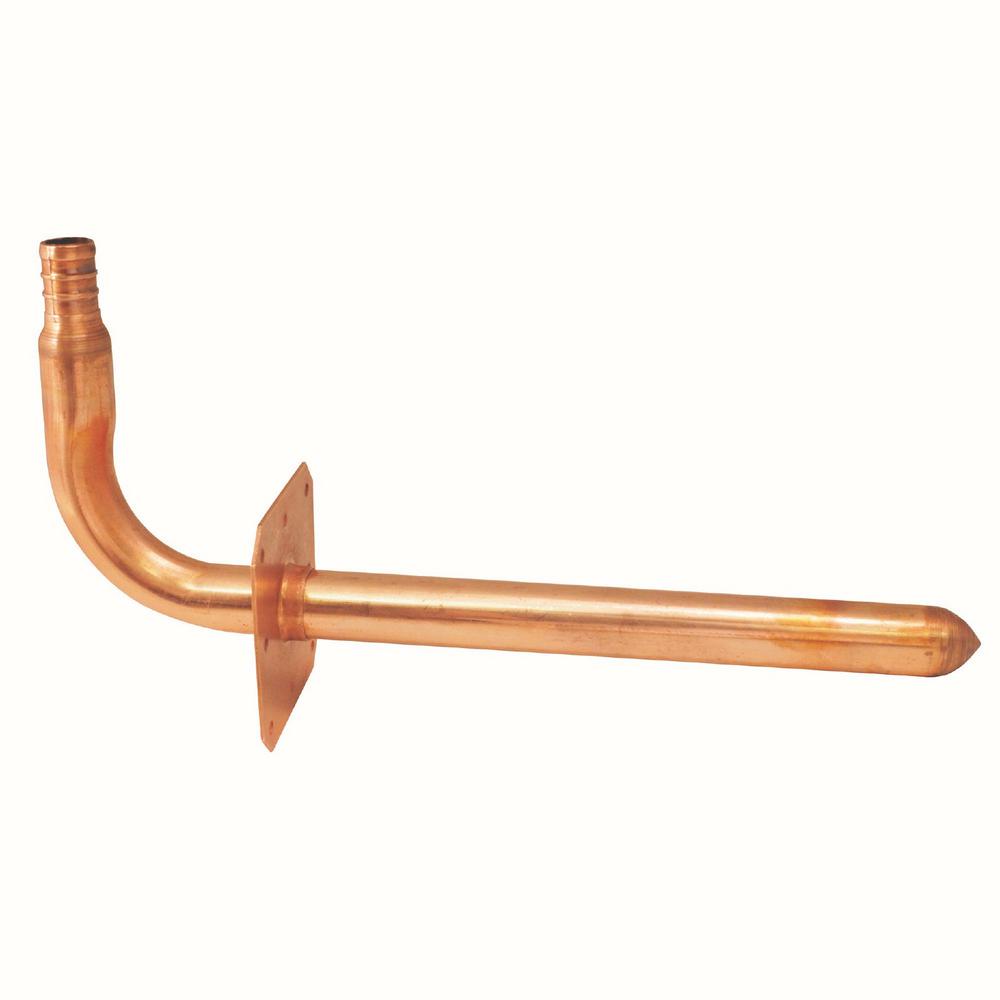
Copper stub out. Decent support but requires a compression valve. Have heard some problems with leaks.

PEX guide. Mounts valve on end of PEX. Least support but least parts/expense.
 

Attachments

  • DropEar.jpg
    DropEar.jpg
    45.1 KB · Views: 121
  • Stubouts.jpg
    Stubouts.jpg
    41.7 KB · Views: 117
To avoid these ads, REGISTER NOW!

klassenl

Well-known member
Joined
Feb 20, 2016
Messages
715
Location
Southern Alberta
In the years I worked with my dad all we ever did was leave the pipe sticking out of the wall and made sure it was fastened properly in the wall.
 
Last edited:

nadogail

Well-known member
Joined
Jan 23, 2009
Messages
32,061
Location
Coronado, CA
I agree with the drop ear elbows because without them the PEX would be unsupported and replacement of angle stops would be problematic.
 

egdede

ALLIANCE MEMBER
Joined
Dec 20, 2009
Messages
2,103
disclaimer; I've only looked at Uncle zane's pex work on the farm. Uncle Zane used copper elbows with thin copper hangers that you slide sticks of copper pipe through to fasten the copper to joists, whatever. He then put a drop of solder on the where the pipe met the hanger, saved $10 each drop elbow, and seemed solid enough:

https://www.zoro.com/mueller-industries-pipe-hanger-cast-brass-12-a-03167/i/G3199926/

I have seen alot worse 'on the farm', that's for sure.

Other than that, I used elbows designed for copper pipe when i sweated copper in my basement workshop for the sink stub-outs because they are so solid, and they make a nice clean transition!
 

Jackfre

Well-known member
Joined
Dec 26, 2010
Messages
4,417
Location
N CA
Being an old plumber I roughed in my homes remodel all with drop ear 90's and then a ****** and a cap until trim. On the trim out I removed the cap and put on an IPS angle stop. Over a two year period every one of the valves cracked and leaked. With the low lead and how thin they make the stops they just did not hold up. I would use the long copper 90 and put a compression stop on. None of those have leaked.
 

yeldogt

Well-known member
Joined
Jan 2, 2012
Messages
18,184
Being an old plumber I roughed in my homes remodel all with drop ear 90's and then a ****** and a cap until trim. On the trim out I removed the cap and put on an IPS angle stop. Over a two year period every one of the valves cracked and leaked. With the low lead and how thin they make the stops they just did not hold up. I would use the long copper 90 and put a compression stop on. None of those have leaked.


I like the stub outs --- thread in a ******. As Jackfre found out - you have to buy decent valves from a supply house ... or get NOS Chicago or the like on e-bay.

I like Aqua for freeze proof ... but they are more money
 

Balvar24

Well-known member
Joined
May 18, 2016
Messages
870
Use copper stub with compression angle stop. Drop ear for shower head.
 

dagofast

Well-known member
Joined
Oct 15, 2006
Messages
411
Location
The QC in AZ
Our house was built in 2017 and they used Pex lines with the copper stub outs(like pictured above) for the water stops. The water stops are a plastic valve that uses a push on with a CW twist motion to install them. They have a round disk that pushes in to stop the water flow and pulls out to turn the valve back on.

Later houses built in our neighborhood used all Pex, even for the stub outs. There was a plastic frame nailed to the stud that the Pex was routed through that made a gentle 90* and clamped the Pex in. The same water stop valves were used after finishing.

The cordless tool they used for installing the Pex on to any T or elbow fittings was pretty cool. It had fingers that they stuck inside the Pex and then it stretch expanded the Pex until the fitting could be easily pushed in. They would hold it for about 10-15 seconds until the Pex shrunk back down and there was no getting that line off after that. No crimping, no leaks.
 
Last edited:
OP
I

Innovate1

Well-known member
Joined
Jul 28, 2014
Messages
4,300
Location
Illinois near St. Louis, Missouri
Copper stub out. Then sweat on a male adapter.

Are you suggesting adding the male thread adapter before or after the pex crimp? There isn't much length between the pex and the soldering. I don't have a mapp gas torch so would be worried I would melt the pex if done after. Mapp gas MIGHT make it quick enough but still seems risky.

They make trim covers for the wall holes that can be put on with the end in place - some are hinged and some are split plastic that can be flexed.
 
Last edited:
OP
I

Innovate1

Well-known member
Joined
Jul 28, 2014
Messages
4,300
Location
Illinois near St. Louis, Missouri
If I use standard copper pipe and elbow that is easy but I still need a transition to pex. Cheaper to put together but a lot more trouble than the prebent 90. I have several new good brand compression stops. Will probably go with those.
 
To avoid these ads, REGISTER NOW!

Git

Well-known member
Joined
May 18, 2008
Messages
6,894
Location
S Cal
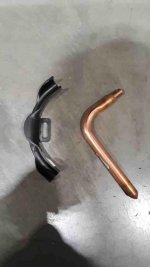
Around here, they use a bracket like this that gets nailed to two studs. Then the stub out is soldered to the bracket

attachment.php


YouTube
 

Attachments

  • TRI - 002.jpg
    TRI - 002.jpg
    55.8 KB · Views: 328

rlitman

Well-known member
Joined
Oct 18, 2010
Messages
24,681
Location
Long Island
Are you suggesting adding the male thread adapter before or after the pex crimp? There isn't much length between the pex and the soldering. I don't have a mapp gas torch so would be worried I would melt the pex if done after. Mapp gas MIGHT make it quick enough but still seems risky.

They make trim covers for the wall holes that can be put on with the end in place - some are hinged and some are split plastic that can be flexed.


Attach the plate on the stub out to the framing. Leave the closed end of the stub closed and PRESSURIZED during sheetrocking/finishing. That way you KNOW that nobody broke anything in the walls while sealing them up.

When you’re ready to add valves, turn off the water, cut the end off the stub out, drain the water, slide on a one piece escutcheon, and sweat on the male adapter. You will NOT melt the PEX. A male adapter has hardly more mass than the pipe, so unlike sweating a valve, it requires very little heat to sweat. Propane is fine.

Lastly, use a good pipe dope, use a backing wrench to hold the pipe in place, and gently screw on the valve. As pointed out above, it is VERY easy to crack a lead-free brass female fitting.

The backing wrench is important. I’ve seen one stub spin as the valve was installed, tearing the PEX in the wall in the process.
 

Norcal

Well-known member
Joined
Mar 16, 2008
Messages
13,770
Around here, they use a bracket like this that gets nailed to two studs. Then the stub out is soldered to the bracket

attachment.php


]

They work very well & easy to use, off topic sometimes they come into scrap yards brought in by people who think they hit the copper jackpot, only to find out they are plated steel.
 

theoldwizard1

Well-known member
Joined
Feb 22, 2011
Messages
43,335
Location
SE MI
The cordless tool they used for installing the Pex on to any T or elbow fittings was pretty cool. It had fingers that they stuck inside the Pex and then it stretch expanded the Pex until the fitting could be easily pushed in. They would hold it for about 10-15 seconds until the Pex shrunk back down and there was no getting that line off after that. No crimping, no leaks.

Yes, very cool, but it requires a special type of PEX and there is also a ring that is expanded with the pipe. The tool is not cheap, and the special Pex is more expensive, but if you are doing dozens of connections every day then it is probably worth the cost.
 

theoldwizard1

Well-known member
Joined
Feb 22, 2011
Messages
43,335
Location
SE MI
Around here, they use a bracket like this that gets nailed to two studs. Then the stub out is soldered to the bracket

attachment.php
They make a galvanized steel version if this bracket that has plastic inserts for the pipe to pass through.

Whatever you choose just make sure it is well supported.
 

Jeepster04

Well-known member
Joined
Jun 25, 2013
Messages
3,103
I personally like the copper stubs. Looks better, you can anchor it really well, and it makes changing out the valve much easier in the future.
 
To avoid these ads, REGISTER NOW!
Top Bottom