To avoid these ads, REGISTER NOW!

How to flatten a large steel plate

B-Olsen

Member
Joined
Aug 28, 2025
Messages
7
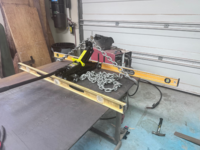
I am making a workbench with a 74" X 39" X 3/8" thick steel plate. The plate is not flat. Any recommendations on flattening the plate? I do have an oxy/acetylene torch. If I use a torch which side of the curve, should I heat up? Or any other recommendations would be grateful. The plan is to attach a 3/4" thick melamine sheathing on top of this plate for woodworking and I want it as flat as flat can be. Once I get it flat, then I am thinking of applying a liquid epoxy or glue over the steel plate and laying the melamine down to float on the liquid and that may flatten out any remaining curves.

Thanks!
Picture1.jpg
Picture2.jpg
Picture3.jpg
Picture4.jpg
 
To avoid these ads, REGISTER NOW!

niget2002

Well-known member
Joined
Oct 2, 2012
Messages
11,203
Location
Josephine, TX
I can't tell how far it's off, but yeah, putting a lip on it and using some leveling epoxy might be your easiest bet.

If it wasn't welded to the sub frame, I was going to say to use shims to level it on the sub frame and use welded on bolts and nuts to pull it tight.
 

whateg01

Well-known member
Joined
Mar 13, 2006
Messages
11,404
Location
doo dah, kansas, usa
Can't really tell how it's not flat. Is the top concave? Is it just bowed in one direction? Is it twisted?

If it's cupped in the middle heat shrinking it is where I would start. If it's bowed, I would probably try heating it along the bow.

I would say if you want it truly flat, get it Blanchard ground. But that is a little over the top for the application I suppose. It'll bend some to take the shape of the frame it's bolted to, too.

Another thing you could do is get it close, then use a couple sheets of mdf with shims to give you a better flat surface. I don't see a lot of woodworkers using steel tables.
 
OP
B

B-Olsen

Member
Joined
Aug 28, 2025
Messages
7
Can't really tell how it's not flat. Is the top concave? Is it just bowed in one direction? Is it twisted?

If it's cupped in the middle heat shrinking it is where I would start. If it's bowed, I would probably try heating it along the bow.

I would say if you want it truly flat, get it Blanchard ground. But that is a little over the top for the application I suppose. It'll bend some to take the shape of the frame it's bolted to, too.
I have not welded it to the frame yet. It is cupped. one side is curved up from the center and then there is a slight curve up in the center also. should I heat from inside the cup (bottom) or the top?
 

whateg01

Well-known member
Joined
Mar 13, 2006
Messages
11,404
Location
doo dah, kansas, usa
I have not welded it to the frame yet. It is cupped. one side is curved up from the center and then there is a slight curve up in the center also. should I heat from inside the cup (bottom) or the top?
Top, but depending on how much heat you put in, it might not matter. You need the center of the plate to shrink. It won't be as dramatic as sheetmetal, but if you want to see how it works, watch some metalshaping videos.
 

Muckin_Slusher

Well-known member
Joined
Apr 1, 2017
Messages
465
Location
Abitibi
When you heat the steel it expands, but if it cannot expand (if it is constrained) then it will deform/upset/crush and once cooled it will "be smaller"

As I understand it, you heat the side you want to shrink.

You can speed the flame straightening process by constraining, as seen below:


From irate4x4:


2 bottles of oxygen in. Just about there!!! I got a GoPro and recorded what I was doing. Took a few different shots hopefully I can make a decent video for you guys.

9EC7F887-B675-405F-9169-9F7993E7EB23.jpeg


69DE17FB-2F7E-46D0-9195-7B648BDA0730.jpeg


1571615F-A4B2-4EB5-BBA3-D1050648CD5F.jpeg
 

KwikFab

Well-known member
Joined
Jul 27, 2024
Messages
1,213
Location
Central Valley, CA
Make your frame underneath as square as possible. Ensure the frame is also level as any twist can lead to a top that isn't fully square.

Clamp to said frame and check for flatness and adjust as needed.

Weld to the frame.

Pretty easy stuff, and even large plate like that won't be flat even brand new. I buy new 4' x 8' sheets every other day and none of them will ever be truly flat (and it's crazy clean without a scratch on it).
 

LXCam

ALLIANCE MEMBER
Joined
Apr 23, 2013
Messages
19,175
Location
AZ
Identify the apex of the convex side. It sounds like you might have two spots. You can try flame straightening it by heating that area red hot and letting it completely cool. But my method is a hot heavy weld bead a couple inches long and space a few inches apart. I suggest you get a good measurement so you can gauge your success or failure 😉
 

whateg01

Well-known member
Joined
Mar 13, 2006
Messages
11,404
Location
doo dah, kansas, usa
Identify the apex of the convex side. It sounds like you might have two spots. You can try flame straightening it by heating that area red hot and letting it completely cool. But my method is a hot heavy weld bead a couple inches long and space a few inches apart. I suggest you get a good measurement so you can gauge your success or failure 😉
He wants to put a laminate on top. Any welding he does will have to ground off afterwards.
 

jack stand

Well-known member
Joined
Feb 29, 2012
Messages
3,346
Location
Lakes Region Maine
Kinda seems like you built a very nice welding table more than something for woodworking.
IMHO any wood is less stable (with moisture changes) than that table is and the minor deviations from flat are not important for gluing up a dresser or tabletop.
Precision woodworking is "the little marks" on a tape measure where it's measured by the thousands with precise dial indicators in precision steel fabrication.
 

Fixr

Well-known member
Joined
Dec 23, 2012
Messages
9,708
Location
SW VA
I don't see the point of using an expensive piece of steel plate and then gluing melamine to it. I'm not seeing all of that heavy steel providing any advantage for a woodworking bench. Plywood seems more appropriate, maybe with a layer of MDF to provide a really smooth gluing surface.
 

mike93lx

ALLIANCE MEMBER
Joined
Dec 9, 2013
Messages
37,805
Location
Richmond, VA
I don't see the point of using an expensive piece of steel plate and then gluing melamine to it. I'm not seeing all of that heavy steel providing any advantage for a woodworking bench. Plywood seems more appropriate, maybe with a layer of MDF to provide a really smooth gluing surface.
This.

A torsion box would be far flatter and more than strong enough for wood working. Even if I had the steel for free, I don't think I would use it in this manner
 
To avoid these ads, REGISTER NOW!

kaymccampbell

Well-known member
Joined
Feb 27, 2015
Messages
29,594
Location
Upstate New York
Steel really isn't the preferred woodworking bench material. My big wood bench is laminated from two layers of really nice flatter 3/4 plywood, with a perimeter and ribs of 3/4 ply between them. Makes a little over 2 inch thick flat and stable top.

I reserved my steel for the big metal bench in the metal shop.
 

KwikFab

Well-known member
Joined
Jul 27, 2024
Messages
1,213
Location
Central Valley, CA
I don't see the point of using an expensive piece of steel plate and then gluing melamine to it. I'm not seeing all of that heavy steel providing any advantage for a woodworking bench. Plywood seems more appropriate, maybe with a layer of MDF to provide a really smooth gluing surface.

Not being a wood worker myself, I had wondered why the OP was using a steel plate at all. Just didn't say anything cause I'm clueless with wood working.

But my method still stands as a means of ensuring it is flat when welded to the frame. It's also super quick and easy.
 

MOS3522

Well-known member
Joined
Nov 6, 2022
Messages
1,791
Location
Colorado
If flat steel is key to you, like a welding table, then go out and get a new piece. That pieces won't ever be straight as long as it's welded to a frame.
 

KwikFab

Well-known member
Joined
Jul 27, 2024
Messages
1,213
Location
Central Valley, CA
The best way to ensure it stays flat when welded to a frame is to not weld it to a frame.

While I agree, welding distorts metal (I'm a welder), you don't fully weld it up to limit distortion.

That steel plate won't be as flat as we want it (or expect it) to be IE a welding fixture style table.

With that said, you would place the metal with the bow in the middle sticking up as a hump. Short stitch welds (along with it being clamped to a square frame) would bring in the hump to ensure it is even more flat.

I've welded many large 8' to 20' assemblies and structures that had to be within 1/8" tolerance (or better for stainless). They were large conveyor assemblies for food packaging.

So yeah it is 100% possible to weld that top and keep things flat (and even make it flatter than it is now).
 
OP
B

B-Olsen

Member
Joined
Aug 28, 2025
Messages
7
I don't see the point of using an expensive piece of steel plate and then gluing melamine to it. I'm not seeing all of that heavy steel providing any advantage for a woodworking bench. Plywood seems more appropriate, maybe with a layer of MDF to provide a really smooth gluing surface.
Unless I buy a 2" thick maple top plywood does not remain flat. I like to use melamine bench tops for woodworking because of the easy glue clean up and it takes a beating. The steel plate is only to hold the melamine flat without the edges rolling down. I will then only bolt the melamine to the steel plate, then I can remove the melamine to have a welding table. :)
 
OP
B

B-Olsen

Member
Joined
Aug 28, 2025
Messages
7
This.

A torsion box would be far flatter and more than strong enough for wood working. Even if I had the steel for free, I don't think I would use it in this manner
I agree, however, then the edges are too thick to clamp anything down within reason.
 

mike93lx

ALLIANCE MEMBER
Joined
Dec 9, 2013
Messages
37,805
Location
Richmond, VA
I agree, however, then the edges are too thick to clamp anything down within reason.
You can easily do a torsion box that is under 2" thick.

I'd probably grab 2 sheets of high quality 1/2 ply and use it for both the top/bottom as well as the grid, making the grid something like 1.25-1.5" thick, depending on what worked well with the cut offs

If you make the grid around 4" thick, you can drill holes in the top to put clamps anywhere. Check out a Paulk workbench
 
Last edited:

Fixr

Well-known member
Joined
Dec 23, 2012
Messages
9,708
Location
SW VA
Unless I buy a 2" thick maple top plywood does not remain flat. I like to use melamine bench tops for woodworking because of the easy glue clean up and it takes a beating. The steel plate is only to hold the melamine flat without the edges rolling down. I will then only bolt the melamine to the steel plate, then I can remove the melamine to have a welding table. :)
I somehow had the impression that you were going to glue the melamine to the steel plate. If not, that's a whole different scenario. Sounds like you have a plan.
 
OP
B

B-Olsen

Member
Joined
Aug 28, 2025
Messages
7
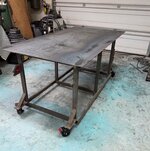
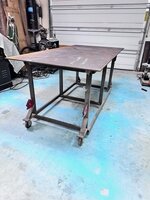
I gave up on the 3/8" steel plate and installed a 1/4" steel plate that was much much more flat! I then can unbolt the melamine and have a welding table!! If and when the melamine becomes too damaged (I had a melamine top work bench for 20+ years prior) i can easily replace it. This is a dream workbench!! Thank you for all your help!

Bench_Final 1.jpg


Bench_Final 2.jpg
 
To avoid these ads, REGISTER NOW!
Top Bottom