To avoid these ads, REGISTER NOW!

How To Get Angle for Parallel Kicker Brace Between Trusses

airman89

Well-known member
Joined
Nov 29, 2023
Messages
72
This is probably a stupid question and I’m sure I’m over thinking this but I’ve used multiple calculators and my 6 or 7 cuts now have all been off…

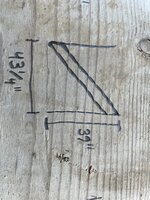
I have 39” height and 43-1/4” width between trusses. The cuts on this kicker board are parallel and the board runs from bottom chord of gable truss to top chord of the next truss. The calculators show angles/lengths for a board running from a vertical plane up to a horizontal plane, not vertical to vertical (parallel). Hopefully this isn’t too confusing, I can draw up a sketch if I need to.

Can anyone give me some incite on how to get the correct angle and length for the cuts. I watched RR Buildings but he specifically said in his one video that he won’t go into the details of how he got the measurement.
 
To avoid these ads, REGISTER NOW!

johnre

Well-known member
Joined
Dec 1, 2016
Messages
1,049
Location
Portland, OR
Use formula
Angle = (180/pi) * arctan (( height - lumber thickness) / width )

Using height = 39, width = 43.25, and stock thickness = 1.625, I come up with 40.8 degrees.

This is close BTW but not exact - if you want closer, multiply the stock width above by 1/sin(Angle) from above, and throw it back into the original formula. This gave me 40.2 degrees the second time, close enough.
 
Last edited:

geneg

Well-known member
Joined
Oct 19, 2020
Messages
467
Location
Midwest
Use formula
(180/pi) * arctan (( height - lumber thickness) / width )

Using height = 39, width = 43.25, and stock thickness = 1.625, I come up with 40.8 degrees.
I agree with the above. Any of the trig functions will work. Right angle formula, etc. The only qualification is that 2x material is now 1-1/2" thick, not 1-5/8. Also use a piece of cardboard to make your templet. Or 2 pieces of string- 1 for the top length, 1 for the bottom length. Mark your brace with them
 

Firstram

Well-known member
Joined
May 16, 2017
Messages
1,391
This is probably a stupid question and I’m sure I’m over thinking this but I’ve used multiple calculators and my 6 or 7 cuts now have all been off…

I have 39” height and 43-1/4” width between trusses. The cuts on this kicker board are parallel and the board runs from bottom chord of gable truss to top chord of the next truss. The calculators show angles/lengths for a board running from a vertical plane up to a horizontal plane, not vertical to vertical (parallel). Hopefully this isn’t too confusing, I can draw up a sketch if I need to.

Can anyone give me some incite on how to get the correct angle and length for the cuts. I watched RR Buildings but he specifically said in his one video that he won’t go into the details of how he got the measurement.
The answer is always “full scale layout” on something that small.
 

CraigStu

Well-known member
Joined
May 22, 2014
Messages
4,027
Location
Blacksburg, Va
Will these boards be finished? Part of a ceiling? Or would get in the way of ceiling sheathing? I am trying to figure why you need such accuracy for something going between trusses.
 
To avoid these ads, REGISTER NOW!
OP
A

airman89

Well-known member
Joined
Nov 29, 2023
Messages
72
Use formula
Angle = (180/pi) * arctan (( height - lumber thickness) / width )

Using height = 39, width = 43.25, and stock thickness = 1.625, I come up with 40.8 degrees.

This is close BTW but not exact - if you want closer, multiply the stock width above by 1/sin(Angle) from above, and throw it back into the original formula. This gave me 40.2 degrees the second time, close enough.
Thanks for this that’s exactly what I needed. Some of these trusses were weathered so that’s not helping my measurements.

Put a string line where you want the 2x4, then duplicate the angle with a sliding t-bevel.

This is what I’ll probably be doing for the rest of them.

I agree with the above. Any of the trig functions will work. Right angle formula, etc. The only qualification is that 2x material is now 1-1/2" thick, not 1-5/8. Also use a piece of cardboard to make your templet. Or 2 pieces of string- 1 for the top length, 1 for the bottom length. Mark your brace with them

The string is a good idea to get both the parallel angles and length. With the top string I could get all my measurements.


Will these boards be finished? Part of a ceiling? Or would get in the way of ceiling sheathing? I am trying to figure why you need such accuracy for something going between trusses.

No these are just rough cut braces inside standard trusses. I just wanted to make things a little easier by having all the measurements and making all the cuts on the ground.

Any reason you can't lay a board on there , draw lines & cut on the lines?
 

geneg

Well-known member
Joined
Oct 19, 2020
Messages
467
Location
Midwest
Thanks for this that’s exactly what I needed. Some of these trusses were weathered so that’s not helping my measurements.


This is what I’ll probably be doing for the rest of them.


The string is a good idea to get both the parallel angles and length. With the top string I could get all my measurements.


No these are just rough cut braces inside standard trusses. I just wanted to make things a little easier by having all the measurements and making all the cuts on the ground.
Real quick & easy- get them where you want & glue & screw a plywood gusset to the faces of both cords or a 2x at whatever angle works
 

geneg

Well-known member
Joined
Oct 19, 2020
Messages
467
Location
Midwest
Look up spiling in boat building.

Yet another method! I was referring to just screwing the gusset to the sides, but spiling would get the inset exact.
Lots of construction took place without lasers & calculators. I amazed one of my sons by levelling a barn door header with a piece of clear vinyl tubing & some water.
 

Firstram

Well-known member
Joined
May 16, 2017
Messages
1,391
Yet another method! I was referring to just screwing the gusset to the sides, but spiling would get the inset exact.
Lots of construction took place without lasers & calculators. I amazed one of my sons by levelling a barn door header with a piece of clear vinyl tubing & some water.
A water level is still the best method ever when you’re crawling around under a house trying to jack it level.
 

The Cobbler

Super Moderator
Staff member
Joined
Oct 24, 2013
Messages
25,876
Location
Niagara Region, Ontario, Canada
I amazed one of my sons by levelling a barn door header with a piece of clear vinyl tubing & some water.
I hung thousands of sqft of suspended ceiling in the 80's using 50' of clear vinyl hose , a windshield washer bottle full of water & a truck tire valve to join the two .
Now, apparently the only way to do the same job is with a laser level that costs who knows how much.
 

Viper98912

Well-known member
Joined
Oct 20, 2012
Messages
1,127
Location
GA
Use formula
Angle = (180/pi) * arctan (( height - lumber thickness) / width )

Using height = 39, width = 43.25, and stock thickness = 1.625, I come up with 40.8 degrees.

This is close BTW but not exact - if you want closer, multiply the stock width above by 1/sin(Angle) from above, and throw it back into the original formula. This gave me 40.2 degrees the second time, close enough.
This is correct, although you can put your graphing calculator into degrees instead of radians and not need the 180/pi.

Also, the original calculation is actually kinda tricky (as johnre stated) because you actually don't know the width of the lumber you need to remove from the height because it's at an angle (the angle you don't know...). But as stated, if you're at 40 or 41 degrees, you should be way more than fine.

And for me, if I can't place a board in place and just trace the line I need to cut with a pencil (because let's say it interferes with how the perpendicular members are coming in), then on the third cut [after cursing a few words at the second one] I just start roughing it in and cut it back sliver by sliver till I get it close enough. I normally have this happen when doing crown moulding and you realize that both the wall corner is not 90 and the ceiling-to-wall is also not 90. And when using a 52/38 crown, and two angles that are not 90, yea forget it I'm just going to rough it and then walk it back.
 

firebirdparts

Well-known member
Joined
Jun 8, 2016
Messages
10,607
Location
Kingsport, TN
The math here is super easy, but remember the board is not point-to-point. One edge is.

But anyway, you can use trig or you can use pythagorus. Eiyher way.

The angle you're going to cut is the anti-tangent of 39/43

The length along one edge is the square root of 39^2 + 43^2. pretty simple.

Those are two separate bits of information and so that might have been an issue.
 
To avoid these ads, REGISTER NOW!
Top Bottom