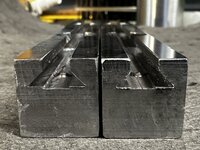
Last time I drilled the hole with the next letter size drill smaller than the ⅛” ball. Then drilled and tapped the back of the hole slightly larger to receive a set screw to apply adjustable pressure to the spring behind the ball.No experience with this but will be interested in the responses. I think the amount exposed would depend on how much detent force you wanted - more exposed would require more force to move. And a drill size just slightly bigger than the ball but just a guess.
In this design the dovetail retains the part, but the ball detent stops it at the correct position to index.-Interesting question to ask. My first thought would be just how much "retention" was wanted. A momentary reference for indexing or a stay that will hold/lock components in place? Some of that would also depend upon the backing spring of course. All machinery/tooling I've made required free movement and a positive lock at designated position. Any minor amount of drag/friction was part of the gib adjustment. I've used a ball detent in some designs but it was to assist locking instead of a tapered pin. I can see where a spring loaded ball detent would be useful, I just haven't had to make something like that. Am curious now.
-How much accuracy does the location require? Yes I know accuracy is a relative word. For indexing mechanisms a tapered pin and matching notch works well when spring loaded. That's what I've used the most. An example would be the Harig type grinding heads and how they hold indexed position.In this design the dovetail retains the part, but the ball detent stops it at the correct position to index.
The ball detent is to just get it in the ball park. This is an interchangeable soft jaw system for a vise. Pins align the two sets of the soft jaws, but the ball detent helps to center in vise. A dovetail lock secures in place.-How much accuracy does the location require? Yes I know accuracy is a relative word. For indexing mechanisms a tapered pin and matching notch works well when spring loaded. That's what I've used the most. An example would be the Harig type grinding heads and how they hold indexed position.
-A good enough method for approximating location. Ball detents won't provide a lot of accuracy and you're already providing positive location with the pins. Is there something you want to improve with the method/process/dimensions/tooling you've been using? How can I help?The ball detent is to just get it in the ball park. This is an interchangeable soft jaw system for a vise. Pins align the two sets of the soft jaws, but the ball detent helps to center in vise. A dovetail lock secures in place.
-A good suggestion I had forgotten about. I have sometimes used the CAD models from product manufacturer sites to "extract" data/dimensions from existing designs instead of re-inventing the wheel. I've also used a lot of Vlier products over the years, always with good results. Thans for reminding me larry_g.
Have you perused the above site? We used a lot of them in our manufacturing machines years ago. The site has spec's and cad drawings of the items that you might be able to glean some information from.
lg
no neat sig line
-I have the book in front of me (20th edition) and attempted to find the formula under: ball, detent, spring, plunger, and no results. It may be online or in a newer edition but not mine.I don’t have the book in front of me, but there is a formula for size and depth for a ball detent in the Machinery Handbook.
Couldn't find anything in my 21st edition either, not saying there isn't anything in there on ball detents but I couldn't find it.-I have the book in front of me (20th edition) and attempted to find the formula under: ball, detent, spring, plunger, and no results. It may be online or in a newer edition but not mine.
Side note- Do printed fonts shrink over time?
-Mine is coming apart at the binding from use. I'm retired now so don't guess I'll need a new one.Need to pick up a more modern edition sometime.
I actually have 4 copies at present but the 21st is the newest. They are dirt cheap on ebay unless you're after a current or almost current edition.-Mine is coming apart at the binding from use. I'm retired now so don't guess I'll need a new one.
-Bought mine new in 1979 when I was fairly new in the trade, have worn the binding out from constant use. Your 1919 edition must be interesting to thumb through. A lot of line drawings reproduced from pen & ink? Vellum reproductions and onion skin overlays too? Things were designed differently back then. Even handwheels had a vaguely art deco look as industrial designs became more refined during that period. Nice that you found it....or it found you.I recently got a very nice example of the 5th Edition from 1919, though more for historical reasons than actually using.
I don't think it's a whole lot different in construction to editions from the 40's. It's all printed paper, nice gilt edges, doesn't look like it's ever been in a machine shop, Mr B. H. Stagg who signed the title page must have really looked after it.-Bought mine new in 1979 when I was fairly new in the trade, have worn the binding out from constant use. Your 1919 edition must be interesting to thumb through. A lot of line drawings reproduced from pen & ink? Vellum reproductions and onion skin overlays too? Things were designed differently back then. Even handwheels had a vaguely art deco look as industrial designs became more refined during that period. Nice that you found it....or it found you.