Often, I need a special spring which can't be sourced from the spring selection at the local hardware store. Sometimes, not even specialty suppliers have the correct one, or their minimum order quantity is absurd for what I need.
The recent "useless tools" thread reminded me about how the lathe is a generally under-appreciated shop tool. There are so many jobs a lathe can do besides turning simple shafts and bushings. Making springs is one of those jobs.
MATERIALS
To wind a spring you need to begin with the right material. An ideal spring material has a large area under the stress-strain curve. That is to say, the material is capable of storing a large amount of potential energy though elastic deformation. Baling wire and safety wire are not suitable for making springs because they do not have a high enough yield strength. As a result, the area under the stress-strain curve is relatively small and the wire deforms plastically instead of elastically.
The basic wire for making springs is spring temper 1080 drawn wire, also known as "music wire." Manufactured per ASTM A228, it has an ultimate tensile strength of 300,000 PSI to 400,000 PSI, about seven times the tensile strength of baling wire.
Music wire is sold in coils by weight and arrives "bent" from the coiling process. The wire must be straightened either with a wire straightener or by hand. This step is IMPORTANT! Bent wire will not form predictable coils because of the stress already inside the wire. What looks like a perfect spring before cutoff will end up a nasty mess when you cut it loose from the mandrel.
THE SPRING
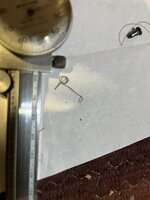
In the case of this tutorial, I need to copy the spring below. It is made from .041" wire with an ID of 1.030 and an OD of 1.114" Length relaxed is about 2.25" and the pitch of the coils is 2.

THE SETUP
The setup is straightforward and simple, just a mandrel and a wire guide. In this case, the mandrel is made from a chunk of scrap and I'll be using an Aloris tool holder as a wire guide.
The mandrel is nothing but a round form over which the wire is wound. As the spring relaxes and gets bigger when cut off the mandrel, the mandrel must be a smaller diameter than the ID of the finished spring. Trial-and-error will result in the correct mandrel diameter with a couple of attempts.
There are many ways to make the wire guide. Ideally, the wire guide will provide enough friction on the wire to force it to wrap around the mandrel while not damaging it. Scores in the wire will result in fatigue failure of the spring. In my case I simply pass the wire though the v-groove in the bottom of the toolholder which has been lightly polished.
To apply tension to the wire so it will wrap around the mandrel, I use the tool mounting screw nearest the mandrel to smash a section of dowel rod into the groove on top of the wire. This results in unpredictable tension which can mildly affect the finished coil diameter, but for one or two springs it's an acceptable method.

MAKING THE SPRING
To start the coil I drill a hole in the mandrel a few thousandths larger in diameter than the wire. This hole doesn't have to be precise. I did this one with a battery drill freehand. Then, I bend a hook in the wire and insert it into the starting hole.

Coiling commences by running the machine in reverse and applying a few wraps to the mandrel. It's important to apply a few more starting and ending wraps than you need as the first and last wraps tend to "go wild."

Once the starting wraps are complete, engage the half nuts and feed the carriage to coil the spring. The pitch of the spring coils is set by this operation. Just as the diameter of the mandrel needs to be smaller to accommodate relaxing of the completed spring, the initial pitch of the spring must be coarser than the final product. It will get shorter when you cut it off the mandrel, resulting in a finer pitch.


Finally, cut the spring loose. Use care here, the wire should be under a LOT of tension and has quite a bit of stored energy. 40 thou wire will raise a good blood blister. 80 thou wire will rip a hole in your hide.
Notice how the first and last coils went "wild?" This is why you must add extra starting and ending coils when winding on a mandrel. Also notice, the spring got shorter.

Cut off the excess coils and adjust the final spring length by pulling it open or crushing it down slightly, if necessary. If you're going to do multiple springs, set the DRO or travel dial and it's possible to make springs with repeatable lengths, so long as you follow the same procedure for each spring.
There you have it! A finished spring!

Now, take those trial springs you made and throw them in the scrap hopper before anybody sees them. After all, you got it right on the first try.


The recent "useless tools" thread reminded me about how the lathe is a generally under-appreciated shop tool. There are so many jobs a lathe can do besides turning simple shafts and bushings. Making springs is one of those jobs.
MATERIALS
To wind a spring you need to begin with the right material. An ideal spring material has a large area under the stress-strain curve. That is to say, the material is capable of storing a large amount of potential energy though elastic deformation. Baling wire and safety wire are not suitable for making springs because they do not have a high enough yield strength. As a result, the area under the stress-strain curve is relatively small and the wire deforms plastically instead of elastically.
The basic wire for making springs is spring temper 1080 drawn wire, also known as "music wire." Manufactured per ASTM A228, it has an ultimate tensile strength of 300,000 PSI to 400,000 PSI, about seven times the tensile strength of baling wire.
Music wire is sold in coils by weight and arrives "bent" from the coiling process. The wire must be straightened either with a wire straightener or by hand. This step is IMPORTANT! Bent wire will not form predictable coils because of the stress already inside the wire. What looks like a perfect spring before cutoff will end up a nasty mess when you cut it loose from the mandrel.
THE SPRING
In the case of this tutorial, I need to copy the spring below. It is made from .041" wire with an ID of 1.030 and an OD of 1.114" Length relaxed is about 2.25" and the pitch of the coils is 2.
THE SETUP
The setup is straightforward and simple, just a mandrel and a wire guide. In this case, the mandrel is made from a chunk of scrap and I'll be using an Aloris tool holder as a wire guide.
The mandrel is nothing but a round form over which the wire is wound. As the spring relaxes and gets bigger when cut off the mandrel, the mandrel must be a smaller diameter than the ID of the finished spring. Trial-and-error will result in the correct mandrel diameter with a couple of attempts.
There are many ways to make the wire guide. Ideally, the wire guide will provide enough friction on the wire to force it to wrap around the mandrel while not damaging it. Scores in the wire will result in fatigue failure of the spring. In my case I simply pass the wire though the v-groove in the bottom of the toolholder which has been lightly polished.
To apply tension to the wire so it will wrap around the mandrel, I use the tool mounting screw nearest the mandrel to smash a section of dowel rod into the groove on top of the wire. This results in unpredictable tension which can mildly affect the finished coil diameter, but for one or two springs it's an acceptable method.
MAKING THE SPRING
To start the coil I drill a hole in the mandrel a few thousandths larger in diameter than the wire. This hole doesn't have to be precise. I did this one with a battery drill freehand. Then, I bend a hook in the wire and insert it into the starting hole.
Coiling commences by running the machine in reverse and applying a few wraps to the mandrel. It's important to apply a few more starting and ending wraps than you need as the first and last wraps tend to "go wild."
Once the starting wraps are complete, engage the half nuts and feed the carriage to coil the spring. The pitch of the spring coils is set by this operation. Just as the diameter of the mandrel needs to be smaller to accommodate relaxing of the completed spring, the initial pitch of the spring must be coarser than the final product. It will get shorter when you cut it off the mandrel, resulting in a finer pitch.
Finally, cut the spring loose. Use care here, the wire should be under a LOT of tension and has quite a bit of stored energy. 40 thou wire will raise a good blood blister. 80 thou wire will rip a hole in your hide.
Notice how the first and last coils went "wild?" This is why you must add extra starting and ending coils when winding on a mandrel. Also notice, the spring got shorter.
Cut off the excess coils and adjust the final spring length by pulling it open or crushing it down slightly, if necessary. If you're going to do multiple springs, set the DRO or travel dial and it's possible to make springs with repeatable lengths, so long as you follow the same procedure for each spring.
There you have it! A finished spring!
Now, take those trial springs you made and throw them in the scrap hopper before anybody sees them. After all, you got it right on the first try.
Last edited:
 thanks for the tips and there are some really cool videos on the tube of making springs.

 Can the next tutorial be on spring design for a specific value?


 So to say, there were quite a few springs in the trash after going through inspection.