To avoid these ads, REGISTER NOW!

how to prevent future tile cracking on concrete?

hal1

Well-known member
Joined
May 10, 2015
Messages
244
Location
Phoenix
Without regard to my problems with the builder (large subdivision builder across many states) I need some help.

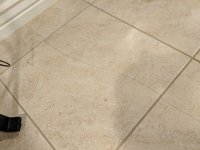
My tile is cracking due the the slab underneath cracking. The builder says that hairline cracks, or under 1/8" are within concrete guideline. Without regard to that, if I replace the tile they'll just crack again if the slab continues to crack/shift.

Is there some membrane/coating I can put down that will make the new/ replaced tiles stay in place, yet have some give to further slab movement? Either something that goes down under the thinset, or a semi-solid adhesive that has some give to it? Since it's only for a half dozen tiles, could I use that self-adhesive mat they make for kitchen backspashes?
 

Attachments

  • IMG_20180108_163542 (2).jpg
    IMG_20180108_163542 (2).jpg
    150.4 KB · Views: 93
  • Copy of IMG_20180106_192804 (1).jpg
    Copy of IMG_20180106_192804 (1).jpg
    148 KB · Views: 93
Last edited:
To avoid these ads, REGISTER NOW!

Rusty Bolt

Well-known member
Joined
Nov 12, 2017
Messages
87
Location
Carson City, NV
My tile guy likes Red Gard for a crack isolation membrane. What an awful name for those who remember the GPCR (Great Proletariat Cultural Revolution). China went insane for 10 years or so. It's like naming something Waffen SS. But all that aside, it's supposed to be good stuff.

There's another, similar product with a different color that I don't remember the name of.

Using a tough tile, like porcelain, should help too. The porcelain tile I laid last week just laughed at carbide. Diamond or nothing! :)
 

TRWham

Well-known member
Joined
Aug 11, 2017
Messages
1,961
Location
East Cobb County, Georgia
If you were redoing the entire space, you could use a decoupling membrane like Schluter Ditra. Unfortunately it won't work for just part of the area. Red Guard might work, but we have only ever used it for waterproofing and now use Schluter Kerdi for showers.
 

Angelfire

Well-known member
Joined
Mar 22, 2012
Messages
1,367
Location
New Mexico and Ireland
Sorry to see this happening. A number of things can happen going forward. The slab could stop cracking/moving or it could continue. What will happen is anyone's guess. You will have to rip up all the tile/thinset and re-do the floor if you intend to try to mitigate future movement. How long has the concrete been down?

The decoupling membrane mentioned above is used extensively for situations like this. Pretty pricey though. Another approach is to use the Redguard as mentioned above or I tend to prefer Mapai's AquaDefense. The stuff really impressed me after having used Redquard on a floor and then the AD on the walls of a shower. Much thicker material. It's a roll-on membrane that you put down over the cracks/control joints. Then, use a higher end modified thinset. Personally, I'm using Flexbond soon on my tile in my garage but there are others. Must be modified which is industry speak for indicating polymers have been added to the mix to allow for some movement. You can make your own modified by replacing water with latex additives if you want to go that route. Then during install, make sure you have 100% coverage....ie. back butter the tiles.
Cheers and good luck. I'm sure others with more experience will be chiming in with their inputs as well.
 
OP
H

hal1

Well-known member
Joined
May 10, 2015
Messages
244
Location
Phoenix
So if there's just a single row of four or five in a line can I just slap down that redgard for those five tiles?

Or how's this for half-assed- Use that self-adhesive mat that they make for kitchen backsplash tiles to lay under those four r tiles?
 
To avoid these ads, REGISTER NOW!

Dakota00

Well-known member
Joined
Mar 9, 2008
Messages
1,078
Location
Woodbridge, Ontario
Sounds like a newly constructed house? Curious to know, how old is the house?
This crack in the floor could be a one time deal that the concrete settled and that's the end of that. Let's hope so!! Angelfire provided excellent info that should be applied to your repair (happy to see members on here echoing what I say).

But understand, if the shifting that occurred is from vertical movement and does happen again. Ditra (can't be used in this repair), Liquid crack isolating membranes like Redgard or AquaDefense might not help in this case. These products are designed more for horizontal movement.

Best of luck!
 
OP
H

hal1

Well-known member
Joined
May 10, 2015
Messages
244
Location
Phoenix
I'll call it new construction - slab was poured just over 2 years ago, house finished about 20 months ago.

Don't know if it's in-plane crack. FWIW, it does have a post tension floating slab. Based on the pic of the slab from the outside, I'm thinking it 'snaped' in half, like a cracker? - one side settling more? not the idea of a post tension floating slab I guess. Maybe I'm wrong and the 2 half seperated, not a folding snap? Hopefully it's a one time thing and the post tension will keep it where it's at now.

Anyway, I'm thinking of replacing those 5 tiles once and if it happens again I'll leave it for several years. Not thrilled but not sure what options if it's not dome moving.
 
OP
H

hal1

Well-known member
Joined
May 10, 2015
Messages
244
Location
Phoenix
why not just redguard that little area and replace tiles. Keep spare tiles for future. Then cross fingers and hope it lasts forever.

I guess that's how I should have started this thread, as that's what my thoughts were, so I asked about redgard in OP
 

Copymutt

Well-known member
Joined
Sep 3, 2016
Messages
3,390
Location
Colorado
As the saying goes... concrete is guaranteed. Guaranteed to crack and guaranteed against theft.
A pro tile man I know always puts down roofing felt on his display floors before tile, just for shifting Crete issues. Most mono / floating slabs will come back to bite you unless perfect soils, perfect compaction, perfect geology, no frost.
Just my expensive experience.
 
To avoid these ads, REGISTER NOW!
Top Bottom