To avoid these ads, REGISTER NOW!

How to Repair Butcher Block Bench Top

NC Fabricator25

Well-known member
Joined
May 28, 2010
Messages
193
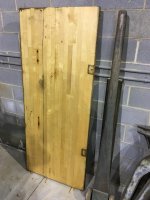
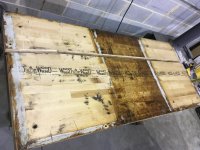
Picked up this freebie bench top a few years back and I need to figure out how to repair it. Had been covered with a piece of 1/4” thick nylon-esue plastic (UHMW?) so I didn’t know the extend of the damage. It’s 1-3/4” thick, 30”x72” and is destined to be a general purpose working bench, I have other better suited flat surfaces for assembly or welding.

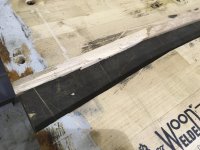
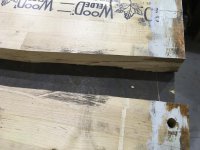
The damage is 90% along one of the glue joints, but then veers off into one of the boards for about 10”. It seems like there are 2 options: I can leave the cracked edges as-is, fill with glue and clamp, or rip new edges on both pieces to get a better glue joint, but probably lose 1-1/2” of total width in the process.

The second option seems straightforward enough and will have the expected outcome (and a narrower top), but the first option to just glue it up as-is is unknown to me. Will it work? Too hard to get the edges cleanly together for the glue to bond? Other thoughts from those that have been there and done this?
 

Attachments

  • AC82BED9-908F-47F6-A77C-F3EC3AD68DCD.jpg
    AC82BED9-908F-47F6-A77C-F3EC3AD68DCD.jpg
    89.8 KB · Views: 122
  • D97F9FEC-08E7-46E5-9657-62BA4B77088C.jpg
    D97F9FEC-08E7-46E5-9657-62BA4B77088C.jpg
    151.6 KB · Views: 114
  • 51964BB5-72F4-4823-B1D0-522358D12566.jpg
    51964BB5-72F4-4823-B1D0-522358D12566.jpg
    150.9 KB · Views: 111
  • 621DCE68-936A-48E4-8DBF-550ED61FF659.jpg
    621DCE68-936A-48E4-8DBF-550ED61FF659.jpg
    149.1 KB · Views: 92
  • 9A214E07-347D-485E-8F2D-B2DCE5EDD8DB.jpg
    9A214E07-347D-485E-8F2D-B2DCE5EDD8DB.jpg
    146.6 KB · Views: 84
To avoid these ads, REGISTER NOW!

wasfast

Well-known member
Joined
Apr 10, 2014
Messages
874
Location
San Diego CA
If it truly split, the match to re-glue is essentially "perfect" already. Some clamps and glue will repair it.

If it's mismatched, a track saw or circular saw with a guide can clean up the 2 faces then glue. The perfectionists might want to run the faces through a jointer but as heavy as this likely is, that's probably more work than it's worth.

The bowling alley versions have nails inside that can kill the blade unknowingly. Most are eastern maple (hard maple) and are pretty tough to cut. Take your time, perhaps even a couple passes on depth with the saw.

Typical PVA type glues (Titebond, Elmers yellow) need to absorb into the grain some. As long as it's not sealed (clear coated etc.), it will bond.
 

TLCObsession

Well-known member
Joined
Aug 30, 2011
Messages
328
Location
Bellingham, WA
I would glue it, clamp it and if my design allowed for it either use a wood stretcher across the width or a router a recess for some 3/32" steel flat and screw it so that it can't ever split again.
 

The Cobbler

Super Moderator
Staff member
Joined
Oct 24, 2013
Messages
25,966
Location
Niagara Region, Ontario, Canada
pull out the loose splinters of wood. do a dry fit with clamps to see how it closes up. repeat step 1 if you're not happy with the fit. be sure to align perfectly and you should be able to get a nice tight clean fit with some patience & fooling around
 
To avoid these ads, REGISTER NOW!

MoonRise

Well-known member
Joined
Nov 5, 2010
Messages
4,031
Location
NJ
Remove any debris from the seam.

Then do a dry test fit and see how the pieces actually line up.

If the joint lines up well, then evaluate how clean the wood surfaces of the joint actually are.

If they are clean bare wood that lines up well, then you might have the option of using a 'wood glue' to glue it back together.

A decent wood glue will make a joint stronger than the wood itself, can't ask for more than that. I will usually use Tite-Bond wood glue for most 'regular' joining of wood. They make different formulas for slightly different applications.

http://titebond.com/community/the-big-three

If you have a clean joint but not a well fitting joint, then you might still have the option of gluing it back together using a different adhesive than wood glue.

Gaps more than a few thou? I'd probably go right to an epoxy adhesive. Still stronger than the wood itself, can fill gaps, etc.

If the joint does not fit well and you want to make the joint look 'better' than a big epoxy-filled gap, then you are pretty much going to have to remachine the joint. Saw or plane (hand or power) or joint (hand jointer plane or a power jointer) to get a 'fit' that you are happy or OK with. Then glue it back up with an appropriate adhesive.

More than one way to put that back together.

:beer:
 

TailGunner3000

Well-known member
Joined
Sep 5, 2019
Messages
364
Location
New Jersey
Do you know why the pieces split? I ask because if it was dropped or had something dropped on it, I would do the glue-up as mentioned by others. But if it split because of moisture or other environmental conditions, I would cut the pieces and glue a new joint. In this scenario, I would also add a spacer or an addition to the backside as I think 30 inches is the minimum width I would accept for a workbench.

Good luck.
 

Michigan Mike

Well-known member
Joined
Sep 12, 2012
Messages
449
Location
Kalamazoo Mi.
I assume you would use bar clamps to clamp it. If you do alternate them from the top side to the bottom side. This will help to keep the top from cupping.
 
To avoid these ads, REGISTER NOW!
Top Bottom