To avoid these ads, REGISTER NOW!

How to repair this wall

OverkillYJ

Well-known member
Joined
Aug 7, 2013
Messages
262
Location
Harleysville, PA
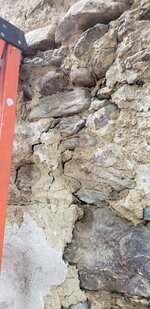
So this wall in my shop is about 100 years old. Its roughly 2-1/2 to 3ft thick and made of local stone. In parts the old original mortar seems solid and is white. In other parts its like the lime is washed out of the mortar and its just firm sand left behind that breaks off kind of easy.

This was skim coated decades ago, but it did not stick properly. It was covered by a peg board that I removed today. SO I plan on using concrete bonding adhesive on the wall, but I have no idea what kind of mortar I should use. Some areas have gaps between stone that looks like I should use a type N mortar I am guessing. But I don't think I should use that to do the entire wall.

What do you suggest I coat this with? I plan on leaving the stuff alone that is firmly attached, repairing the stuff I broke off easily, then painting the whole thing. In some areas it needs to be 1/8" thick, in other areas like 6" thick.

Thanks for the help.
 

Attachments

  • 20211111_213748.jpg
    20211111_213748.jpg
    351.9 KB · Views: 185
  • 20211111_213839.jpg
    20211111_213839.jpg
    422.2 KB · Views: 188
To avoid these ads, REGISTER NOW!

olytdi

Well-known member
Joined
Dec 3, 2011
Messages
2,202
Location
Olympia, Washington
Use a 3:1:1 mix (3 sand: 1 portland cement: 1 lime) to repair that. Lime gives you the stickiness that allows you to "plaster coat" the wall. Gradually fill the voids first (use stone if there's a large hole to fill) then build up to a full cover coat allowing a good cure in between (day or so). If you do have to do some repair, make the mix for that without the lime.

Don't over-do your applications. It shouldn't sag. Scratch the previous under coats while green such that you will have a textured surface on which to put the next coat. Build up until you're flush with the area to which you seek to mate up.

The old sandy crumbly stuff is most likely slack lime mortar that was pre-portland cement. You may even find horse hair in there. The stuff that's more "rock-like" is modern cement-based mortar.

I was a stone mason in Bucks County in my youth...a long time ago!
 
OP
O

OverkillYJ

Well-known member
Joined
Aug 7, 2013
Messages
262
Location
Harleysville, PA
Use a 3:1:1 mix (3 sand: 1 portland cement: 1 lime) to repair that. Lime gives you the stickiness that allows you to "plaster coat" the wall. Gradually fill the voids first (use stone if there's a large hole to fill) then build up to a full cover coat allowing a good cure in between (day or so). If you do have to do some repair, make the mix for that without the lime.

Don't over-do your applications. It shouldn't sag. Scratch the previous under coats while green such that you will have a textured surface on which to put the next coat. Build up until you're flush with the area to which you seek to mate up.

The old sandy crumbly stuff is most likely slack lime mortar that was pre-portland cement. You may even find horse hair in there. The stuff that's more "rock-like" is modern cement-based mortar.

I was a stone mason in Bucks County in my youth...a long time ago!
That makes sense. I thought I was seeing old dead fine roots coming through, but its horse hair.

I have the ingredients for all the stuff all ready to go. So you are saying same recipe without the lime for voids between stones I find, but on the surface stick with an equal part lime to portland, which will stop it from falling off the wall.

Thank you
 

nadogail

Well-known member
Joined
Jan 23, 2009
Messages
32,336
Location
Coronado, CA
One of the things I learned from the men who built my house in Spain was the importance of lime in stucco and mortor, they insisted without lime the mortor was of poor quality.
Techniques may have changed since 1966.
 

FredWanaker

Well-known member
Joined
Mar 27, 2021
Messages
1,470
Location
NorCal
paint with a mastic and membrane of some kind then build a wall just inside it with studs and drywall. Insulate in between. you'll only lose a small space and save yourself lots of headaches.
 

Bert_

Well-known member
Joined
Dec 24, 2016
Messages
9,916
Location
NW Iowa
paint with a mastic and membrane of some kind then build a wall just inside it with studs and drywall. Insulate in between. you'll only lose a small space and save yourself lots of headaches.
And just ignore the stone wall that will continue to deteriorate? Sorry but even if the op wanted to do what you suggest the stone wall needs repaired first.
 
To avoid these ads, REGISTER NOW!

olytdi

Well-known member
Joined
Dec 3, 2011
Messages
2,202
Location
Olympia, Washington
Lime weakens mortar somewhat and no stone mason I'm familiar with ever puts lime in mortar when laying stone -- it's unnecessary. Lime makes mortar sticky and is usually reserved for pointing or plastering after the wall or chimney is erected. Lime in the mix can make "throwing" mortar into voids like you have much easier, however.
 

theoldwizard1

Well-known member
Joined
Feb 22, 2011
Messages
43,620
Location
SE MI
Lime weakens mortar somewhat and no stone mason I'm familiar with ever puts lime in mortar when laying stone -- it's unnecessary. Lime makes mortar sticky and is usually reserved for pointing or plastering ...
This is a "plastering" job so LIME IS A KEY INGREDIENT ! I don't know the ratio, but some videos I have seen of people pointing/plastering stone walls they use NO CEMENT in their mix.
 

FredWanaker

Well-known member
Joined
Mar 27, 2021
Messages
1,470
Location
NorCal
And just ignore the stone wall that will continue to deteriorate? Sorry but even if the op wanted to do what you suggest the stone wall needs repaired first.
I never said ignore the cause of the damage. If there is moisture on the outside causing it then the moisture migration has to be stopped from the outside of the wall. A new wall can be erected on the inside out of studs and drywall rather than trying to repair the aesthetic damage that has already occurred. Or he can build a block wall and tie to the existing structure. Or he can tear the whole place down and start over if you prefer that.
 

slowtwitch73

Well-known member
Joined
Apr 18, 2019
Messages
5,876
Location
Hellgate
Make sure there is no hydraulic pressure being exerted... like a downspout on the outside etc. Fix that first if need be.

Within reason I would get rid of the really loose stuff and try to remove any dust etc with a shop vac used sparingly. Some of the really crtical areas I would wipe/clean with some alchohol to promore bonding.

Then I'd use modern day adhesives from Sika in combination with something you spray/blast and really shoot it in all the nooks cranny's.
 
OP
O

OverkillYJ

Well-known member
Joined
Aug 7, 2013
Messages
262
Location
Harleysville, PA
And just ignore the stone wall that will continue to deteriorate? Sorry but even if the op wanted to do what you suggest the stone wall needs repaired first.
Correct. I just removed a Peg Board from that wall that was fine, because I know I need to deal with this masonry work. I could have fixed the one loose anchor I had and painted it, but this wall needs to be repaired.
 

Attachments

  • 20211110_120820.jpg
    20211110_120820.jpg
    355.5 KB · Views: 58
  • 20211111_152133.jpg
    20211111_152133.jpg
    337.5 KB · Views: 67
OP
O

OverkillYJ

Well-known member
Joined
Aug 7, 2013
Messages
262
Location
Harleysville, PA
This is a "plastering" job so LIME IS A KEY INGREDIENT ! I don't know the ratio, but some videos I have seen of people pointing/plastering stone walls they use NO CEMENT in their mix.
I rebuilt my fireplace using the mortar they would have used when they built my home, and did not use and cement in it. The lime mortars are great, if not exposed to weather. You dont want to use a lime based mortar where there is a lot of weathering. When compared to cement, it does not hold up well at all.
 
To avoid these ads, REGISTER NOW!
Top Bottom