
You are using an out of date browser. It may not display this or other websites correctly.
You should upgrade or use an alternative browser.
You should upgrade or use an alternative browser.
how to wire shop lights with single switch?
- Thread starter brett3xx
- Start date

bamawildcat
Well-known member
- Joined
- Jul 12, 2014
- Messages
- 153
To code yes, as switches require neutrals to them even if not used. To save money, do it like 10 years ago and run 2 conductor with ground and re-identify the neutral as a hot by putting a wrap of black electrical tape around it on both ends. 99% of the world will identify that as a switch leg and understand.
To code yes, as switches require neutrals to them even if not used. To save money, do it like 10 years ago and run 2 conductor with ground and re-identify the neutral as a hot by putting a wrap of black electrical tape around it on both ends. 99% of the world will identify that as a switch leg and understand.
any way you could post a diagram?
wyliesdiesels
Well-known member
you would need to run **/3 NM-b from the first light through each light all the way to the switch to be code compliant with the neutral requirement
Bretny
Well-known member
How much are you really saving by not just running to the switch first? Are you planing on putting a dawn to dusk light over the door or anything else on the other side that needs constant power?
you would need to run **/3 NM-b from the first light through each light all the way to the switch to be code compliant with the neutral requirement
Just to confirm, would that be the same as the diagram?
How much are you really saving by not just running to the switch first? Are you planing on putting a dawn to dusk light over the door or anything else on the other side that needs constant power?
I thought it needed to be done this way instead of running extra wire to the light first. Which is the best way to do it? I may add a dusk to dawn light in the future, just havent got that far yet.
BillK
Well-known member
Which is the best way to do it?
The "best" way is to run power to the switch first, then from the switch to the lights. Especially if you might put an outdoor light near where the switch is.
exranger06
Well-known member
any way you could post a diagram?
He's talking about doing it this way:
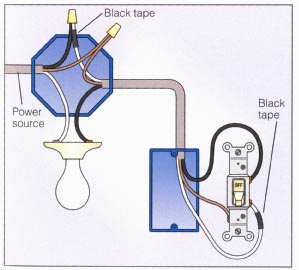
But to be "up to code" (I put that in quotes because this method is NOT up to code anymore and I therefore DON'T recommend it), you use the white wire as the constant hot, NOT the switched leg.
EDIT: I forgot to add that even if you DID wire it up this way, you'd STILL have to run 3-conductor cable in between the light fixtures, and you could use a 2-conductor cable only between the last fixture and the switch. Not worth it; just run a 3-conductor cable to the switch.
Last edited:
exranger06
Well-known member
Yes.Just to confirm, would that be the same as the diagram?
You're on the right track. Proceed with your original plan and diagram. That's the way I would do it. Running the feed to the switch first has its advantages, but there's no sense in running two cables from one side of the shop to the other when you can just run a single 3-conductor cable.I thought it needed to be done this way instead of running extra wire to the light first. Which is the best way to do it? I may add a dusk to dawn light in the future, just havent got that far yet.
If he uses 3 conductor cable to the switch like he's supposed to, he can still wire an outdoor light/motion sensor light from the switch box just as easily as running the feed directly there.The "best" way is to run power to the switch first, then from the switch to the lights. Especially if you might put an outdoor light near where the switch is.
Yes.
You're on the right track. Proceed with your original plan and diagram. That's the way I would do it. Running the feed to the switch first has its advantages, but there's no sense in running two cables from one side of the shop to the other when you can just run a single 3-conductor cable.
If he uses 3 conductor cable to the switch like he's supposed to, he can still wire an outdoor light/motion sensor light from the switch box just as easily as running the feed directly there.
thanks for the info, how many can I run on one breaker? I have 6 LEDs overhead lights
exranger06
Well-known member
Depends on the amperage of the circuit, and the wattage of each light fixture, but you should have no problem putting all 6 fixtures on one circuit. A 15 amp circuit can have up to 1,800 watts on it. A 20 amp can have 2,400 W. 1800 divided by 6 = 300W per fixture. Your fixtures are probably WAY less than 300W each.thanks for the info, how many can I run on one breaker? I have 6 LEDs overhead lights
Fasthotrod
Well-known member
The number of lights doesn't really matter... it's the amount of load that each light pulls that matters.
So for example, let's say you had six lights that had traditional screw in light bulbs and each fixture was able to handle 120 Watts each, so you dropped in six, 120 watt bulbs. 6 * 120 = 720 Watts.
Watt = Voltage * Amperes
120 W = 120 Volts * 1 Amp.
So with six of those lights, this circuit would have 6 amps of current draw... most basic switches are rated for 15A so assuming that the circuit had 14 AWG copper from a 15A breaker, to the switch, then to the fixtures, you'd be good for that and a quite a few more if you wanted.
EDIT: Looks like Ranger beat me to it... I guess Rangers really do Lead the Way!
So for example, let's say you had six lights that had traditional screw in light bulbs and each fixture was able to handle 120 Watts each, so you dropped in six, 120 watt bulbs. 6 * 120 = 720 Watts.
Watt = Voltage * Amperes
120 W = 120 Volts * 1 Amp.
So with six of those lights, this circuit would have 6 amps of current draw... most basic switches are rated for 15A so assuming that the circuit had 14 AWG copper from a 15A breaker, to the switch, then to the fixtures, you'd be good for that and a quite a few more if you wanted.
EDIT: Looks like Ranger beat me to it... I guess Rangers really do Lead the Way!
theoldwizard1
Well-known member
Most 4' LED "shop lights" come with a power cord on one end and an outlet on the other and can be daisy chained. Install one octagon ceiling box at the beginning and then install a octagon-to-duplex cover and a duplex outlet.