To avoid these ads, REGISTER NOW!

HP rating is HP rating ?

NUTTSGT

Super Moderator
Staff member
Joined
Sep 14, 2009
Messages
51,304
Location
Northern Central Ohio
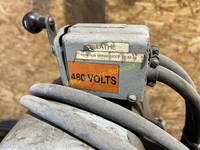
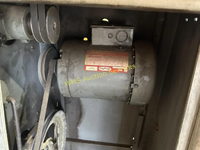
I'm looking at a lathe with a 3 phase motor. It has a 3/4 HP rated motor on it. If I replaced that 3 phase motor with a 120V 3/4 HP would I have any issues ? Common sense tells me, the rating will be the same everything else being equal but I don't deal with 3 phase stuff very often if, at all.

I'd run this one by my step-dad (retired electrician) but I think the Alzheimer's is too far gone for him to correctly answer it.

Appreciate the help.
 
To avoid these ads, REGISTER NOW!

mike93lx

ALLIANCE MEMBER
Joined
Dec 9, 2013
Messages
38,398
Location
Richmond, VA
Is the lathe using a Vfd for speed control? Or is there a switch to reverse direction? Those are benefits of a 3 phase motor.

If not then, yes, you can swap it if you can find the same mounting pattern

If it has a weird mount, I'd do a Vfd before trying to swap
 
OP
N

NUTTSGT

Super Moderator
Staff member
Joined
Sep 14, 2009
Messages
51,304
Location
Northern Central Ohio
You'd be better off putting a vfd on it than replacing the motor.
I already have the 120V motor.
Look into a VFD, just stay away from off breed ones like Hungyang. Downside is GFCI's do not like them.
Not worried about the GFCI.

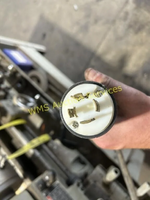
Just curious, auction still has just under 4 days left on it. It's on a 3 phase outlet right now, pretty sure there's no VFD at this place.
 

niget2002

Well-known member
Joined
Oct 2, 2012
Messages
11,389
Location
Josephine, TX
I already have the 120V motor.

Not worried about the GFCI.

Just curious, auction still has just under 4 days left on it. It's on a 3 phase outlet right now, pretty sure there's no VFD at this place.
Ah. If you already have it. I think it'd work, but I think you'd lose the ability to reverse. I assume the reverse is a switch like on my mill where the 3phase is used to spin the motor backwards.
 
OP
N

NUTTSGT

Super Moderator
Staff member
Joined
Sep 14, 2009
Messages
51,304
Location
Northern Central Ohio
Ah. If you already have it. I think it'd work, but I think you'd lose the ability to reverse. I assume the reverse is a switch like on my mill where the 3phase is used to spin the motor backwards.
Good to know.

Honestly, I can almost bet, I will get out bid, so it's probably a moot point. . . but you never know.
 

KenC

Well-known member
Joined
Dec 20, 2009
Messages
2,602
Location
oklahoma
Ah. If you already have it. I think it'd work, but I think you'd lose the ability to reverse. I assume the reverse is a switch like on my mill where the 3phase is used to spin the motor backwards.
Some single phase motors are reversible. I have a shaper with a 120/240 single phase 3/4hp that reverses using a drum switch. wiring is more complicated that a reversing 3 phase but works well.
 

rsanter

Well-known member
Joined
Dec 22, 2007
Messages
18,541
Location
visalia ca
3 phase motor with have more torque

personally I would use at least a 1hp, but you say you have the motor so give it a try
 

Cruzan80

Well-known member
Joined
Jul 22, 2015
Messages
4,414
Location
Denver, CO
Looks like the lathe has a reversing switch, so you can control the 1ph motor just as easily. These (think I recognize the maker) were commonly sold with 3/4-1HP 1ph motors.
 

OccupantRJ

Well-known member
Joined
May 15, 2009
Messages
11,383
Location
Eastern North Carolina
Either way, it should not present a problem. A used single phase motor can be had for $75-100, and Teco makes a vfd that will run a 1 hp 3 phase motor on 120 volts For $190. I have one.
 

micromind

Well-known member
Joined
Sep 24, 2023
Messages
3,125
Location
Fernley, Nevada, about 30 miles east of Reno.
Provided both motors are standard NEMA frame (like the one in post #10), a 3/4HP 120 volt single phase motor will produce the same amount of work that a 3/4HP 3Ø model will.

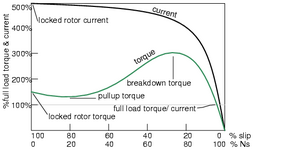
When operated on line power, a 3Ø motor will typically have more starting torque and more breakdown torque than a single phase one of the same HP.

When operated by a VFD, the opposite is true. Usually less starting torque (often a lot less), less breakdown torque (again, often a lot less) than a single phase model.
 
To avoid these ads, REGISTER NOW!

American Locomotive

Well-known member
Joined
Jan 8, 2017
Messages
11,086
Location
Rhode Island
HP is HP, but you'll want to make sure the motor is also the same speed.

Not all single phase motors are reversible either, which can be important on a lathe.

Might just be easier to wire the existing motor for 240v and use a VFD.
 

walta

Well-known member
Joined
Jan 13, 2017
Messages
2,316
Location
Dutzow Missouri
When operated by a VFD, the opposite is true. Usually less starting torque (often a lot less), less breakdown torque (again, often a lot less) than a single phase model.


I am not say you are wrong help me understand.

Please explain why a VFD outputting the same voltage and current would provide less breakdown torque? I could see how a VFD would sense an overload faster than an old fashion motor starter and trip off faster but there are setting for that.
2025-09-28_11-18-41.jpg
As for the start up the AI seems to disagree. “A Variable Frequency Drive (VFD) can provide more startup torque compared to traditional methods, especially when programmed correctly for high torque applications. This is because a VFD can adjust both the voltage and frequency during startup, allowing for better control over the motor's performance.”


Walta
 

Firebrick43

Well-known member
Joined
May 12, 2015
Messages
14,353
Location
West central Indiana
I am not say you are wrong help me understand.

Please explain why a VFD outputting the same voltage and current would provide less breakdown torque? I could see how a VFD would sense an overload faster than an old fashion motor starter and trip off faster but there are setting for that.
2025-09-28_11-18-41.jpg
As for the start up the AI seems to disagree. “A Variable Frequency Drive (VFD) can provide more startup torque compared to traditional methods, especially when programmed correctly for high torque applications. This is because a VFD can adjust both the voltage and frequency during startup, allowing for better control over the motor's performance.”


Walta
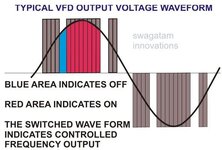
Because it only output the voltage and current for a portion of the time.

The slower you want the motor to turn, the more time that no electricity is being sent to the motor by the VFD

51b550fd3ba82f2a6b7de7caef0198e315e49bf1_large-2837826486.jpg

You do know that AI is only as good as the fools that programmed it right? And they program in bias and lack logic

What is true about VFD in starting is they can control it instead of 100% instantly like a standard motor. With heavy loads its not that vfd controlled motors necessarily have more torque, its that they apply the torque slowly in a controlled manner as the speed increases. Without the VFD many of these heavy loads need larger than necessary motors just so they can accelerate the load at start and not trip because of the amps they are pulling.

AI just doesn't have the logic to understand what is really going on.
 

Steve from Socal

Well-known member
Joined
Jan 27, 2009
Messages
3,528
Location
Hutchinson Ks.
A single phase motor will work in machine tools however, a three phase motor is less prone to cogging. I put a 5 hp single phase motor in my small milling machine, there is a lot of mass in the gear train so not as big a deal. On a step pulley lathe the slight pulsing could lead to finish issues? Will you notice this? Perhaps, maybe not, small hobby lathes have been sold with single phase motors for decades.

The motor shown is dual voltage, running it at 240 with a VFD will give you much more flexability and infinate spped options. The motor control are handled by the VFD so no need to replace overloads. The reversing switch can be used with the VFD, just don't try instant reversing with a threaded spindle chuck.
 

micromind

Well-known member
Joined
Sep 24, 2023
Messages
3,125
Location
Fernley, Nevada, about 30 miles east of Reno.
Because it only output the voltage and current for a portion of the time.

The slower you want the motor to turn, the more time that no electricity is being sent to the motor by the VFD

51b550fd3ba82f2a6b7de7caef0198e315e49bf1_large-2837826486.jpg

You do know that AI is only as good as the fools that programmed it right? And they program in bias and lack logic

What is true about VFD in starting is they can control it instead of 100% instantly like a standard motor. With heavy loads its not that vfd controlled motors necessarily have more torque, its that they apply the torque slowly in a controlled manner as the speed increases. Without the VFD many of these heavy loads need larger than necessary motors just so they can accelerate the load at start and not trip because of the amps they are pulling.

AI just doesn't have the logic to understand what is really going on.

This^^^^^

A VFD can't operate a motor as well as line voltage can because it's not a true sine wave.
 

micromind

Well-known member
Joined
Sep 24, 2023
Messages
3,125
Location
Fernley, Nevada, about 30 miles east of Reno.
The motor shown in the pic is 3Ø, 230/460 volts. It can be easily reconnected to operate on 230 volts.

If using a VFD, ensure that the output of the VFD goes directly to the motor and no switches or other loads are connected to it.

If the motor is switched on and off with the VFD outputting power, teeny-weeny itsy-bitsy holes will be blown in the semi-conductor layer of the output transistors and eventually they'll fail. Usually not right away but eventually.......

Connecting anything other than a motor to the output of VFD will usually result in the destruction of the device.
 

micromind

Well-known member
Joined
Sep 24, 2023
Messages
3,125
Location
Fernley, Nevada, about 30 miles east of Reno.
As for the start up the AI seems to disagree. “A Variable Frequency Drive (VFD) can provide more startup torque compared to traditional methods, especially when programmed correctly for high torque applications. This is because a VFD can adjust both the voltage and frequency during startup, allowing for better control over the motor's performance.”


Walta

Depends on the definition of 'traditional starting methods'.

If across-the-lines is a traditional starting method then the AI is wrong.

If traditional starting methods are an electronic soft-start, an autotransformer, part-winding or Y-∆ then yes, a VFD can provide more starting torque although an autotransformer set to 80% is pretty hard to beat.
 

American Locomotive

Well-known member
Joined
Jan 8, 2017
Messages
11,086
Location
Rhode Island
There's a misunderstanding of how VFDs and AC current works here.
Because it only output the voltage and current for a portion of the time.

The slower you want the motor to turn, the more time that no electricity is being sent to the motor by the VFD
But that's literally how AC current works - the voltage is continually varying. Take 120v AC mains: The "peak" voltage on the sine wave is actually 170v, but it only hits that peak voltage for a brief moment every cycle. For roughly 50% of the AC cycle, the voltage is below 120v. Then on top of that the voltage is literally 0v 120x a second!

VFDs take the AC input, rectify into higher voltage DC (240vAC becomes 340vDC). The drive then pulses the motor with bursts of 340vDC varying duration - typically 6,000 - 10,000 times per second. Those bursts are so fast, and the motor has so much inductance, that they are averaged and filtered (by the motor) to be equivalent to the AC waveform. The motor really doesn't know it's not seeing a normal AC waveform. Here is a picture showing the switching (in red) and the current (in green). Notice how the current tracks just like a normal sine wave?
THiD-at-8kHz-switching-frequency.jpg

VFDs, in most applications, are purposely set to limit starting torque and current. However, a properly sized and set-up VFD can produce very high starting torque. There are applications where VFDs are set up to generate 200-250% of a motor's rated torque at 0 RPM, at significantly less current than it would on an across-the-line start. This is because the lower starting frequency (as low as 0.5Hz in most modern VFDs) allows more of the incoming power to be converted into torque, instead of being burned away as heat in the windings or rotor.

However, all of that is irrelevant to the topic at hand, as a lathe is not a machine that requires particularly high starting torque.
 

dscheidt

Well-known member
Joined
Apr 26, 2017
Messages
2,925
Dep
However, all of that is irrelevant to the topic at hand, as a lathe is not a machine that requires particularly high starting torque.

No, but they benefit from constant torque. Single phase induction motors have a torque output that fluctuates with the line voltage frequency. Not a problem with most loads, but it can show up as tool chatter on a lathe, especially a light one that isn't terribly rigid. three phase motors have a smoother curve, because the applied voltage is never zero.
 

Firebrick43

Well-known member
Joined
May 12, 2015
Messages
14,353
Location
West central Indiana
There's a misunderstanding of how VFDs and AC current works here.

But that's literally how AC current works - the voltage is continually varying. Take 120v AC mains: The "peak" voltage on the sine wave is actually 170v, but it only hits that peak voltage for a brief moment every cycle. For roughly 50% of the AC cycle, the voltage is below 120v. Then on top of that the voltage is literally 0v 120x a second!
I misunderstand? But say the exact same thing in a much more condensed version, below in red. Even showed a chart of it?

Because it only output the voltage and current for a portion of the time.

The slower you want the motor to turn, the more time that no electricity is being sent to the motor by the VFD

51b550fd3ba82f2a6b7de7caef0198e315e49bf1_large-2837826486.jpg
The second sentence in blue is where you start loosing toque with cheap Chinese VFD in V/Hz mode which absolutely suffers in torque.

Also many don't take the time or have the experience to tune a drive that has sensor less vector modes. Although many even basic name brand drives auto tune is getting better and better.
VFDs, in most applications, are purposely set to limit starting torque and current. However, a properly sized and set-up VFD can produce very high starting torque. There are applications where VFDs are set up to generate 200-250% of a motor's rated torque at 0 RPM, at significantly less current than it would on an across-the-line start. This is because the lower starting frequency (as low as 0.5Hz in most modern VFDs) allows more of the incoming power to be converted into torque, instead of being burned away as heat in the windings or rotor.
You might get 200 percent locked rotor torque with sensorless vector mode but even that is iffy with a good tune. And you are only getting it for a few seconds unless the drive is significantly oversized. 250 percent is likely only achievable with an encoder in servo mode.

Plus trying to drive an old motor to high torque loads under 20 hz on a vfd is going to likely to blow holes in the insulation as they don't have insulation that meets NEMA MG-1 part 31 specs, typically an F or H class insulation in smaller motors


American Locomotive

Well-known member
Joined
Jan 8, 2017
Messages
11,086
Location
Rhode Island
I misunderstand? But say the exact same thing in a much more condensed version, below in red. Even showed a chart of it?


The second sentence in blue is where you start loosing toque with cheap Chinese VFD in V/Hz mode which absolutely suffers in torque.

Also many don't take the time or have the experience to tune a drive that has sensor less vector modes. Although many even basic name brand drives auto tune is getting better and better.

You might get 200 percent locked rotor torque with sensorless vector mode but even that is iffy with a good tune. And you are only getting it for a few seconds unless the drive is significantly oversized. 250 percent is likely only achievable with an encoder in servo mode.

Plus trying to drive an old motor to high torque loads under 20 hz on a vfd is going to likely to blow holes in the insulation as they don't have insulation that meets NEMA MG-1 part 31 specs, typically an F or H class insulation in smaller motors


Your post is insinuating that motors have reduced torque on a VFD because they pulse to simulate a sinewave.

No, that is not the reason. As far as the dynamics of the motor is concerned, it's the exact same thing as mains power. The current waveform reflects this.

Motor torque is a function of current. Motor torque is constant in V/Hz mode, throughout the speed range (except at very low speeds, say <10Hz). This is because impedance is a function of frequency and inductance. The lower the frequency, the lower the voltage you need to push a certain current, and therefore torque. It's a linear relationship: i.e., 30 Hz @ 120v will produce the same current and torque in a motor as 240v @ 60 Hz. What you lose is horsepower as frequency decreases, which is why a VFD isn't a replacement for a gearbox.

Most motors on VFD applications have limited torque, because the drive is set up to limit current to nameplate. If you set the current limit to something obnoxiously high, the motor will perform like it is on mains.
 

Firebrick43

Well-known member
Joined
May 12, 2015
Messages
14,353
Location
West central Indiana
Your post is insinuating that motors have reduced torque on a VFD because they pulse to simulate a sinewave.
No I am not, re read it

Motor torque is a function of current. Motor torque is constant in V/Hz mode, throughout the speed range (except at very low speeds, say <10Hz). This is because impedance is a function of frequency and inductance. The lower the frequency, the lower the voltage you need to push a certain current, and therefore torque. It's a linear relationship: i.e., 30 Hz @ 120v will produce the same current and torque in a motor as 240v @ 60 Hz.
Are you talking about vfd's only while we are talking about mains powered motors compared to a vfd in torque????

1759271328198.png

vs

1759271901299.png

Most motors on VFD applications have limited torque, because the drive is set up to limit current to nameplate. If you set the current limit to something obnoxiously high, the motor will perform like it is on mains.
And how do you expect someone to know what they are doing in the regard? In the context of the machinery we are talking about in the thread.
 
Last edited:

Cruzan80

Well-known member
Joined
Jul 22, 2015
Messages
4,414
Location
Denver, CO
Back on topic a bit, I will say that swapping motors in that cabinet is kind of a PITA. The cabinet is fairly narrow, so hard to get your shoulders inside. And it bolts thru the "back" of the cabinet, so having a second person to help tighten nuts is helpful.

This is only needed if you decide to swap motors, or the original has problems.
 

micromind

Well-known member
Joined
Sep 24, 2023
Messages
3,125
Location
Fernley, Nevada, about 30 miles east of Reno.
It's common knowledge that if a motor has a service factor of more than 1.0 (like 1.15 or higher) and it's run on a VFD, the service factor becomes 1.0

Further, in my own personal experience, 2 identical pumps, both connected to the same suction and discharge manifolds, one is line powered the other is on a VFD, running at 60HZ, the frame of the VFD motor will be hotter than the line powered one.

One I did a couple of years ago, 250HP vertical hollowshaft motor driving a turbine pump. 287 nameplate amps, 1.15 service factor. It ran on line power for a few years, the current was around 285 amps and the GPM of the pump was 2600.

They had me install a VFD, when I was done, the current was 285 amps @ 56HZ and 2420 GPM. At 60HZ, it was just a bit over 300 amps and 2550 GPM.

Motors do not perform as well on a VFD (modified sine wave) as they do on line power (true sine wave).

Another thing that almost no one considers is that VFDs will screw up the sine wave of the line power. A 5HP VFD on a 2000 amp service won't make any difference but if the majority of motors are on VFDs, the waveform can easily be distorted enough to cause trouble with fully loaded motors on line power.
 

Steve from Socal

Well-known member
Joined
Jan 27, 2009
Messages
3,528
Location
Hutchinson Ks.
I don't have 250HP motors or inverter, biggest is a 60HP motor/VFD. All my VFD's over 5HP have line reactors on the input and outputs. That does help with harmonics a lot, that is where a lot of the heat comes from. As noted a small VFD under 5HP is not really going to do much regarding harmonics 'generally'
 

Cruzan80

Well-known member
Joined
Jul 22, 2015
Messages
4,414
Location
Denver, CO
Roughly speaking, I would be surprised if it pulled $1200-1500+ in the open market (if it had some decent accessories). I have seen them all the way down to dirt cheap, but those over the the 1250 mark tend to linger for a bit.

But auctions hit the "I have to have it" bug for some people.
 
OP
N

NUTTSGT

Super Moderator
Staff member
Joined
Sep 14, 2009
Messages
51,304
Location
Northern Central Ohio
Roughly speaking, I would be surprised if it pulled $1200-1500+ in the open market (if it had some decent accessories). I have seen them all the way down to dirt cheap, but those over the the 1250 mark tend to linger for a bit.

But auctions hit the "I have to have it" bug for some people.
Yeah, the auction is LIVE right now and at $230. I'm expecting to to start climbing as it has about 40 minutes left.

EDIT: Auction ended at $260.
 
Last edited:
To avoid these ads, REGISTER NOW!
Top Bottom