To avoid these ads, REGISTER NOW!

Humidity Question

Stephanorf

Member
Joined
Jan 24, 2020
Messages
9
Location
Garland, TX
I've read a lot of other posts with similar threads but it seems no two situations are exactly the same, right?

So I bought a house with a 30 x 40 metal-on-slab pole barn. The thing was build about 30 years ago, and it in pretty good shape. I noticed a lot of surface rust on the interior, along with what looked like dried black mildew on the walls. There are no leaks, it is water tight.

49439205077_40bc589b22.jpg
[/url]

I live in the Dallas area, where winters a slightly cold and wet, and summers are hot and usually very humid. A few things I noticed are common to metal pole buildings, although I was unaware when I purchased the property:

First, I get crazy condensation on the floor of the shop when there is a temp change and high humidity. Enough condensation to where the bottoms of my cars are actually dripping with moisture.

Second, any bare metal that isn't painted/coated is either rusty or beginning to rust. I have a 1968 Mustang California Special, 1969 Mustang coupe and 1965 fastback Mustangs in there, and I'm worried about them deterioration.

Eventually I want climate control. But for now i just want to keep the humidity/condensation at bay. It seems I need to enclose the shop so the air from outside is kept out.

The metal siding is corrugated, so every foot or so there is a large gap. All along the perimeter of the building at the ground, and also where the walls meet the roof.

49438509323_60f738f3a3.jpg


You can get a feel for the problem from inside the building. These shots were taken with all the doors shut, no flash and no lights on in the shop. Keep in mind that there are no windows on this building.

Here you can see the gaps at the roof-line. Also the garage door. I have the weatherstripping/surround for the garage doors.
49438978286_1d6c49fe31.jpg


Looking at the shop door from the inside. I have the weatherstripping/threshold for the door. But as you can see there are a lot more gaps than just around the man door.
49438509908_2f133b52c0.jpg


Here is a shot looking down at the floor. Same gaps all around the perimeter.
49438509693_7f761a07dc.jpg


Lastly, if I look up at the peak of the roof, I can see light all along the pace where the two halves of the roof meet. There are no sofit vents or ridge vent on this building.
49439205657_d1485cb323.jpg


So, do I need to fill all these gaps? I will eventually be adding heat/AC to the building. But it seems like my first priority should be to take care of all these gaps.

Any advice? Should the gaps be eliminated? I would think so, but I've read the building needs to "breathe", so am a little unsure what that means exactly (an in my particular instance, what gaps should be left open, if any.)
 
To avoid these ads, REGISTER NOW!

Jeepster04

Well-known member
Joined
Jun 25, 2013
Messages
3,100
You'll never have an issue with that building not breathing.

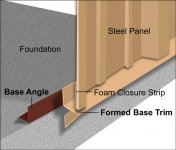
I would purchase rat guards and closure strips for the metal along the block. You can also use the closure strips along the gable ends and where the metal meets the walls. Some people complain about the strips falling out over time. When I built mine I was able to put the screws right through the closure strips to keep them from falling out when the adhesive failed.

Also, even if you seal it up, as soon as you open a door on a warm humid day, everything inside will sweat if its below the dew point. Keeping the building slightly warm will keep that from happening.
 

Attachments

  • RHINO-Formed-Base-Trim.jpg
    RHINO-Formed-Base-Trim.jpg
    88.1 KB · Views: 39
Last edited:
OP
S

Stephanorf

Member
Joined
Jan 24, 2020
Messages
9
Location
Garland, TX
You'll never have an issue with that building not breathing.

I would purchase rat guards and closure strips for the metal along the block. You can also use the closure strips along the gable ends and where the metal meets the walls. Some people complain about the strips falling out over time. When I built mine I was able to put the screws right through the closure strips to keep them from falling out when the adhesive failed.

Thanks, I bought some "Great Stuff" that I was going to use, but the I read about the closure strips. The local home Depot sells them, but the ones I found are made out of wood.

What about the gap at the very top of the building, where the roof panels meet?
 

3rdgendslmech

Well-known member
Joined
Mar 12, 2017
Messages
499
Location
Maryland
Would you happen to know if there's plastic under your slab?
If not then that's where your moisture problem could be coming from.
 
OP
S

Stephanorf

Member
Joined
Jan 24, 2020
Messages
9
Location
Garland, TX
Would you happen to know if there's plastic under your slab?
If not then that's where your moisture problem could be coming from.

Well, I'm not sure if there's a moisture barrier under the slab. If I did along side the perimeter do you think you be able to find out... Like would the plastic extend beyond the edge of the slab when they pour it?

I did paint the floor with some epoxy paint when it was empty.

The first time I noticed the condensation it was when the man-for was open. The floor from the door and about 3 or 4 feet into the shop was really wet. Almost like a thin layer of standing water.
 

3rdgendslmech

Well-known member
Joined
Mar 12, 2017
Messages
499
Location
Maryland
Easiest thing to do is to get a piece of plastic and lay it down on the floor flat. If you go out the next morning and there's moisture on the bottom side, there's your problem, you more than likely do not have a vapor barrier under your slab.
I know in the winter when we have those freak days when the temps jump up from mid 30s to the 60s everything gets a little moisture on it. I open up the doors and turn on a fan or 2 and after a bit everything is dry.
I dont keep my building climate controlled 24/7
 
OP
S

Stephanorf

Member
Joined
Jan 24, 2020
Messages
9
Location
Garland, TX
Easiest thing to do is to get a piece of plastic and lay it down on the floor flat. If you go out the next morning and there's moisture on the bottom side, there's your problem, you more than likely do not have a vapor barrier under your slab.

Thanks, I'll have to try that.

So for the plastic test... If there's water on top of the plastic, but not under, then it is condensation. And if there's no water on top of the plastic, but it's we underneath, the it is moisture coming up through the slab. And if there's water on top of the plastic, and underneath the plastic, then I have both. Is that right?
 
To avoid these ads, REGISTER NOW!

Jeepster04

Well-known member
Joined
Jun 25, 2013
Messages
3,100
Thanks, I bought some "Great Stuff" that I was going to use, but the I read about the closure strips. The local home Depot sells them, but the ones I found are made out of wood.

What about the gap at the very top of the building, where the roof panels meet?

If youre talking about the peak of the roof, you can also use the closure strips there. Again, even though the adhesive seemed very good on mine, I made sure they either had screws going through them or they were sandwiched so tight they couldnt come out.

Depending on what you plan on doing with the building, they made closure strips that will vent air.. Theyre more $$ though.
 

Shovelhead

Well-known member
Joined
Dec 22, 2018
Messages
397
Location
DEEP EAST TEXAS
Hello there Dallas from Galveston County.
C'mon down here and I'll show you some humidity.

You need to insulate that shop and get some sort of controlled ventilation. Gable fans, or..?

Until you insulate, seal and get some proper ventilation, I suggest at the very least to park them Stangs on plywood. It will make a ton of difference.

Good luck
 

Vicious_Cycle

Well-known member
Joined
Jan 11, 2006
Messages
360
Location
Chardon, OH
You have warm moist outside air flowing over a slab that is cool enough to cause the moisture in the air to condense on the floor. Just like the water droplets that appear on a cold drink when it's humid outside.
Heat fixes the problem. In the absence of heat, fans will help a lot.
 

TexasRacer

New member
Joined
Oct 7, 2015
Messages
1
I would like to add to this discussion as I am having a similar problem here in Texas also. I too have a pole barn style building that is 20x30x12. I had the entire interior (sans the roll up doors) sprayed with 3 1/2" of open cell spray foam. The ridge vent at the top was sprayed and covered also. The concrete is 6" thick with heavy visqueen plastic under it. I didn't have any condensation problems on the bare concrete floor, but once I epoxy coated it, I have been really fighting the condensation during the spring and fall when our temperatures fluctuate as much as 35 degrees in a day. Just this weekend I installed a ventilation fan in the rear gable with a combination thermostat/humidistat. The last two days I have had even more condensation with the fan blowing nonstop. I don't what else to do other than play with the settings on the T/H unit or just install a minisplit. I don't want to hijack this thread, but I wanted to share my experiences with some of you that are offering advice.
 

Showkey

"MEMBER EMERITUS"
Joined
Aug 9, 2014
Messages
8,638
Location
Wausau WI
If the building is sealed and insulated...........moving large quantities of air is counter productive.

If you air conditioned your home got it dry and cool ........would.........open the window and install a fan on 85* humid day to make your home more comfortable?

If the shop is not climate controlled there’s going to days with condensation when the temp swings. Sealing and insulation will moderate those days and swings.......but.......climate control ( AC/heat) in the building is the real fix.

We are back to the ice tea glass on warm humid day ........it’s going to sweat. Insulate the glass, move it in the condition space of a home, warm the tea and sweating ( condensation) stops.

Up north are unheated garage floors have been “cooling down” all winter........they are now 40-45* concrete blocks weighing 8 tons. First warm humid spring day the concrete will sweat like crazy.
 
Last edited:

greenskeeper

Well-known member
Joined
Dec 7, 2018
Messages
650
Location
PA
The cheapskate in me says "expandable foam" applied carefully and trimmed where there's overflow as a 1st step.
 
To avoid these ads, REGISTER NOW!
Top Bottom