SweetD
Well-known member
Hi Guys,
Looking for some opinions / reassurance from GJ HVAC pros here on the attached quote. I'm no pro and know very little other than research I have done on-line to date, and talking with a couple of engineering friends. I'm not looking so much for a finite $ answer as I understand that costs can vary widely depending on where you live and who you are talking to, but I am looking for experienced opinions on the overall work to be done.
I have a newer (installed 2006) hydro-air system - at the time we had the A/C "roughed in" and now we are looking to finish it. I had a reputable, (recommended by my contractor friend) local, larger company come out to take a look and get a quote last week.
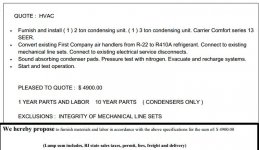
I've attached the quote here. It's not really broken out into too much detail, but it's the quote for everything all-in. Condensers are called out at 2 ton and 3 ton. They sell Carrier units. SEER rating is not a critical concern for me - based on our relatively limited usage and moderate climate, I'm good with keeping it lower cost on the SEER rating - it would take a long time for me to see my investment returned on high SEER value units.
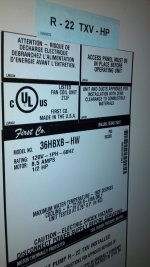
Basically I have two handlers, one for the basement / master / and main floor of the house, and then the other one in the attic crawlspace for the second floor. Both units are set up for R-22, and the guy strongly recommended that we convert them to R-410A. Is that smart / reasonable to do?
The guy was very professional and they are NATE certified, etc. He said all the right things about purging the system, pressure testing, 500 micron test, etc. The copper lines that are currently roughed in are soldered to the air handlers rather than brazed, and he said they would braze them as that's what's needed for the R-410A.
One other thing, the copper lines were never capped outside the house - just left open to the elements, etc. He said they can use the same lines, they'll just need to clean them up. You'll notice in the quote he calls out an "integrity of mechanical line sets" exclusion. Opinions on that? Is that standard procedure?
Thanks in advance for any opinions from you all that have professional experience in this area.
Dave
Looking for some opinions / reassurance from GJ HVAC pros here on the attached quote. I'm no pro and know very little other than research I have done on-line to date, and talking with a couple of engineering friends. I'm not looking so much for a finite $ answer as I understand that costs can vary widely depending on where you live and who you are talking to, but I am looking for experienced opinions on the overall work to be done.
I have a newer (installed 2006) hydro-air system - at the time we had the A/C "roughed in" and now we are looking to finish it. I had a reputable, (recommended by my contractor friend) local, larger company come out to take a look and get a quote last week.
I've attached the quote here. It's not really broken out into too much detail, but it's the quote for everything all-in. Condensers are called out at 2 ton and 3 ton. They sell Carrier units. SEER rating is not a critical concern for me - based on our relatively limited usage and moderate climate, I'm good with keeping it lower cost on the SEER rating - it would take a long time for me to see my investment returned on high SEER value units.
Basically I have two handlers, one for the basement / master / and main floor of the house, and then the other one in the attic crawlspace for the second floor. Both units are set up for R-22, and the guy strongly recommended that we convert them to R-410A. Is that smart / reasonable to do?
The guy was very professional and they are NATE certified, etc. He said all the right things about purging the system, pressure testing, 500 micron test, etc. The copper lines that are currently roughed in are soldered to the air handlers rather than brazed, and he said they would braze them as that's what's needed for the R-410A.
One other thing, the copper lines were never capped outside the house - just left open to the elements, etc. He said they can use the same lines, they'll just need to clean them up. You'll notice in the quote he calls out an "integrity of mechanical line sets" exclusion. Opinions on that? Is that standard procedure?
Thanks in advance for any opinions from you all that have professional experience in this area.
Dave
Last edited: