To avoid these ads, REGISTER NOW!

Hvac return vent size

paulmars

Well-known member
Joined
Jun 7, 2013
Messages
207
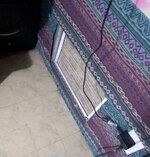
Is 18x12 filter size return large enough? 773 sq ft house. Im getting quotes to replace furnace and condenser w\heat pump. Several quoters have said 2 ton & that existing 18x12 is too small. I was going to cut larger the existing hole which was originally cut thru cmu structural wall. Not a task im looking forward too. I'm looking at larger return vents that id need to buy & most have grills that block up to 50% of airflow. Air handler manufacturers must consider that when specifying return size. My 18x12 has no grill. So. I think it can safely be 50% smaller then manufacturers specify.


Questions I know ill be asked:
This hole was cut thru structural cmu wall when central oil furnace heater was added to 1952 house before i bought in 1986. Sometime after that, but still before I bought, central cooling was added.

In 2002 the condenser started over heating & I was told it needed to be replaced. Contractor installed 3 ton and used that existing hole. After he left I read the install papers & it specified a larger hole. Later I learned 3 ton was too big. A few years later I removed the grill. This also makes it easier to see if it's dirty. It's worked fine all these years, but I know I use it much less then most Floridians.

I think im ok leaving it at 18x12 since no grating to restrict air.

Your thoughts?
 

Attachments

  • edited_edited_PXL_20241213_165802151.jpg
    edited_edited_PXL_20241213_165802151.jpg
    419.5 KB · Views: 34
To avoid these ads, REGISTER NOW!

PCustoms

Well-known member
Joined
Jul 23, 2011
Messages
23,421
Location
VT
Can't answer but subscribing as I have same question. My return was an aluminum gable vent set into the basement door...
 

PoorUB

Well-known member
Joined
Mar 29, 2021
Messages
11,701
Location
Fargo, ND
Is 18x12 filter size return large enough?
You mention 2 tons of cooling, so I will use that. 18x12=216sqin or 1.5 sqft. I go to sqft as the air flow will be in CFM, cubic feet per minute.
cooling requires 400 CFM per ton, so 2 tones = 800 CFM. The calculation for velocity is V = CFM/Area and we are looking for feet per minute, so 800/1.5= 533 FPM

Recommended FPM for an air filter is 250 so you are well under half of what you need.

Turning the equation around, 800/250=3.2 sqft or 460 sqin. You can go larger, larger in the case of air filters is better. Smaller is a no-no. A 20x24 filter is 480sqin.

If you are looking at 3 ton, it is 50% worse. 3 tons needs 1200 CFM 1200/250=4.8 sqft, or 691 sqin.

So, yes your air return is woefully undersized.

I run a 20x 24 filter on my 1.5 ton AC so I am around 180 FPM

As for the AC size? Unless you are trying to cool a screen porch, assuming average or better insulation, 2 ton should be plenty in 700 sqft home.
 

Bert_

Well-known member
Joined
Dec 24, 2016
Messages
9,775
Location
NW Iowa
Your pleated filter is a huge restriction. Even with a regular cheap fiberglass filter it's too small.

Those 1" pleated filters should be illegal to sell

The duct size is probably ok.
 
OP
P

paulmars

Well-known member
Joined
Jun 7, 2013
Messages
207
Ok. Thanks for the through replies. I looked up the spec sheets for two of the air handlers in quotes that i received. Both 2 ton. One said 16x20 filter, the other said 18x18. Based in those replies and considering that 50% of that area can be covered with a louvered grill does that reduce the effective size to 1\2 of 16x20 & 18x18? Btw i was looking at vents offered by same maker of the air handlers.
 

Bert_

Well-known member
Joined
Dec 24, 2016
Messages
9,775
Location
NW Iowa
Ok. Thanks for the through replies. I looked up the spec sheets for two of the air handlers in quotes that i received. Both 2 ton. One said 16x20 filter, the other said 18x18. Based in those replies and considering that 50% of that area can be covered with a louvered grill does that reduce the effective size to 1\2 of 16x20 & 18x18? Btw i was looking at vents offered by same maker of the air handlers.
16x20 or similar is probably bare minimum. Size of the grate or duct are different than filter size.

With a 1" filter of that size you have to use the cheap fiberglass filters.
 

PoorUB

Well-known member
Joined
Mar 29, 2021
Messages
11,701
Location
Fargo, ND
Ok. Thanks for the through replies. I looked up the spec sheets for two of the air handlers in quotes that i received. Both 2 ton. One said 16x20 filter, the other said 18x18. Based in those replies and considering that 50% of that area can be covered with a louvered grill does that reduce the effective size to 1\2 of 16x20 & 18x18? Btw i was looking at vents offered by same maker of the air handlers.
If the filter is the proper size, a grill over it should not affect it. The grill should flow more CFM than the filer. i just looked, a 18x18 return grill is good for 900 CFM.

The point I am getting at is you have an air filter at that return grill. The grill will flow more air than you want for an air filter. Beings you have a essentially a filter grill it needs to be sized for the CFM of the air filter, not the grill, so you need 460 sqin or a 20x24 filter.

Your guys that are saying 18x18 or 16x20 are sizing it by the grill size and not the filter size. Typical Hack B.S. The CFM through a grill can be much higher than air filter CFM requirements. The deal with an air filter is the slower the air, the better it filters. Better chance of particulate getting caught.

I remember one of the installers I worked with was going to put an air filter in a duct for a 5 ton return air. He had a 16x20 return duct which was probably border line ok, but then the filter rack chokes the size down to 14x18, with 1" channel all around. 5 ton is 2,000 CFM so the filter size would be 1,152 sqin or something like a 30x40 filter. Even if he had doubled or trippled the size of the filter is was too small!
 
OP
P

paulmars

Well-known member
Joined
Jun 7, 2013
Messages
207
Manufacturer install docs say 18x18, 16x20 filter.

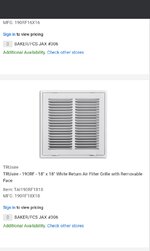
18x18 is 324 sq in. They sell this 18x18 return. Is this 324 sq in of air flow?
 
OP
P

paulmars

Well-known member
Joined
Jun 7, 2013
Messages
207
This
 

Attachments

  • edited_Screenshot_20241216-121620.jpg
    edited_Screenshot_20241216-121620.jpg
    165.5 KB · Views: 28

PoorUB

Well-known member
Joined
Mar 29, 2021
Messages
11,701
Location
Fargo, ND
Manufacturer install docs say 18x18, 16x20 filter.

18x18 is 324 sq in. They sell this 18x18 return. Is this 324 sq in of air flow?
Typically a grill is about 75% of the air flow for it's size, so roughly 243 sqin of air flow. I am seriously surprised the manufacturer says that an 18x18 is fine. i wouldn't recommend it!
 

brewchief

Well-known member
Joined
Sep 20, 2008
Messages
2,370
Location
Michigan
What's the rest of return look like? I would eliminate that filter if possible and use a larger thick media filter at the unit if possible.
 
OP
P

paulmars

Well-known member
Joined
Jun 7, 2013
Messages
207
More flow
 

Attachments

  • Screenshot_20241217-214508.png
    Screenshot_20241217-214508.png
    627.3 KB · Views: 25
OP
P

paulmars

Well-known member
Joined
Jun 7, 2013
Messages
207
Last contractor actually said he wasn't sure of size needed & will get back to me. 2 days later he said "I have an air duct calculator and a 12 x 18 opening will move 1400 CFM. A 2 ton system is 800 CFM. If you add a filter and a front grille, it drops to 900 CFM. It is fine for a 2 ton system but too small for a 3 ton system."

Your thoughts?
 

AGuinn

Well-known member
Joined
Jan 5, 2015
Messages
48
Location
West TN.
Perhaps something of a thread hijack - what if the ducting from the filter to the air handler has a *much* smaller cross section than the filter?

We have a 3-ton unit with a 20x20 and a 20x16 filter mounted in wall cavities, which gives me 5sqft of filtration and 240fpm at the filters. The air then turns 90 degrees and runs between studs, so 3.5x20* and 3.5x16* for a total of 0.875sqft and a flow rate of 1375fpm through the walls to the flexible ducting in the attic. (* there is a further restriction from the filter frame, so the openings are closer to 2x20 and 2x16). In the summer, it seems like the system isn't moving enough air, and I can barely feel airflow from the ceiling registers. By my logic, the in-wall ducts are the bottleneck, but I'm unsure how undersized they are.
 
OP
P

paulmars

Well-known member
Joined
Jun 7, 2013
Messages
207
This AH can support internal air filter. In that case could i keep the return hole 18x12?
 

75gmck25

Well-known member
Joined
Jul 21, 2014
Messages
1,328
Location
Alexandria, VA
The opening appears to be 18" wide and 12" tall. Just rent a concrete saw and cut up or down to the next CMU joint (8"?), and you should have an 18'x20" opening. You might even be able to go up 16". I've cut multiple openings in the brick/CMU of my basement wall and garage wall, and it's not really that hard if you have two strong people to support the saw.

Drill through the corners of the new hole to get a good reference point on each side, and then make a saw cut from each side (14" saw cuts about 6" inches deep. You need two folks to support the electric saw so that you get straight cuts, or you need to make some type of support. For the horizontal cuts I bolted a piece of wood across the face so I could rest the saw on it as I cut across. Vertical cuts were easier, as long as you let the spin of the blade help move the saw forward.

You should also install a lintel to support the wall above and there should already be one that you can move up. Also, if you have a local brick/block vendor they should sell steel lintels in lengths of 2 or 3 feet.
 
Last edited:
To avoid these ads, REGISTER NOW!

gamp945

Well-known member
Joined
Jun 4, 2014
Messages
1,547
Last contractor actually said he wasn't sure of size needed & will get back to me. 2 days later he said "I have an air duct calculator and a 12 x 18 opening will move 1400 CFM. A 2 ton system is 800 CFM. If you add a filter and a front grille, it drops to 900 CFM. It is fine for a 2 ton system but too small for a 3 ton system."

Your thoughts?
You have already received amazing advice from @PoorUB. I would re-read his posts and make sure you understand what he is saying.

Based on your description of your existing system, I think it is almost certain that your air handler is pulling air from areas other than the return filter. If your 3-ton system (about 1200CFM) has "worked fine" with a tiny 1.5 sq ft filter, it is almost certain that your air handler is pulling most of its air from the attic, crawlspace, or outdoors instead of across the return filter inside your home. Such a small air filter with so much air flow is simply too restrictive, and the air handler is very likely pulling air from other areas instead. That would be a massive waste of energy and money and has probably resulted in comfort issues in your home.

If your proposed contractor is using a ductulator to calculate return air filter size you should fire them immediately. A return filter is not a duct and a ductolator is not the proper tool. Regardless of that incorrect starting point, I have no idea how he would conclude that 900CFM across a 12x18 filter as OK. That would result in 600FPM across the filter (900CFM / 1.5 SqFt filter area). That is at least double the maximum. And you shouldn't be building a new system based on the worst-case spec anyway. That contractor is a total hack.

My advice is to start over. You are in Florida, correct? There is no shortage of HVAC companies in FL. Find one that begins the conversation by doing a load calculation on your home; how much heating and cooling capacity do you actually need? From personal experience, I can say that most HVAC companies are full of hacks and won't do an actual load calculation because they are complicated. But that is there job and you should only hire companies with professionals that can actually do something complicated.

I am extremely skeptical that you need 2 tons for a 773 Sq Ft house, even if it built in 1952. More than likely you have had exceptionally lazy and unprofessional HVAC companies use an old "rule of thumb" of 1 ton per 400 Sq Ft to conclude in two seconds that you need a 2-ton unit. A proper load calculation, which might take an hour or more, is more complicated.

Watch this video, and others like it, to understand why you don't want to oversize your system:


Have you done any air sealing and/or insulation upgrades to your home? That will impact how much heating/cooling you need. How is your indoor humidity?

Even without having done a load calculation on your home, my guess is that you would be far more comfortable with a 1.5 ton central heat pump. It might seem counterintuitive, but you need to size the system so that it runs as much as possible. On the hottest day of the year, it should be running virtually non-stop.

If you right-size your installation, your 12x18 return might be OK. Note that in Florida, 350CFM/ton is a common target (not 400CFM/ton) to increase latent heat removal (i.e., humidity). On a 1.5ton system with 350CFM/ton across an 18 x 12 filter, you would get:

(350CFM * 1.5ton = 525) / (18 * 12 = 216 sq in = 1.5 sq ft) = 350FPM across the filter

That is still a bit too high (should be 300FPM at most), but you can see that downsizing your equipment and slowing the air speed to increase humidity removal reduces the need for large ductwork and filter size. Reducing the size of equipment also costs less money up front. Smaller equipment needs lower amperage also, and that may be a consideration for a 1952 home which probably has only 100A service.

Another option in a 773 sq ft house is to use one or more mini splits. No ductwork at all in that case. You could even reasonably do the purchase and installation of mini splits yourself if you are motivated.
 
OP
P

paulmars

Well-known member
Joined
Jun 7, 2013
Messages
207
I appreciate your advice. Everyones. However, uve misquoted what I've said. None of the hvac contractors except one explicitly said 12x18 was fine. The contractor i choose (in part because of everyone heres advice) told me 24x24. Also only two said 2.0 ton, most said 2.5 after walking around outside house & entering number into a laptop. Some went back to office to crunch numbers. 2 said 3.0 for reasons I wont bother to repeat. The contractor I choose said 1.5, but agreed to go 2.0 after I stated why.

The AHU fan air box I can look in. It looks sealed & is just 10" from my 12x18 return filter. Now im sure there are a few small leaks,but nothing major. In house standing near the return u can hear the air sucking in.

I've added insulation to attic several times. Also added ridge & soffit vents.

New 2 ton AHU specs say 700 cfm.

Ive considered mini splits & window units.

With 3 ton I have no humidity issues. Except for the 1st cycle, it cycles on for 5 minutes & off for 10 to 20. After a few cycles I turn it off and I feel fine for hours. It's always off at night. When I get up or home and turn it on, after 5 minutes temp has gone down 2 deg & humidity by 20 percentage points. This is why ive decided on 2 ton opposed to 1.5.

ive read iver poorUB many times. I dont understand.

I asked the contractor i chosen if we can use the internal 16x20 & ill put a grate over return hole in house. He said that will be fine.

BTW the 3 ton is still working fine & it's 22 years old.

Ill watch that vid after I post this.
 

gamp945

Well-known member
Joined
Jun 4, 2014
Messages
1,547
No offense, but your practice of manually turning your system on/off is old school. Your description of your 3 ton unit is exactly what you DON'T want. On for 5 minutes only is a "short cycle". Your humidity should NEVER be high enough that it can go down 20 percent! Your humidity should stay very constant. For health, comfort, and longevity of building materials, your humidity should hover around 45% - 50%. I would not accept even 55%. When you have low humidity inside, you can keep the temperature higher (e.g., 74F - 78F) and feel very comfortable. To achieve that, you need a right-sized system that runs as long as possible. A smaller-capacity system that has long run cycles (as long as possible) does not cost you extra money because it uses less energy (e.g., 1.5 tons) than a higher-capacity system (e.g., 2 tons).

You should not be manually intervening to turn on / off your system. Letting the compressor run as long as possible removes more humidity compared to short run cycles. More air needs to flow across the cold coil to remove more humidity. A 5-minute run cycle only allows a small amount of air to be dehumidified.

When your contractors are supposedly doing a load calculation and coming up with 2 tons, they are most likely rounding UP, not down. Nobody should be more interested in your system's performance and your own comfort than YOU, so I would invest the time and effort of performing your own manual J load calculation (as you have done already).

Note that when you came up with 1.7 tons, that is sized for the few (like 3) hottest days of the entire year. That's how a load calculation works. If you put in a 2 ton system, it will be oversized for even the hottest days of the year. That means it works worse, not better, for even the hottest days of the year. It would be even more oversized, and work worse, not better, for moderate weather days (and most days in a year are moderate temperatures, not extreme temperatures). Why would you want that? If you put in a 1.5 ton system instead of a 2 ton system, it will barely be undersized for the hottest day of the year, and it will be right-sized for all of the more typical days of the year.

Check out this blog post about the 99% / 1% design temperatures here:

And a short video that describes the same here:

Another way of looking at load calculation is that they are already oversized even when done correctly - the equipment is sized correct for the few (3) hottest days of the year and oversized for the other 362! The recommendation by the smart building science guys is to round down, not up. Right-sizing an HVAC system is kind of counterintuitive for a lot of guys because for a lot of other things, more power/capacity (oversizing) is considered better. But that is not true at all for sizing an HVAC system.

From your description and load calculation, a 1.5 ton system would definitely be better than a 2 ton system for your home. Aside from being more comfortable, it would also require less amperage (easier/better for old electrical service), work better with existing (probably undersized) ductwork (lower static pressure = less blower stress = less electricity and longer life), and be less expensive to purchase in the first place. You would turn it on on day one of installation and never fiddle with the thermostat again and it would work correctly, as intended.

One other thing: I'd again encourage you to vigorously inspect how the existing air handler might be interacting with the attic and/or crawlspace. There is no way your system has been pulling 1200cfm through a 1.5sq ft filter. The air velocity and pressure would easily collapse the filter. To give you an example of what that might look like: when I purchased my 1960s home, my air handler, like yours, had a central return. It was installed in a central closet. The closet had a 16" x 8" return grille (for a 3-ton system). How did this tiny return allow enough air in for the system to operate correctly? The closet's ceiling was open to the attic. The air handler was pulling humid/hot outdoor air into the attic through the ridge, soffit, and gable vents, then into the AHU closet where it would then send it into the home. A "professional" did this. It took me, a "homeowner" to figure it out and correct their mistake.

If your current air handler is installed in a location that allows it to return air to bypass the filter in the wall, then this problem will persist even after installing a new HVAC system. You want 100% of the air going through the AHU to be properly filtered. That keeps your coil cleaner and therefore working optimally.

Where in your home is your current air handler installed?
 
OP
P

paulmars

Well-known member
Joined
Jun 7, 2013
Messages
207
U want me to leave it on all day when i can turn it off for hours & still be comfortable...ok

Id freeze my a** off having it set to 78
 

Bert_

Well-known member
Joined
Dec 24, 2016
Messages
9,775
Location
NW Iowa
Last summer I used an 8,000 btu window air conditioner. That is 0.66 Ton. It cooled the 1100sq ft main floor and had no problem keeping the interior about 20* cooler than outside temperature.

My house was built in the 1920's, many original windows, 60% or so has good insulation.

Just trying to give you a baseline.
 
Last edited:

gamp945

Well-known member
Joined
Jun 4, 2014
Messages
1,547
U want me to leave it on all day when i can turn it off for hours & still be comfortable...ok

Id freeze my a** off having it set to 78
With respect, I think the reason you think that way is because you have never had a properly functioning HVAC system. I promise you that the many thousands of brilliant scientists and engineers that have worked on the science of psychrometrics have not made a mistake in designing HVAC systems to run continuously.

The most likely reason that you have a distorted view of a continuously-operating HVAC system is because for the last 2+ decades you have lived in a home that has about 3x too much AC capacity for the vast majority of days (not your fault). When the AC kicks on it is blasting you with arctic chilled air blowing with 3x the velocity ("wind") that it should. The air coming from the registers in a properly sized system will be far closer to the ambient temperature and you won't notice it being "freezing", nor will you notice it blowing on you because it will move much more slowly. If you are freezing with the thermostat set to 78F, then putting in another oversized system (2 ton) will continue to give you comfort problems, albeit not as much as a 3 ton system.

A properly sized and designed system will be invisible. You should not notice it being on at all. No hot spots nor cold spots in the home, and no noticeable air blowing on you. That all requires that it runs as much as possible. That means luke warm air (in the winter) and slightly chilled air (in the summer) moving very slowly and not blowing directly onto humans. The proper difference in temperature from air going into the return and the air coming out of the registers (known as delta-T) should be only 20F. If you were able to measure the air in your current system I'm confident you would find the delta-T is much higher than that. That's why you are freezing your a** off when the system is turned on.

With a continuously running system, your comfort inside your home is tempered by radiation and conduction from the stuff inside it (walls, floor, ceiling, furniture, etc), not by convection via hot or cold air being blasted directly onto your skin. In other words, what keeps you optimally comfortable is that *everything* in your home is the same temperature (78F for example), not just the air inside the home. Here's a good building science blog post on the topic:


When you turn on an oversized system, the air temperature feels too hot or too cold very quickly. That's why you turn it off - its uncomforable. Meanwhile, everything else in your home (building materials, furniture, etc) remains too warm (in the summer) or too cold (in the winter). Air is a poor conductor of heat energy. It takes lots of time for the air coming out of the registers to turn the entire building and contents into a consistent temperature. A proper-sized system will run as much as possible so that the entire building structure reaches nearly the same temperature. That's comfortable because it is invisible to you.

BTW, mini splits use compressors with inverters. That means that a single unit's capacity is not one value (e.g., 1 ton). Instead, the compressor is able to vary from the nameplate rating (e.g., 12K / 1 ton) to a very low capacity (e.g., 2.5K or just 1/5 ton). They are designed to run constantly. They do so by only producing enough heat or cold to maintain your setpoint (e.g., 78F). That means the under normal conditions, the air coming out of them should feel almost the same as the ambient room air if you put your hand in front of the blower.

In contrast, central systems rarely use inverters (although they are available but expensive). Central systems are usually single-stage, and I'm sure that's what has been quoted to you. That means the system is either totally on (100%) or off (0%). That's not great, but if you right-size the system, most days it will have long run times and keep you very comfortable. A good compromise is a 2-stage central system which runs at about 70% of capacity when it first turns on, and then ramps up to 100% if needed. I have a 2-stage system. This allows it to run more often in the "shoulder seasons" of fall and spring. That allows it to dehumidify well even when it isn't blazing hot out in the middle of summer. My 2-stage system runs in the first stage (70% capacity) about 90% of the time. It only ramps up to 100% capacity on the very hottest hours of the very hottest days.

Your last response makes it sound like you might not want want evidence-based advice, so I guess I'll stop bothering you with my time and effort. I guess that might have been why PoorUB stopped posting. I was trying to return the favor done to me from the brilliant people that have posted about HVAC on forums that I've learned from.
 
OP
P

paulmars

Well-known member
Joined
Jun 7, 2013
Messages
207
I never turn it off cuz im uncomfortable. Im cheap & i noticed that house stays comfortable often for hours once it has cycled once (shady days) or a few times (very hot & sunny days). So why spend money hearing it cycle on when im already comfortable?

Several years ago I measured the temperature difference & it was 12 degrees.

Who said every one should be comfortable at 78?
 
OP
P

paulmars

Well-known member
Joined
Jun 7, 2013
Messages
207
"Meanwhile, everything else in your home (building materials, furniture, etc) remains too warm (in the summer)" Is that why it stays off for 10 to 15 minutes before cycling back on?
 
OP
P

paulmars

Well-known member
Joined
Jun 7, 2013
Messages
207
Do you know why im replacing this perfectly working condenser that keeps me very comfortable in Florida summers? Ill tell you. The oil heater broke & I decided to go heat pump. I use the heater more then the condenser. Cold bothers me more then heat.
 

acer66

Well-known member
Joined
Dec 4, 2010
Messages
4,418
Location
Western North Carolina
With respect, I think the reason you think that way is because you have never had a properly functioning HVAC system. I promise you that the many thousands of brilliant scientists and engineers that have worked on the science of psychrometrics have not made a mistake in designing HVAC systems to run continuously.

The most likely reason that you have a distorted view of a continuously-operating HVAC system is because for the last 2+ decades you have lived in a home that has about 3x too much AC capacity for the vast majority of days (not your fault). When the AC kicks on it is blasting you with arctic chilled air blowing with 3x the velocity ("wind") that it should. The air coming from the registers in a properly sized system will be far closer to the ambient temperature and you won't notice it being "freezing", nor will you notice it blowing on you because it will move much more slowly. If you are freezing with the thermostat set to 78F, then putting in another oversized system (2 ton) will continue to give you comfort problems, albeit not as much as a 3 ton system.

A properly sized and designed system will be invisible. You should not notice it being on at all. No hot spots nor cold spots in the home, and no noticeable air blowing on you. That all requires that it runs as much as possible. That means luke warm air (in the winter) and slightly chilled air (in the summer) moving very slowly and not blowing directly onto humans. The proper difference in temperature from air going into the return and the air coming out of the registers (known as delta-T) should be only 20F. If you were able to measure the air in your current system I'm confident you would find the delta-T is much higher than that. That's why you are freezing your a** off when the system is turned on.

With a continuously running system, your comfort inside your home is tempered by radiation and conduction from the stuff inside it (walls, floor, ceiling, furniture, etc), not by convection via hot or cold air being blasted directly onto your skin. In other words, what keeps you optimally comfortable is that *everything* in your home is the same temperature (78F for example), not just the air inside the home. Here's a good building science blog post on the topic:


When you turn on an oversized system, the air temperature feels too hot or too cold very quickly. That's why you turn it off - its uncomforable. Meanwhile, everything else in your home (building materials, furniture, etc) remains too warm (in the summer) or too cold (in the winter). Air is a poor conductor of heat energy. It takes lots of time for the air coming out of the registers to turn the entire building and contents into a consistent temperature. A proper-sized system will run as much as possible so that the entire building structure reaches nearly the same temperature. That's comfortable because it is invisible to you.

BTW, mini splits use compressors with inverters. That means that a single unit's capacity is not one value (e.g., 1 ton). Instead, the compressor is able to vary from the nameplate rating (e.g., 12K / 1 ton) to a very low capacity (e.g., 2.5K or just 1/5 ton). They are designed to run constantly. They do so by only producing enough heat or cold to maintain your setpoint (e.g., 78F). That means the under normal conditions, the air coming out of them should feel almost the same as the ambient room air if you put your hand in front of the blower.

In contrast, central systems rarely use inverters (although they are available but expensive). Central systems are usually single-stage, and I'm sure that's what has been quoted to you. That means the system is either totally on (100%) or off (0%). That's not great, but if you right-size the system, most days it will have long run times and keep you very comfortable. A good compromise is a 2-stage central system which runs at about 70% of capacity when it first turns on, and then ramps up to 100% if needed. I have a 2-stage system. This allows it to run more often in the "shoulder seasons" of fall and spring. That allows it to dehumidify well even when it isn't blazing hot out in the middle of summer. My 2-stage system runs in the first stage (70% capacity) about 90% of the time. It only ramps up to 100% capacity on the very hottest hours of the very hottest days.

Your last response makes it sound like you might not want want evidence-based advice, so I guess I'll stop bothering you with my time and effort. I guess that might have been why PoorUB stopped posting. I was trying to return the favor done to me from the brilliant people that have posted about HVAC on forums that I've learned from.
Man I lived in a small old house with an insanely oversized furnace.
Every time it kicked in it felt like Sahara winds going through the house then it shut off only to kick back on after icicles formed.

“A/C” was a jerry rigged into the ducting squirrel cage that blowed coldish damp basement air into the house operated by a manual switch.

Fun times! 😉
 

gamp945

Well-known member
Joined
Jun 4, 2014
Messages
1,547
I never turn it off cuz im uncomfortable. Im cheap & i noticed that house stays comfortable often for hours once it has cycled once (shady days) or a few times (very hot & sunny days). So why spend money hearing it cycle on when im already comfortable?

Several years ago I measured the temperature difference & it was 12 degrees.

Who said every one should be comfortable at 78?
"Meanwhile, everything else in your home (building materials, furniture, etc) remains too warm (in the summer)" Is that why it stays off for 10 to 15 minutes before cycling back on?

I'm not going to give you any more advice and I'm sorry that I spent any time already. I'd just delete my posts but maybe some that doesn't already have their mind made up that they know better than building scientists might read it and get some value.

I'm only replying to say two things:

If your delta-T measures 12 degrees with a double oversized system, then you have even bigger problems than you know. Good luck.

I didn't say everyone should be comfortable at 78. I stated "e.g., 78F". The first part of that, "e.g." is latin for exempli gratia, meaning "for example." The saying "for example" is English, meaning that the information being given is illustrative only and can be substituted with other values.

Your last question was addressed in the blog post I linked which you clearly didn't read or understand.

I've never been snippy on this forum in the 10+ years I've been active and genuinely just want to help people. I'll be sure to remember your username and not offer help in the future.
 
OP
P

paulmars

Well-known member
Joined
Jun 7, 2013
Messages
207
"If your delta-T measures 12 degrees with a double oversized system, then you have even bigger problems than you know. Good luck." It's low on charge. It's never been charged since it was installed. Condenser refrigerant temps confirm that.

I appreciate all the help I get on these forums, but if someone says something that is wrong about me or what ive said or makes erroneous presumptions, Ill point those out. Example telling me that i turn it off cuz cold air is making me uncomfortable. Not true. Problem is you're so d*** sure that 2 ton is too big that that is all that matters to you, so ur trying to find issues with my 3 ton. I know it's too big & return is too small. Still ive never lived in a house or apartment that was more comfortable. Im 62 yo. So, im not dropping to 1\2 that size. Maybe some of those contractors were right. Ive gotten 12 quotes. Only one said 1.5 & he thinks 2 Will be fine & he's not just agreeing with me to make me happy. He has disagreed with some of my other proposals. Two others said 2, most said 2.5, & 3 said 3 ton.

Because of advice on forums im going with larger return.

P
 
OP
P

paulmars

Well-known member
Joined
Jun 7, 2013
Messages
207
Man I lived in a small old house with an insanely oversized furnace.
Every time it kicked in it felt like Sahara winds going through the house

Fun times! 😉
I suspect that my ducts are too undersized to cause that
 

PopcornSutton

Well-known member
Joined
Jun 10, 2024
Messages
800
Location
Northern Tip of VA
Proper size unit, proper sized supply ducts are key. Return air, let it breath! You can't make it too big. Many buildings are designed with no return ducts, ceilings have return grills and the whole ceiling space is a return plenum.
 
To avoid these ads, REGISTER NOW!
Top Bottom