To avoid these ads, REGISTER NOW!

HVAC sizing sanity check

Innovate1

Well-known member
Joined
Jul 28, 2014
Messages
4,288
Location
Illinois near St. Louis, Missouri
Have quotes for HVAC for new construction home and detached garage. The sizing varied so doing my own calcs for comparison. Started with the detached garage as it is a simpler case.

1200 sq feet, 2 people doors on north side, 12 x 12 and 9 x 8 OHDs on east side
2x6 insulated walls, 2" foam under slab and at edge (except at OHDs).

Quote1: 45kBTU furnace, 2 ton AC
Quote 2: 70kBTU furnace, 2.5 ton AC
Quote 3: 70kBTU furnace, 2 ton AC
My calc: 30kBTU furnace, 1.5 ton AC (below minimum sizes for ducted furnace/AC)

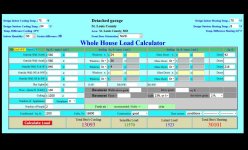
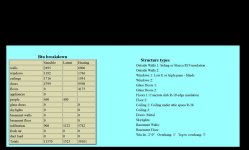
Here's my calcs:
 

Attachments

  • ShopHVAC1.jpg
    ShopHVAC1.jpg
    152.2 KB · Views: 79
  • ShopHVAC2.jpg
    ShopHVAC2.jpg
    108.8 KB · Views: 50
Last edited:
To avoid these ads, REGISTER NOW!

LS6 Tommy

Well-known member
Joined
Dec 27, 2013
Messages
26,162
Location
Northern NJ
IMO, If they only used the specs you posted no one could have given you an accurate size. I suggest you get a real Manual J calculation done.

Tommy
 
OP
I

Innovate1

Well-known member
Joined
Jul 28, 2014
Messages
4,288
Location
Illinois near St. Louis, Missouri
I gave them the plans that had all the details. Just posted the main details.

The amount of time the doors are open will make more difference than the finer details. Maybe that's why one contractor sized a 110k BTU furnace for the 25 x 25 attached, insulated garage? The doors will be open very infrequently and I don't need quick recovery for that. This area gets high humidity in the summer. Don't want to oversize the AC as that would have worse humidity removal.
 
OP
I

Innovate1

Well-known member
Joined
Jul 28, 2014
Messages
4,288
Location
Illinois near St. Louis, Missouri
How big is the house?

It's a detached garage. The house is 1600 sq ft but it doesn't affect this sizing.

In case I wasn't clear I am building a house with attached and detached garages. The numbers I posted were all for the detached garage. Once I do that I will go back and look at sizing for the other spaces.
 
Last edited:

justinjoyal

Well-known member
Joined
Apr 30, 2015
Messages
888
Location
Quebec
IMO, If they only used the specs you posted no one could have given you an accurate size. I suggest you get a real Manual J calculation done.

Tommy

Well actually looking at his calc and specs we can figure out just about everything that's needed, considering what he put in is right.

Fresh air intake + infitration is missing, but if it's a new building it should be at least average, hopefully better.

2-ton + 45k seems good.

Did you ask the contractors how they came up with those numbers ?
 

MattT

Well-known member
Joined
Feb 20, 2010
Messages
3,201
Only thing I see obviously wrong is you've ran the entire slab perimeter as R10. Other than that rating the construction as "good" may be too optimistic. I've never seen an OHD I'd call good.

Regards humidity control going with 2 stage AC, if you want ducted, will help with that.
 

yeldogt

Well-known member
Joined
Jan 2, 2012
Messages
18,184
I do 1700sf with net of about 30k btu -- it has no problem. I'm using an electric 13k Btu currently because of construction and it's having no issues keeping the whole space in the 60's with 30 degree weather.

You will be more comfortable with smaller and longer run times with both heat and cool.

The issue many have with garage spaces. 1. poorly insulated 2. leakage. Because of 1 and 2 they don't want to maintain a temp. So the heater needs to be larger to both over come 1&2 .. plus heat 40 degree air for an hour.

If you insulate and get a proper size heater -- you will save money and be more comfortable going forward.

Cabinet heater and mini-split. How much AC do you need ?
 

brewchief

Well-known member
Joined
Sep 20, 2008
Messages
2,370
Location
Michigan
Ductwork exposed or in attic?

A 45,000 btu 80% furnace will have an output of 36,000 btus


1.5 ton ACs are available.

Sometimes a piece of equipment will have a different input then what the model number shows, a Lennox 70k furnace is currently 66k input.

Most people won't keep a detached building at their normal comfort level, they will turn it down in the winter and turn the AC off or way up in the summer, contractors don't want to hear about it taking hours to warm up a customers garage so they tend to oversize things a bit.

Knowing how people are I would be fine with either a 45k or a 70k furnace and a 2 ton AC, the 70k would provide some extra recovery if things change down the road and the doors get opened more often.
 

Showkey

"MEMBER EMERITUS"
Joined
Aug 9, 2014
Messages
8,638
Location
Wausau WI
New home..........80% would not even be a remote consideration. Some locations 80% would not be permitted by code.

Common sense would say 20% going up the stack a waste of money for the next 20 years.
 

Jim greengo

Well-known member
Joined
Sep 3, 2018
Messages
7,415
Location
Behind my house
It's a detached garage. The house is 1600 sq ft but it doesn't affect this sizing.

In case I wasn't clear I am building a house with attached and detached garages. The numbers I posted were all for the detached garage. Once I do that I will go back and look at sizing for the other spaces.
Nope,I was just trying to figure out equipt sizing for house.
Is that main floor footage,or does that include a basement also?
 

brewchief

Well-known member
Joined
Sep 20, 2008
Messages
2,370
Location
Michigan
New home..........80% would not even be a remote consideration. Some locations 80% would not be permitted by code.

Common sense would say 20% going up the stack a waste of money for the next 20 years.

I agree on not doing an 80% furnace in the house, the sizing he was showing was for a detached garage, do a 90+ furnace in there and you have to deal with condensate disposal in freezing temps so you can't just dump it out the wall like the AC. At some point someone will decide they don't want to run the heat all the time and you can end up with damage to the furnace from condensate freezing in it.
 

Slowgsr

Well-known member
Joined
Nov 14, 2014
Messages
610
Location
Southern ontario
Why not a tube heater and a mini split? My schwank 50kbtu in my 30x30x14 is excellent. -25c (-13f) here and
95f (35c) in the summer with 100% humidity. My mini split is a Mr slim mitsu 2ton. I have no issues keeping it at 20 Deg c and dry in the summer, and 20Deg in the winter when I'm out working.
 

justinjoyal

Well-known member
Joined
Apr 30, 2015
Messages
888
Location
Quebec
Only thing I see obviously wrong is you've ran the entire slab perimeter as R10. Other than that rating the construction as "good" may be too optimistic. I've never seen an OHD I'd call good.


Regards humidity control going with 2 stage AC, if you want ducted, will help with that.


R10 around the slab is possible and actually common around here, so why not ?
 

Mabalzach

New member
Joined
Sep 5, 2015
Messages
4
I would go with quote 2 calculation and here is why. I used to live in the KC area which is similar climate to STL. The calculations in manual j are off in regards to humidity for the area.

I have worked in the HVAC industry for 15 years and have dealt with this issue many times(lack of capacity/airflow). In a space that potentially opens to the outside, you will want a fast recovery time for comfort. I have only seen a grossly oversized system that caused humidity related issues maybe 2-3 times in my professional career. They were oversized several tons and the places were closed off. A extra ton of capacity will be welcome in the garage.

Costs differences will be almost nil for 2 reasons. 1-3 ton air handlers and furnaces all use the same drive of 1200 cfm. Your only additional cost will be the outside unit with should only be a few hundred dollars extra-at most. A properly designed system will cycle 3-6 times per hour during peak demand. I guarantee a 1.5 ton system in a garage will struggle after a few years if it is not maintained well and the install is not ideal.

If you haven't had a 410a system in your house they are a different animal compared to the older r22 systems. They run at almost double the pressure on a high load situation. Personally in the long run, I want that system running as little as possible to extend the life of the equipment and cool the space effectively. A smaller system will accomplish the opposite of that.

Manual j is a great guide, but is the minimal guideline for a space.
 

justinjoyal

Well-known member
Joined
Apr 30, 2015
Messages
888
Location
Quebec
Because the OP said he had 2" foam around the slab except for the OHDs. So ~120' of R10 and ~20' of R0.

Oh right i had missed that.


A properly designed system will cycle 3-6 times per hour during peak demand. I guarantee a 1.5 ton system in a garage will struggle after a few years if it is not maintained well and the install is not ideal.

A properly designed system will not cycle as such

And

I’ve never heard of a sizing a system based on problematic installation and neglected maintenance...


If you haven't had a 410a system in your house they are a different animal compared to the older r22 systems. They run at almost double the pressure on a high load situation. Personally in the long run, I want that system running as little as possible to extend the life of the equipment and cool the space effectively. A smaller system will accomplish the opposite of that.


Manual j is a great guide, but is the minimal guideline for a space.

Are you suggesting that short-cycling is the way to go ? That’s how you kill a system, not with the high pressure it is designed to work with.

Manual J reflects the actual needs so you can size a system for efficiency and comfort.

OP said the OHDs will not often be opened and that he doesn’t need quick recovery. He also said humidity is an issue, so the last thing I’d want is an oversized, short-cycling A/C.
 
OP
I

Innovate1

Well-known member
Joined
Jul 28, 2014
Messages
4,288
Location
Illinois near St. Louis, Missouri
R10 around the slab is possible and actually common around here, so why not ?

Would be interested in more details on how it is done there. Here they have all sorts of rules about minimum insulation but don't address slab edge so it isn't common. I am planning to run the 2" foam to the top of the foundation with nailers in the concrete for fastening. There is an issue with flame spread on some foams and initially AHJ said it wasn't allowed (may have just been an issue in attached garage) but I found testing for a particular brand stating it was acceptable and giving the numbers. Still considering what to cover it with - fire treated plywood/osb or drywall.
 
OP
I

Innovate1

Well-known member
Joined
Jul 28, 2014
Messages
4,288
Location
Illinois near St. Louis, Missouri
Because the OP said he had 2" foam around the slab except for the OHDs. So ~120' of R10 and ~20' of R0.

You are right I didn't model this. Will have to look at how to do it. The bottom two feet of the wall is foundation with 2" foam so that would be a second wall entry but the effect of the slab at OHD is likely bigger so could use the second type of wall for the slab at OHD. For the slab at the OHD there is no wall - not sure how to enter it. I don't see how to enter a wall with R0. Would like to insulate slab at OHD but don't see a way to practically do it.
 
To avoid these ads, REGISTER NOW!
OP
I

Innovate1

Well-known member
Joined
Jul 28, 2014
Messages
4,288
Location
Illinois near St. Louis, Missouri
I agree on not doing an 80% furnace in the house, the sizing he was showing was for a detached garage, do a 90+ furnace in there and you have to deal with condensate disposal in freezing temps so you can't just dump it out the wall like the AC. At some point someone will decide they don't want to run the heat all the time and you can end up with damage to the furnace from condensate freezing in it.

There is a half bath in the building and a floor drain for condensate so that issue is covered. But there are other issues I am just looking into. Read that set point shouldn't be below 55F to prevent condensation in primary heat exchanger and early failure. Normally will be in that range but would be nice to be able to lower it more for longer periods of non-use. Apparently they can be winterized by draining the trap although there is some conflicting info on if there can be enough water left in the secondary heat exchanger to cause freeze damage.
 
OP
I

Innovate1

Well-known member
Joined
Jul 28, 2014
Messages
4,288
Location
Illinois near St. Louis, Missouri
Wondering about the difference in heating costs between a natural gas 80% and 92% furnace for the 1200 sq ft garage and found this calculator:

http://www.energydepot.com/ResidentialEnergyCalculator/

It doesn't have any adjustment for insulation values and such and has other loads (water heating, etc) but just getting the difference between the two furnace efficiencies was $93 per year. Given I won't be maintaining 70F all the time and the building is well insulated (but has big doors) I should be under that. Maybe a 80% furnace isn't such a bad option after all.

Wonder how much loss the flue of the 80% is? Leakage up the flue when the unit is off and use of conditioned air for combustion. I think some of the 80% units use outside air for combustion.
 

LS6 Tommy

Well-known member
Joined
Dec 27, 2013
Messages
26,162
Location
Northern NJ
Well actually looking at his calc and specs we can figure out just about everything that's needed, considering what he put in is right.

Fresh air intake + infitration is missing, but if it's a new building it should be at least average, hopefully better.

I originally looked at the post on my phone and didn't see the insulation info. :thumbup:

Tommy
 

brewchief

Well-known member
Joined
Sep 20, 2008
Messages
2,370
Location
Michigan
There is a half bath in the building and a floor drain for condensate so that issue is covered. But there are other issues I am just looking into. Read that set point shouldn't be below 55F to prevent condensation in primary heat exchanger and early failure. Normally will be in that range but would be nice to be able to lower it more for longer periods of non-use. Apparently they can be winterized by draining the trap although there is some conflicting info on if there can be enough water left in the secondary heat exchanger to cause freeze damage.
I've done jobs where the furnace was placed in a small mechanical room ( half bath could be included as well) and a section of electric baseboard was used to provide freeze protection when the furnace was completely off. If you plan on keeping it 55f and then warming it up when you want to use it I would lean to the 70k furnace, it will still be small enough to minimize short cycling but will allow for a reasonable warm up time. If you are really worried about it being oversized then you could go to a two stage furnace.

FWIW I ran the info you showed through my heat load program and it was pretty close to your numbers, I had to make some assumptions but I don't see anything that would make a major difference.

Sent from my SM-G965U using Tapatalk
 
OP
I

Innovate1

Well-known member
Joined
Jul 28, 2014
Messages
4,288
Location
Illinois near St. Louis, Missouri
The furnace will be in a corner room that is about 15 x 15 and planned manual dampers so I could heat/cool (probably just an issue for heating) just that section. Would isolate the section with the large OHDs so that will cut the heat loss a lot. 2 walls and the ceiling are to outside temp.
 

Mabalzach

New member
Joined
Sep 5, 2015
Messages
4
Oh right i had missed that.

I’ve never heard of a sizing a system based on problematic installation and neglected maintenance...

That's not what I was saying. You don't size for these. But it creates a perfect storm of problems that are not cheap to fix. We have a lot of regional problems especially in commercial HVAC with engineering companies from out of state under sizing systems here and managing o/a improperly. They are going by tables that are not up to date in regards to average temperature, etc.

Marginally sizing a system for humidity removal is almost a guarantee for problems in the future. Especially if the install is not ideal. St Louis has far more Hot/Humid Days than what people think and that system will be running all day long if the doors get opened. Half a ton of extra capacity is nothing in the long run especially with a TXV and as the system ages will still be able to perform well as add a little bit of flexibility just in case needs change. I don't know about you but I hate changing compressors. Especially if it is preventable.

Are you suggesting that short-cycling is the way to go ? That’s how you kill a A/C.
-3 to 6 times a hour is perfectly fine and will not cause humidity removal issues at all. Manufacturers typically spec 2-5 cycles per hour. Actually You kill a A/C by running it nonstop and shortening the life cycle of the equipment.
 

justinjoyal

Well-known member
Joined
Apr 30, 2015
Messages
888
Location
Quebec
That's not what I was saying. You don't size for these. But it creates a perfect storm of problems that are not cheap to fix. We have a lot of regional problems especially in commercial HVAC with engineering companies from out of state under sizing systems here and managing o/a improperly. They are going by tables that are not up to date in regards to average temperature, etc.


Marginally sizing a system for humidity removal is almost a guarantee for problems in the future. Especially if the install is not ideal. St Louis has far more Hot/Humid Days than what people think and that system will be running all day long if the doors get opened. Half a ton of extra capacity is nothing in the long run especially with a TXV and as the system ages will still be able to perform well as add a little bit of flexibility just in case needs change. I don't know about you but I hate changing compressors. Especially if it is preventable.


-3 to 6 times a hour is perfectly fine and will not cause humidity removal issues at all. Manufacturers typically spec 2-5 cycles per hour. Actually You kill a A/C by running it nonstop and shortening the life cycle of the equipment.


How do you figure actually sizing a unit according to the cooling load will shorten the compressor’s life ?

Oversized units are a pain.
 

Mabalzach

New member
Joined
Sep 5, 2015
Messages
4
How do you figure actually sizing a unit according to the cooling load will shorten the compressor’s life ?

Oversized units are a pain.

Here I will spell it out for you very simply. If the numbers in the calculations are based on inaccurate or dated data, you are not oversizing the system-it is merely a correction. Typically in Missouri the temps can be above 90f from July through September often for weeks on end and with elevated levels of humidity. The 1% number ASHRAE gives IMO is slightly low for the area. If the actual load on the building is higher that what was calculated, the system will run longer to pull the building down to temp/remove humidity.
This means:
1. A higher energy bill because of extended runtimes and possible premature equipment failure. The chance of this is increased if maintenance is not done in proper intervals.
2. A unhappy customer as there is literally nothing you can do short of adding capacity. Do you want to be the Company Owner telling a unhappy customer that the 10k they just spent on a system that doesn't work is fine; 'because it's sized to the manual j"? I personally don't.

In your part of the world, typically building code enforcement is much more stringent and homes are insulated much better than they are in flyover country.
Designing a HVAC system without a little flexibility is a unwise move especially if the building envelope is not built 100% as designed-they rarely are.
 

justinjoyal

Well-known member
Joined
Apr 30, 2015
Messages
888
Location
Quebec
Here I will spell it out for you very simply. If the numbers in the calculations are based on inaccurate or dated data, you are not oversizing the system-it is merely a correction. Typically in Missouri the temps can be above 90f from July through September often for weeks on end and with elevated levels of humidity. The 1% number ASHRAE gives IMO is slightly low for the area. If the actual load on the building is higher that what was calculated, the system will run longer to pull the building down to temp/remove humidity.

This means:

1. A higher energy bill because of extended runtimes and possible premature equipment failure. The chance of this is increased if maintenance is not done in proper intervals.

2. A unhappy customer as there is literally nothing you can do short of adding capacity. Do you want to be the Company Owner telling a unhappy customer that the 10k they just spent on a system that doesn't work is fine; 'because it's sized to the manual j"? I personally don't.


In your part of the world, typically building code enforcement is much more stringent and homes are insulated much better than they are in flyover country.

Designing a HVAC system without a little flexibility is a unwise move especially if the building envelope is not built 100% as designed-they rarely are.


Of course if the numbers are inaccurate the results will suffer... I can’t argue with that.

The 2-ton quote in this case is almost double what OP really needs... even a 1.5-ton is ~35-40% oversized. Why 2.5-ton ?!?
 
Last edited:
OP
I

Innovate1

Well-known member
Joined
Jul 28, 2014
Messages
4,288
Location
Illinois near St. Louis, Missouri
In an attempt to model the losses at the slab for the OHDs I selected a second wall type of "Brick - no insulation" which seemed to be the closest thing. I put in 7.3 sq ft for 4" x 12' and 10'. The increase in heating BTU was only about 100. Cooling BTU went up slightly less. That seems awfully low but that's what the calculator outputs.
 

Attachments

  • ShopHVACAdjustforOHDSlab2.jpg
    ShopHVACAdjustforOHDSlab2.jpg
    165 KB · Views: 14
OP
I

Innovate1

Well-known member
Joined
Jul 28, 2014
Messages
4,288
Location
Illinois near St. Louis, Missouri
I then did a couple other variations that neglect the slab at ohd because only 2 wall types are allowed for. I did one with the lower 2 feet of wall as R11 Brick. Actually will be concrete with R10 interior insulation.

Then did the lower 2 feet as Brick no insulation to be similar to concrete with no insulation. Only made about 10% difference. Figured it would be higher. Perhaps they assume a framed wall with no insulation which would be better than direct air contact with the brick/concrete but didn't find any details on the wall types.
 

Attachments

  • ShopHVACInsulated StubWall2.jpg
    ShopHVACInsulated StubWall2.jpg
    167.3 KB · Views: 12
  • ShopHVACUnInsulated StubWall2.jpg
    ShopHVACUnInsulated StubWall2.jpg
    162.3 KB · Views: 12

yeldogt

Well-known member
Joined
Jan 2, 2012
Messages
18,184
New home..........80% would not even be a remote consideration. Some locations 80% would not be permitted by code.

Common sense would say 20% going up the stack a waste of money for the next 20 years.

He is doing a detached garage ... a80% heaters are used all the time. It all question of placement and design days. You don't want to run a condensing furnace in a space where you are running low temps. Especially in a detached garage where it may freeze.

People do 80% in houses all the time in mild climates ... The new Bosch split system is an 80%. With proper insulation in many situation the savings are not there


All the mr heater and other hanging garage heaters are all 80% ...as are the cabinet sealed combustion.

When getting towards temps (outside) the unit should be running all the time.

Again -- it a question of use.
 

TRWham

Well-known member
Joined
Aug 11, 2017
Messages
1,961
Location
East Cobb County, Georgia
...

Marginally sizing a system for humidity removal is almost a guarantee for problems in the future...

A smaller system will dehumidify more effectively, not less. In suburban Atlanta, with similar humidity to SL, I slowed the blower (to about 350 cfm per ton) on both my units to lower the sensible heat ratio and increase run-time to improve dehumidification. They are closing on 15 years old and the only failure has been 2 capacitors (same unit lost its dual cap twice). I now keep a spare.
 

Jim greengo

Well-known member
Joined
Sep 3, 2018
Messages
7,415
Location
Behind my house
A smaller system will dehumidify more effectively, not less. In suburban Atlanta, with similar humidity to SL, I slowed the blower (to about 350 cfm per ton) on both my units to lower the sensible heat ratio and increase run-time to improve dehumidification. They are closing on 15 years old and the only failure has been 2 capacitors (same unit lost its dual cap twice). I now keep a spare.
:beer::beer::beer::beer:
 

Showkey

"MEMBER EMERITUS"
Joined
Aug 9, 2014
Messages
8,638
Location
Wausau WI
There is a half bath in the building and a floor drain for condensate so that issue is covered. But there are other issues I am just looking into. Read that set point shouldn't be below 55F to prevent condensation in primary heat exchanger and early failure. Normally will be in that range but would be nice to be able to lower it more for longer periods of non-use. Apparently they can be winterized by draining the trap although there is some conflicting info on if there can be enough water left in the secondary heat exchanger to cause freeze damage.


Conventional 80% hanging garage heater have warning in the manual DO NOT USE IN AN AREA where the temperature is set below 50*. Corrosion is the concern.

My mistake.......I was confused on the home vs garage heater quote. I have a hanging garage 80% heater in free standing 1000sqft shop............when it fails............I will be replacing with a 96% NG heater.
 
Last edited:
OP
I

Innovate1

Well-known member
Joined
Jul 28, 2014
Messages
4,288
Location
Illinois near St. Louis, Missouri
Conventional 80% hanging garage heater have warning in the manual DO NOT USE IN AN AREA where the temperature is set below 50*. Corrosion is the concern.

My mistake.......I was confused on the home vs garage heater quote. I have a hanging garage 80% heater in free standing 1000sqft shop............when it fails............I will be replacing with a 96% NG heater.


What I saw about 50F was for a condensing furnace. Apparently that applies to both types of NG heaters/furnaces.

You are one of the few that is planning a condensing furnace in a free standing shop/garage. I was thinking the same thing but others have raised concerns about low temps/freezing. I don't plan to let my buildings get that cold and will probably set them back to around 55F - maybe a bit cooler in the large garage when I won't be using it for longer periods (hopefully that won't be very often!). I would be interested in your use of the space and reasoning for a condensing furnace.
 
OP
I

Innovate1

Well-known member
Joined
Jul 28, 2014
Messages
4,288
Location
Illinois near St. Louis, Missouri
I worked up the numbers house and attached garage:

House:
1600 sq ft on main floor, 2 x 6 insulated walls, walk out with about half basement finished, 2 x 4 insulated walls in basement except walkout area
15.5kBTU cooling
25kBTU heating
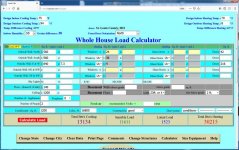
Posting the setup page - not sure I handled the basement correctly. I was going to leave off the wall area on the west/north side where the garage is but just left off a short section of shared north wall. The cooling numbers may need to be a bit more due to that. I would appreciate knowing if anything looks off.


Attached garage:
530 sq ft, insulated 2 x 6 walls
Heating 11kBTU
 

Attachments

  • House1.jpg
    House1.jpg
    145.1 KB · Views: 13
  • House2.jpg
    House2.jpg
    157.9 KB · Views: 12

yeldogt

Well-known member
Joined
Jan 2, 2012
Messages
18,184
What I saw about 50F was for a condensing furnace. Apparently that applies to both types of NG heaters/furnaces.

You are one of the few that is planning a condensing furnace in a free standing shop/garage. I was thinking the same thing but others have raised concerns about low temps/freezing. I don't plan to let my buildings get that cold and will probably set them back to around 55F - maybe a bit cooler in the large garage when I won't be using it for longer periods (hopefully that won't be very often!). I would be interested in your use of the space and reasoning for a condensing furnace.


You have to add up the overall cost of the equipment and the cost of fuel. No heater wants to have air blowing across the heat exchanger cold enough to affect fuel combustion or have the large about of water in NG condensing on the inside of the heat exchanger. Burning of NG produces large amount of water -- condensing furnaces have secondary heat exchangers that are designed for this water ...not the primary.

If the overall winter gas use will be $600 dollars ... what's the savings? Most open flame garage heaters will have the cold restrictions -- some will have SS heat exchangers w/ lower temps allowed.

Sometimes people put in the condensing units only because of the ability to use a small flue connection .. the 80's require a traditional setup. There is no best setup.

That's why a couple of us mentioned the modulating cabinet set up -- and a mini split for AC. Getting a small conventional is easier today as more manufacturers make smaller units -- but not as small as you need.

You don't want an oversized AC with humidity ..... the mistake people make with AC is design for an outside temp that only happens once a year or less. It happens all the time and you need up with an oversized unit.


As before ... it's how you use the space. If you pull a hot car in three times a day -- you have to plan on a bit more capacity.

What people don't understand -- most are more comfortable at 74 or even higher and low humidity vs 70 and higher humidity. That's what happens when you oversize .... in an attempt to get a comfortable humidity you have to overcool the space.
 
To avoid these ads, REGISTER NOW!
Top Bottom