beuford
Member
I recently purchased a Hein-Werner HW93642 floor jack from Northern Tool ($319 + free delivery). Seemed like a good deal at the time. According to Northern Tool it shipped direct from the manufacturer, which was confirmed by the shipping label on the packaging. Direct shipping was important to me because I had heard horror stories about some companies shipping these with marginal shipping vendors and insufficient packaging resulting in a damaged jack or leaking of the hydraulic fluid.
Unfortunately, direct ship didn't help. The packaging and/or shipper handling were still poor, and the jack arrived in a damaged cardboard box containing broken foam packing elements, all soaked with hydraulic fluid. The cardboard box appeared to have been repaired mid-shipment, as one end had a second layer of new cardboard to cover the oil-stained original box. The jack seemed to be completely empty of hydraulic fluid and did not work at all upon receipt. I had to go to the store and buy hydraulic fluid and fill the jack before it would operate.
The jack itself is a mixed-bag. For instance, the vent screw is an interesting idea, but because it screws into the thin metal housing of the pump cover it didn't have much thread area to begin with. The threads of the vent screw hole seemed to be partially stripped upon receipt, and I had to be very careful when reinstalling the vent screw to prevent stripping the threads further. Not good...
Also, the jack does not sit level; the left front wheel is ~1/8" off of the ground. In addition, the jack flexes easily towards that wheel (even after the wheel contacts the ground), but not the other direction. It just doesn't feel solid.
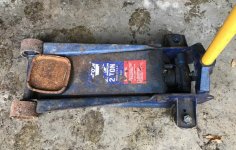
I also noticed that the hydraulic unit has mounting points that are machined/cast too long, as if they are for the heavier steel panels used in the 3 ton model of this jack. In most floor jacks the hydraulic unit bolts securely to the side frame panels, acting as a structural component that prevents spreading of the side frame panels when the jack is under load. However, in the 2 ton jack the mounting points extend through **and past** the side frame panels by about 1/16" to 1/8". There are bolts and washers on each of the mounting points, but they do not contact the side frame panels and so do nothing but plug the bolt holes in the mounting points. The result is that the side frame panels can flex outward if sufficiently loaded. A more correct way to mount this hydraulic unit would have been to a) machine the mounting points so that they do not protrude past the side plates, or b) use spacers so that when the hydraulic unit bolts are tightened their force is applied to the side frame panels. I'll try to attach a photo of this condition for your review. I'd be curious if older Walker jacks are built the same way, or as I described instead.
On the plus side, the cast lift arm and saddle mount are really stout. The lift arm does not fill well within the frame, though; it moves back and forth along its hinge bolt quite a bit. The total movement (including that of the saddle cradle) is a little over 1/4" at the saddle end. My old imported jack barely moves.
Also, the release valve control is very smooth; you can lower a vehicle at pretty much any speed you want. Jacking up the car, though, is a slow and painful process; from 0 to full lift (unloaded) takes 40 pumps (!!).
All in all, I don't think I would buy this floor jack again. I'd rather look for an older USA-made floor jack to rebuild. The current HW production is better than the cheap imported floor jacks, but not enough so to warrant the price. Also, in my humble opinion the company has taken steps to cut costs - in production and shipping - that further erode the value.
It's a nice jack, but for me the value proposition just isn't there. However, that's just my opinion - your mileage may vary.
Beuford
Unfortunately, direct ship didn't help. The packaging and/or shipper handling were still poor, and the jack arrived in a damaged cardboard box containing broken foam packing elements, all soaked with hydraulic fluid. The cardboard box appeared to have been repaired mid-shipment, as one end had a second layer of new cardboard to cover the oil-stained original box. The jack seemed to be completely empty of hydraulic fluid and did not work at all upon receipt. I had to go to the store and buy hydraulic fluid and fill the jack before it would operate.
The jack itself is a mixed-bag. For instance, the vent screw is an interesting idea, but because it screws into the thin metal housing of the pump cover it didn't have much thread area to begin with. The threads of the vent screw hole seemed to be partially stripped upon receipt, and I had to be very careful when reinstalling the vent screw to prevent stripping the threads further. Not good...
Also, the jack does not sit level; the left front wheel is ~1/8" off of the ground. In addition, the jack flexes easily towards that wheel (even after the wheel contacts the ground), but not the other direction. It just doesn't feel solid.
I also noticed that the hydraulic unit has mounting points that are machined/cast too long, as if they are for the heavier steel panels used in the 3 ton model of this jack. In most floor jacks the hydraulic unit bolts securely to the side frame panels, acting as a structural component that prevents spreading of the side frame panels when the jack is under load. However, in the 2 ton jack the mounting points extend through **and past** the side frame panels by about 1/16" to 1/8". There are bolts and washers on each of the mounting points, but they do not contact the side frame panels and so do nothing but plug the bolt holes in the mounting points. The result is that the side frame panels can flex outward if sufficiently loaded. A more correct way to mount this hydraulic unit would have been to a) machine the mounting points so that they do not protrude past the side plates, or b) use spacers so that when the hydraulic unit bolts are tightened their force is applied to the side frame panels. I'll try to attach a photo of this condition for your review. I'd be curious if older Walker jacks are built the same way, or as I described instead.
On the plus side, the cast lift arm and saddle mount are really stout. The lift arm does not fill well within the frame, though; it moves back and forth along its hinge bolt quite a bit. The total movement (including that of the saddle cradle) is a little over 1/4" at the saddle end. My old imported jack barely moves.
Also, the release valve control is very smooth; you can lower a vehicle at pretty much any speed you want. Jacking up the car, though, is a slow and painful process; from 0 to full lift (unloaded) takes 40 pumps (!!).
All in all, I don't think I would buy this floor jack again. I'd rather look for an older USA-made floor jack to rebuild. The current HW production is better than the cheap imported floor jacks, but not enough so to warrant the price. Also, in my humble opinion the company has taken steps to cut costs - in production and shipping - that further erode the value.
It's a nice jack, but for me the value proposition just isn't there. However, that's just my opinion - your mileage may vary.
Beuford