Zaxxn
Well-known member
So some time ago I bought a Mohawk System II lift from a dealership that replaced them. Did all the mechanical work, new bearings, etc. The lift was in use to pretty much the day I picked it up, but I didn't take it apart myself, just picked up the pieces. Finally got it all installed, all the hydraulics hooked up, system bled according to Mohawk's instructions, all went well, no leaks, both pistons in the upper locks after bleeding. Released the locks, pressed the lowering valve, heard a "PLUNK" and that was it. Nothing lowering. Not a bit. Not even with putting weight on the "sleds". Since I have another Mohawk lift, I know the power unit, albeit almost new (2018), isn't the original Mohawk unit.
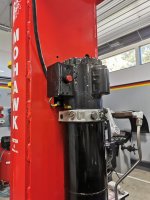
However, both, the original Mohawk unit and this one have what I think could be a check valve on the output port (the two part, rust colored hex unit connected directly to the pump body), and I am not so sure it should be there at least for the new power unit, and I am wondering if the power unit they gave me wasn't with this lift originally or so. I attached a couple of pics of the unit.
So, two questions now: First, should the check valve even be there, if it is one. And second, how do I remove the pressure out of the system now that the cylinders are all the way up and the system most likely with a lot of pressure in it?
Sorry for all the questions and thanks for your help already in advance. Somewhat of a hydraulic noob...
--Zax
However, both, the original Mohawk unit and this one have what I think could be a check valve on the output port (the two part, rust colored hex unit connected directly to the pump body), and I am not so sure it should be there at least for the new power unit, and I am wondering if the power unit they gave me wasn't with this lift originally or so. I attached a couple of pics of the unit.
So, two questions now: First, should the check valve even be there, if it is one. And second, how do I remove the pressure out of the system now that the cylinders are all the way up and the system most likely with a lot of pressure in it?
Sorry for all the questions and thanks for your help already in advance. Somewhat of a hydraulic noob...
--Zax