

You are using an out of date browser. It may not display this or other websites correctly.
You should upgrade or use an alternative browser.
You should upgrade or use an alternative browser.
Hydraulic trivia
- Thread starter JordanOH
- Start date

manwithtools
ALLIANCE MEMBER
It's the same as long as pressure is supplied to the piston end of the cylinder and not the rod end.
Last edited:
WillyBoy
Well-known member
The cylinder can be oriented either way and it usually depends on the best way to route the hoses. The loader on my tractor has the cylinders for the arm lift positioned one way and the bucket tilt oriented the other way to make the solid lines and the hose lengths more efficient.
It's the same as long as pressure is supplied to the piston end of the cylinder and not the rod end.
manwithtools
ALLIANCE MEMBER
The lifting force is determined by pressure x area. Orientation of the cylinder does not matter. The rod side of the cylinder creates less force because the rod occupies part of the piston area. So in the illustration, the lift capacity is the same as long as the pressure is supplied to the end of the cylinder that does not have the rod in it. See the image below.????

kaymccampbell
Well-known member
I was starting to type something, then my brain turned on and realized they only lift in one direction, so it's the same. Sneaky little devil.
jack stand
Well-known member
They extend in both directions, but as @manwithtools explains extending the rod has more power than retracting it always, it's the bassis of a cylinders math & operation.
manwithtools
ALLIANCE MEMBER
To expand on that point just a bit, let's assume a cylinder has a 2.5" diameter bore and 1" diameter shaft.it's the basis of a cylinders math & operation.
The piston side without the rod has 4.91 sq. in. of area. The rod side of the piston has 4.12 sq. in. of area.
Given a hypothetical supply pressure of 2500 psi would result in 10,300 lbs in retraction force and 12,275 lbs of extension force.
Last edited:
rocksnstumps
Well-known member
- Joined
- Mar 20, 2024
- Messages
- 157
While I took it since no hoses were shown in the cutoff picture they were obviously mounted at the bottom out of view in both cases  As such the right arrangement is stronger. The left arrangement would bother my frugal nature if the hose was mounted to the top and has to be even longer to account for when cylinder extends. Don't know about you but I gotta pay for hose by the foot.
Edit: my phone only showed a partial picture unless I log in and click on the pic. I never saw full pic until saw a later post
As such the right arrangement is stronger. The left arrangement would bother my frugal nature if the hose was mounted to the top and has to be even longer to account for when cylinder extends. Don't know about you but I gotta pay for hose by the foot.Edit: my phone only showed a partial picture unless I log in and click on the pic. I never saw full pic until saw a later post
Key word is “lift”While I took it since no hoses were shown in the cutoff picture they were obviously mounted at the bottom out of view in both cases
Edit: my phone only showed a partial picture unless I log in and click on the pic. I never saw full pic until saw a later post
Good luck getting the left side to lift pushing fluid in the rod end.
manwithtools
ALLIANCE MEMBER
Same goes for the right side.Good luck getting the left side to lift pushing fluid in the rod end.
racecougar
Well-known member
Why would you do that? That would retract the cylinder.Key word is “lift”
Good luck getting the left side to lift pushing fluid in the rod end.
The lift force of both arrangements is the same. You apply pressure to the piston end to extend (raise) both.
ArcReactorKC
Well-known member
Force=PSI*(A*R^(2))
Either orientation should create the same amount of lifting force. I am an electrical engineer not a structural engineer but I think you might see a difference in deflection based upon orientation, but again that is outside of my area of expertise.
Either orientation should create the same amount of lifting force. I am an electrical engineer not a structural engineer but I think you might see a difference in deflection based upon orientation, but again that is outside of my area of expertise.
I’m very much aware of that. I’m referencing this postWhy would you do that? That would retract the cylinder.
The lift force of both arrangements is the same. You apply pressure to the piston end to extend (raise) both.
While I took it since no hoses were shown in the cutoff picture they were obviously mounted at the bottom out of view in both cases
Edit: my phone only showed a partial picture unless I log in and click on the pic. I never saw full pic until saw a later post
lolaetype
Well-known member
If you are asking which arrangement can lift the greater useful load (is that the correct term?) I'd say the one on the right.
My reasoning is the in the arrangement on the left the cylinder is lifting the arm and whatever is attached to it, in this case the load and the cylinder body. The arrangement on the right doesn't have to lift the weight of the cylinder body, just the arm and the load.
Full disclosure: Dammit Jim, I'm an economist, not an engineer.
My reasoning is the in the arrangement on the left the cylinder is lifting the arm and whatever is attached to it, in this case the load and the cylinder body. The arrangement on the right doesn't have to lift the weight of the cylinder body, just the arm and the load.
Full disclosure: Dammit Jim, I'm an economist, not an engineer.
racecougar
Well-known member
Does the cylinder body weigh more than the rod and piston?
lolaetype
Well-known member
Probably. You also have to add in the weight of the hydraulic fluid.Does the cylinder body weigh more than the rod and piston?
x2. I assumed the same hose placement. Assumed, again, and I know better. Should have said that no answer is possible without a full depiction of pressure source.While I took it since no hoses were shown in the cutoff picture they were obviously mounted at the bottom out of view in both cases
Edit: my phone only showed a partial picture unless I log in and click on the pic. I never saw full pic until saw a later post
manwithtools
ALLIANCE MEMBER
My reasoning is the in the arrangement on the left the cylinder is lifting the arm and whatever is attached to it, in this case the load and the cylinder body. The arrangement on the right doesn't have to lift the weight of the cylinder body, just the arm and the load.
Difference would be so small I'd bet it would be immeasurable with a load cell.
andyvh1959
Well-known member
The question, and picture only makes sense if it indicated which end of the cylinder is the pressure port, or if it indicated the cylinder was single acting. Without that detail the survey is meani gless.
The question, and picture only makes sense if it indicated which end of the cylinder is the pressure port, or if it indicated the cylinder was single acting. Without that detail the survey is meani gless.
There is only one place the hose can go to provide LIFT, and that is the piston end.x2. I assumed the same hose placement. Assumed, again, and I know better. Should have said that no answer is possible without a full depiction of pressure source.
andyvh1959
Well-known member
Well true, the full force capability of a cylinder has to be on the piston end. However, a double acting cylinder can function to apply a force (not just lift) from the piston or rod end. However, the rod end will provide less force because of the reduced effective area of the rod. If the same flow and pressure is applied to the rod end of a double acting cylinder versus the piston end, it will move faster but with less force.
A double acting cylinder could be one with a piston in the middle with a rod extending from each end so the effective force area of each end is the same. Could be a hydraulic cylinder used for steering, of a cylinder used for trim control on a boat.
So the image with the survey should have detailed which end of the cylinder was the pressure port, we could assume its a single acting cylinder (load or gravity return).
A double acting cylinder could be one with a piston in the middle with a rod extending from each end so the effective force area of each end is the same. Could be a hydraulic cylinder used for steering, of a cylinder used for trim control on a boat.
So the image with the survey should have detailed which end of the cylinder was the pressure port, we could assume its a single acting cylinder (load or gravity return).
But, pressure can be applied to either the rod end or piston end. Every tractor loader has that configuration. And the cylinders can be reversed to apply more down pressure if desired. A pressure hose in the bottom of the left cylinder pictured will lift, but with less force than the rt.There is only one place the hose can go to provide LIFT, and that is the piston end.
racecougar
Well-known member
No. Pressure applied into the bottom of the left cylinder (circled) will retract the cylinder and lower the arm.But, pressure can be applied to either the rod end or piston end. Every tractor loader has that configuration. And the cylinders can be reversed to apply more down pressure if desired. A pressure hose in the bottom of the left cylinder pictured will lift, but with less force than the rt.

racecougar
Well-known member
Same as above. In order to lift the arm, pressure has to be applied to the piston end of the two cylinders shown. That would be the upper portion on the left side and the lower portion on the right side.Well true, the full force capability of a cylinder has to be on the piston end. However, a double acting cylinder can function to apply a force (not just lift) from the piston or rod end. However, the rod end will provide less force because of the reduced effective area of the rod. If the same flow and pressure is applied to the rod end of a double acting cylinder versus the piston end, it will move faster but with less force.
A double acting cylinder could be one with a piston in the middle with a rod extending from each end so the effective force area of each end is the same. Could be a hydraulic cylinder used for steering, of a cylinder used for trim control on a boat.
So the image with the survey should have detailed which end of the cylinder was the pressure port, we could assume its a single acting cylinder (load or gravity return).
You are correct. Looking at the whole pic really helps.No. Pressure applied into the bottom of the left cylinder (circled) will retract the cylinder and lower the arm.
andyvh1959
Well-known member
No. if pressurized fluid is pumped into the rod end of that cylinder it will extend, assuming the piston end of the cylinder is vented to atmosphere (single acting cylinder) or is plumbed back to a control valve or tank. The rod end of that left hand cylinder has less effective piston area because of the rod, but there is volume between the rod and cylinder housing, and if fluid is pumped in thier it is displacing that volume, and the cylinder extends, it does not retract.You are correct. Looking at the whole pic really helps.
You are assuming the cylinder can only produce force from the piston end. Yes, It will produce the most force from the piston end. But if pressure is applied from the rod end, and IF the rod is less diameter than the piston, it will generate a force to extend the cylinder. But because the rod decreases the effective area of the piston, the force will be limited to the effective area, that being the area of the piston minus the area of the rod.Same as above. In order to lift the arm, pressure has to be applied to the piston end of the two cylinders shown. That would be the upper portion on the left side and the lower portion on the right side.
Since the picture shows there is volume between the rod and cylinder housing, fluid applied displacing that volume WILL cause the and the cylinder to extend, not retract. Manwithtools described it properly above to show the reduced lift capabilty for the rod end versus the piston end of the cylinder. All that said, for the picture shown, IF it detailed the pressure is only applied to the piston end of either cylinder, both will lift with equal force.
Last edited:
racecougar
Well-known member
If pressurized fluid is pumped into the rod end of the cylinder on the left, the cylinder will retract, not extend. I'm not sure how this is even a question here. You said you retired from Parker?No. if pressurized fluid is pumped into the rod end of that cylinder it will extend, assuming the piston end of the cylinder is vented to atmosphere (single acting cylinder) or is plumbed back to a control valve or tank. The rod end of that left hand cylinder has less effective piston area because of the rod, but there is volume between the rod and cylinder housing, and if fluid is pumped in thier it is displacing that volume, and the cylinder extends, it does not retract.
Since the picture shows there is volume between the rod and cylinder housing, fluid applied displacing that volume WILL cause the and the cylinder to extend, not retract. Manwithtools described it properly above to show the reduced lift capabilty for the rod end versus the piston end of the cylinder. All that said, for the picture shown, IF it detailed the pressure is only applied to the piston end of either cylinder, both will lift with equal force.
I am certainly not assuming that at all.You are assuming the cylinder can only produce force from the piston end.
racecougar
Well-known member
The setup on the right would work the same way.If pressurized fluid is pumped into the rod end of the cylinder on the left, the cylinder will retract, not extend
customh
Well-known member
A. This thread should be deleted or moved to Free Parking as it is more brain teaser *spam* than real information or question.
B. The only thing restricting the lift (height) of either setup is clearance against the frame and hose routing. Assuming all things equal size between them they would have equal lifting weight capacity ratings.
B. The only thing restricting the lift (height) of either setup is clearance against the frame and hose routing. Assuming all things equal size between them they would have equal lifting weight capacity ratings.
manwithtools
ALLIANCE MEMBER
The only way the cylinders will produce any lifting force from hydraulic pressure supplied to the rod end, is if the cylinders and mechanics are inverted as shown in this image:
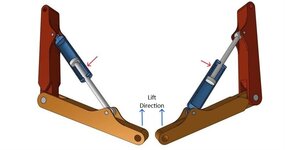
A lot of confusion in this post, not sure what the purpose of it was to begin with
A lot of confusion in this post, not sure what the purpose of it was to begin with
Attachments
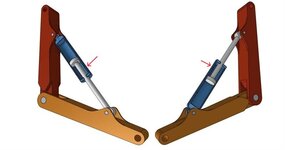
Last edited:
racecougar
Well-known member
Agreed.The setup on the right would work the same way.
racecougar
Well-known member
Applying fluid to the rod end will retract both of those cylinders.The only way the cylinders will produce any lifting force from hydraulic pressure supplied to the rod end, is if the cylinders and mechanics are inverted as shown in this image:
A lot of confusion in this post, not sure what the purpose of it was to begin with

manwithtools
ALLIANCE MEMBER
Correct, I don't think I implied anything differently.Applying fluid to the rod end will retract both of those cylinders.
racecougar
Well-known member
You're right. I'm just trying to make it crystal clear for others.Correct, I don't think I implied anything differently.
cmandp
Well-known member
Wait!
We need a Free Body Diagram!
No I am not going to do it. Nose goes.
We need a Free Body Diagram!
No I am not going to do it. Nose goes.
andyvh1959
Well-known member
What the diagram doesn't detail is which port is the pressure port, If both indicated the piston end was the pressure port (which it usually is) then either lift force is the same assuming the cyliders are the same size, and the cylinders extend. If these are double acting cylinders, then yes, applying pressure to the rod end will cause the cylinder to retract, since flow from the piston port back through a control valve will be vented back to tank. For single acting cylinders the rod end is usually vented to atmoshpere.

racecougar
Well-known member
Bingo....then yes, applying pressure to the rod end will cause the cylinder to retract...