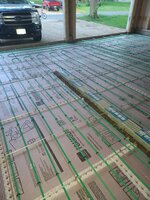
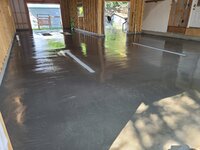
I have a 40x64x16 garage that I done heated floor. I have 6 inch cement for the floor. I tied the 1/2" pex tubing to the bottom of the rebar (request from my cement guy who had to make the saw cuts in the floor. He said they done one with pex on top and it floated up a bit and the saw it it. It was not a 6" floor but I see the logic in it. I did not want pex on the insulation, I wanted it up in the cement. There is 2 different thoughts on this. One is if it is at the bottom it has a wider V temp going up to cover more of the surface area. The other is in the middle of the cement you pull more heat from the line as it is totally covered in cement and doesn't take as much heat to reach the surface. I like the second and I have used my thermal scope and when I first turned it on you could see where the lines were. After a day my foor was all white with heat and pretty even. In our new shop and work they done it at the bottom on insulation it had a 8" thick floor. When it was on for a while all you seen was lines too. After a day it was all even. After seen this I don't believe having it on the bottom gives more even heat in the floor. My rebar is on 24 inch center and done the pex on 12 inch center. See pictures. Here are some of the tips that I was told. Run two heated loops (coming from the heat source) along the outside and the return up through more toward the middle of the floor back to the heat source. Another wards don't run the cooler water return right along the heated water along the outside lines (supply, supply, return return, not supply return, supply, return. Do NOT make sharp turns, you kink the pex, it is not good. I was told not to use it if it kinks. I cut my pex to 300 ft for each of the 8 loops. Started the close to where the manifold was going to be and left 4 ft of pex going up the wall where manifold was going to be. I didn't plan on manifolds being that high but wanted to have some extra for the Oh, didn't think of that. Had my daughter help me with this part of running under rebar. I started tying the heated loop (supply) from manifold area along the outside of the wall and she was feeding it under the rebar from that area. I pulled it along tying with plastic zip ties along the outside until return was about the same height as the supply on the was. Then took another heated and tied 12" from the first one I had done. You dont want all your return lines running next to each other. I used 3/4" electrical conduit 90' sweeps to put over the pex to where it comes of the floor. I used the sweeps with the belled end and had the belled end sticking up. I cut 3/4 conduit in 18" pieces and stuck them in the belled end of the sweeps (did not glue, didn't want any of the glue on the pex) and used couple 2x4 boards and conduit clamps to the clamp the conduit to the boards. Had one board down lower and one at the top of the conduit with the conduit spaced the same as the manifolds. This gives the pex protection coming out of the floor and from kinking. I have seen several installation that used electrical conduit sweeps and other commercial guides in the floor and but never extended up like I did. You can imagine the things I seen fall down in there and lay along pex. I have seen rocks, pieces of cement, screws, nails, and pieces of tin. I didn't have and won't have that issue. Also pressurize your pex BEFORE you pour the cement (40 psi was I seen for recommended psi) and have it where you can add air pressure again if needed. I used 1/4" water line and ran it over to a door with a valve stem like for a tire. Had a psi gauge mounted there too. And have a couple splices on hand so if the pex gets hit, poked or broken while pouring, that it can be fixed immediately. Also have a roll of good electrical tape so if you have to use the splice(s) that you cover it with several raps of electrical tape. Start wrapping about 1 1/2 before the splice and go to about the same distance past. You don't want cement to touch the splice or clamps. I lucked out and didn't have an issue but Murphy' law kicks in when least expected. Better have and not need then to need and not have. I also used some 5/8" heater hose cut to about 2" long and split to put around one of the pex lines if they had to cross each other to just to prevent them from touching each other. This happens when you are close to your manifold area. One thing I wish I had done different is had my manifolds switched around. With how my panels is mounted, the supply comes off the left side and the right manifold is supply. The lines coming off the panel is crossed, doesn't hurt anything, just would have looked a little neater.