To avoid these ads, REGISTER NOW!

Hydrostatic test on compressor tank

Yohahn

Member
Joined
Nov 22, 2015
Messages
14
I'm refurbing a very old tank. 1949 vintage. Now and again I see people advising others to toss such a tank based on its age. Today I plugged all the holes, filled it with water and put a sprinkler gauge on it. I had to link a few different couplings together but it connected the pressure washer to it and pumped it to 300 psi. It's a low volume washer and an 80 gallon tank so it wash quite controllable. That was my main concern when I decided to try it. In any case it held. I kept a gate valve between the wasger and tank to close it off to check how it holds. It leaked down some through the gate valve but stopped at 200 psi.

So would anyone not be satisfied that this tank is safe for 175psi.

If so I'm interested to know why. Otherwise, I'm here to say it was very easy and only cost a dozen bucks or so for some fittings. I would be careful with a bigger washer. I think many of them can adjust the pressure down. Or you could idle it if it's gas. In any case I'd hesitate to whack it with 3 or 4000 psi. You will have to be real fast on thge trigger and I would think even getting to 300 psi in too much a hurry is unfair.
 
To avoid these ads, REGISTER NOW!

ssdave

Banned
Joined
Apr 11, 2015
Messages
2,913
Location
Eastern Oregon
What you did was perfectly safe, the reason for having water instead of air in the tank is that water is not compressible. No matter how big a pressure washer you put on it, if it broke, the pressure would immediately drop to nothing as the first cup of water leaked out. It wouldn't explode, it would just break and leak. The only danger is that you could ruin the tank unnecessarily by overshooting your target pressure.

Your tank should be rated as good for 50% of the test pressure, which is 150 psi. You can probably assume that it's good for 175 psi, there's just not a 2:1 safety margin. If you really wanted to be safe, you'd take the test pressure to 350 psi, and know that you have a 2:1 safety margin on your working pressure of 175 psi.
 

fireguy

Well-known member
Joined
May 25, 2008
Messages
530
You lost 100 PSI, from a starting pressure of 300 PSI and think the tank is safe for a working pressure of 175 PSI? You used a wet sprinkler gauge, with a max of 300 PSI, as a test gauge. Did you do an internal visual inspection before filling the tank w/water? Do you know the test pressure and the allowed pressure drop for that size and type of pressure vessel? How long does the tank have to hold the required pressure? After the pressure test, did you dry the inside of the tank? What temperature was the air you used to dry the tank? What temp did the tank reach? There is a reason those who test low-pressure and high-pressure tanks are certified by 3rd party inspectors.
 
OP
Y

Yohahn

Member
Joined
Nov 22, 2015
Messages
14
You lost 100 PSI, from a starting pressure of 300 PSI and think the tank is safe for a working pressure of 175 PSI? You used a wet sprinkler gauge, with a max of 300 PSI, as a test gauge. Did you do an internal visual inspection before filling the tank w/water? Do you know the test pressure and the allowed pressure drop for that size and type of pressure vessel? How long does the tank have to hold the required pressure? After the pressure test, did you dry the inside of the tank? What temperature was the air you used to dry the tank? What temp did the tank reach? There is a reason those who test low-pressure and high-pressure tanks are certified by 3rd party inspectors.

Very impressed fireguy. 300 psi didn't break it so I'm gonna say 175psi won't. But I promise I'll only fill it up with air and not poison gas. BTW. Your post did nothing for anyone but perhaps the United Brotherhood of Vessel Testors and Inspectors. High handed and non instructive. I'll bet a "compressor" tank test is closer to what I did and doesnt involve taking anythings temperature.
 
OP
Y

Yohahn

Member
Joined
Nov 22, 2015
Messages
14
What you did was perfectly safe, the reason for having water instead of air in the tank is that water is not compressible. No matter how big a pressure washer you put on it, if it broke, the pressure would immediately drop to nothing as the first cup of water leaked out. It wouldn't explode, it would just break and leak. The only danger is that you could ruin the tank unnecessarily by overshooting your target pressure.

Your tank should be rated as good for 50% of the test pressure, which is 150 psi. You can probably assume that it's good for 175 psi, there's just not a 2:1 safety margin. If you really wanted to be safe, you'd take the test pressure to 350 psi, and know that you have a 2:1 safety margin on your working pressure of 175 psi.


SS Dave. I was thinking of knocking it down to 150 psi when I get it back together. What you've said settles it. The pump is fast enough to make a lot of cfm and I think the only point to higher pressures is storage. I know I'll never need 175 psi or anywhere near it. We agree on the pressure washer. I was just concerned it would be too fast to control but it was really perfect. I wasn't looking forward to using a grease gun as I've read about in some places. All in all I'm satisfied and glad I did it. Gives me some peace of mind and I'm glad to keep that old tank. I'm pretty sure its twice as thick as the newer ones. Very likely that newer steels are superior but it will do its job. Tnx.
 

Damian_74

Member
Joined
Oct 18, 2009
Messages
24
Location
Brisbane, Australia
Some info from my Steam Engineering University notes that is relevant.

For new boilers, Lloyd’s Register Rules say that a new boiler can either be tested at 1.5 times the design pressure or if each component is tested to 1.5 times design pressure, the completed boiler is to be tested to 1.25 times the design pressure. 1.25 times the working pressure is acceptable for most repair work.
 

ssdave

Banned
Joined
Apr 11, 2015
Messages
2,913
Location
Eastern Oregon
I do this incidentally as a part of my job, so have some familiarity with it.

I've never been able to find good agreement on standards for hydrostatic testing of air compressor tanks, particularly the test pressure to use. For new tanks, I've seen several standards. One approach is to arbitrarily have a standard % test pressure, typically 130%, 167% or 200%. Another is to measure the volume of the vessel before filling, measure it under test pressure, and measure again after decanting. The amount of stretch under pressure, along with the permanent stretch measured after decanting allow mechanical engineers to calculate if the vessel was tested past it's yield strength. Of course, this is too complex for our purposes.

Here's a good standard, in my opinion, for testing. It uses 167% of working pressure as a standard, but requires the vessel to be held there for 30 minutes to give it time to fail. It is the New York City standard for commercial applictions.

FDNY Requirements For Hydrostatic Tank Testing

Hydrostatic tank testing must be completed by a licensed certified tank tester with special equipment designed for the task.
The tank should be tested every five years.
The tank must be tested more often than every five years if there are any visual signs of degradation or damage.
Requirements under the law state that the tank to be tested must be filled with water and pressurized to 167% of the maximum operating pressure listed on the side of the tank.
The tank, including all of the valves and other closures, must hold the pressure test for at least 30 minutes without leaking or bulging.
Details and requirements for hydrostatic testing are covered under OSHA regulations section 180.407.

My thoughts are that this is a good defensible standard. If the pressure is only brought up instantaneously and not held, I think that 200% of working pressure is more appropriate, but also is more likely to fail the tank.

I built a special pump for doing this years ago, I used a constant displacement low volume pump, and a bypass pressure regulator. It runs continuously, and can get hot enough to boil water. I have a small radiator and fan set up on the bypass to cool the water before going back to the input side of the pump. I use it with a measured volume of water, and can measure the leakage rate using the lost volume. That is for piping systems, which are allowed a certain amount of leakage per time.


As an aside, pay no attention to the comments that berate you for not drying out the inside of the tank when done. All air compressors operate at 100% humidity nearly continuously when in operation. That's the nature of compressing and cooling gases that have water vapor in them. The dampness caused by your test is no different than the water that condenses continuously inside the tank when you operate the compressor. That is in fact the reason we periodically hydrostaticaly test tanks; the moisture causes rust inside, reducing the wall thickness and weakening the tank.
 

DekeT

Well-known member
Joined
Aug 12, 2011
Messages
2,234
Location
USA
I'm refurbing a very old tank. 1949 vintage. Now and again I see people advising others to toss such a tank based on its age. Today I plugged all the holes, filled it with water and put a sprinkler gauge on it. I had to link a few different couplings together but it connected the pressure washer to it and pumped it to 300 psi. It's a low volume washer and an 80 gallon tank so it wash quite controllable. That was my main concern when I decided to try it. In any case it held. I kept a gate valve between the wasger and tank to close it off to check how it holds. It leaked down some through the gate valve but stopped at 200 psi.

So would anyone not be satisfied that this tank is safe for 175psi.

If so I'm interested to know why. Otherwise, I'm here to say it was very easy and only cost a dozen bucks or so for some fittings. I would be careful with a bigger washer. I think many of them can adjust the pressure down. Or you could idle it if it's gas. In any case I'd hesitate to whack it with 3 or 4000 psi. You will have to be real fast on thge trigger and I would think even getting to 300 psi in too much a hurry is unfair.

What do you mean by "plugged all the holes"? I would personally be more confident with a higher quality testing gauge. A thorough hydrostatic test includes the volume expansion and elasticity of the pressure vessel. You don't know how your tank performed in that area but no one even with a new tank really does.
 
OP
Y

Yohahn

Member
Joined
Nov 22, 2015
Messages
14
By plugging all the homes I mean outlets. I'd love to know thge yield but I'm doing this in the backyard. As technical as its going to get. I have to think that if it holds up to my test its safe. There's no circumstance in which it will see anywhere near 300psi under normal use.

ssdave. Thank you again for the useful information. I will fix the valve and make it hold pressure. Im sure it will. I can see it weeping from the valve. Thanks again for the vote of confidence as well.
 
To avoid these ads, REGISTER NOW!
OP
Y

Yohahn

Member
Joined
Nov 22, 2015
Messages
14
i happened to look at my 1983 Quincy compressor tag today, it was hydro tested to 200psi, and the compressor operates at 175psi with a 10hp motor attached.

That's what I'm working on. A Quincy 325 from either late 40's or early 50's. Its a ROC 1. What a monster. At least for my home shop. Love having some old American Made. Tank is a Westinghouse Air Brake. Very heavy. That's what we have on the trains as well. Everything is waaay overbuilt. Reason I'm not inclined to toss out this tank.
 

dutchgray

Well-known member
Joined
Sep 28, 2014
Messages
6,465
Location
Dorset. England.
There is an old compressor a mate has, 1959 on the tag, that is rated 200, tested 416 psi, also made out of 1/4 boiler plate with proper inspection holes. I know I would trust it over a decade old modern horizontal tank.
 

lakeroadster

Well-known member
Joined
Jan 19, 2015
Messages
5,166
Location
Central Colorado
So would anyone not be satisfied that this tank is safe for 175psi.

Yohahn,

Does the tank have a nameplate on it stating a Maximum Allowable Working Pressure, aka as the MAWP?

Short answer to your question:

Your pressure test is in no way a valid method to determine a safe pressure to operate the tank at.

Long answer to your question:

The ASME code, the code these tanks are normally designed to, has approximately a 3.5:1 safety factor for new vessels.

The ASME code specifies that a new or an altered tank is hydrostatically tested at a pressure that is 1.3 or 1.5 times the MAWP.

This tells you the hydrotest pressure is no where near a pressure that the tank would fail at.

When a repaired tank is hydrostatically tested the hydro pressure is normally the MAWP.

If you don't know the MAWP you still don't know what a "safe" pressure is to operate at.

So, off the record, let's say you run with the 3.5:1 ratio, just as a point of discussion. Your 300 psi test means the tank may be good for 85 psi.

I have done destructive testing on new vessel component designs in order to back into a design pressure. This is allowable by the ASME for designs that are out of the ordinary, where there are no textbook calculations to justify the design. This type of test typically results in a design pressure that is at 1/5 of the bursting pressure.

So, off the record, assuming your 300 psi hydrotest was nearly at burst pressure (nobody knows without knowing dimensional data and material data for your tank) that means the MAWP of your tank may be 60 psi.

Starting to see how conservative the ASME code is?

More data will help us to help you:

  • What is the o.d. of the tank?
  • Any idea how thick the heads and shell are?
  • Got a picture of the tank you could post up here?
 
Last edited:
OP
Y

Yohahn

Member
Joined
Nov 22, 2015
Messages
14
Yohahn,

Does the tank have a nameplate on it stating a Maximum Allowable Working Pressure, aka as the MAWP?

Short answer to your question:

Your pressure test is in no way a valid method to determine a safe pressure to operate the tank at.

Long answer to your question:

The ASME code, the code these tanks are normally designed to, has approximately a 3.5:1 safety factor for new vessels.

The ASME code specifies that a new or an altered tank is hydrostatically tested at a pressure that is 1.3 or 1.5 times the MAWP.

This tells you the hydrotest pressure is no where near a pressure that the tank would fail at.

When a repaired tank is hydrostatically tested the hydro pressure is normally the MAWP.

If you don't know the MAWP you still don't know what a "safe" pressure is to operate at.

So, off the record, let's say you run with the 3.5:1 ratio, just as a point of discussion. Your 300 psi test means the tank may be good for 85 psi.

I have done destructive testing on new vessel component designs in order to back into a design pressure. This is allowable by the ASME for designs that are out of the ordinary, where there are no textbook calculations to justify the design. This type of test typically results in a design pressure that is at 1/5 of the bursting pressure.

So, off the record, assuming your 300 psi hydrotest was nearly at burst pressure (nobody knows without knowing dimensional data and material data for your tank) that means the MAWP of your tank may be 60 psi.

Starting to see how conservative the ASME code is?

More data will help us to help you:

  • What is the o.d. of the tank?
  • Any idea how thick the heads and shell are?
  • Got a picture of the tank you could post up here?

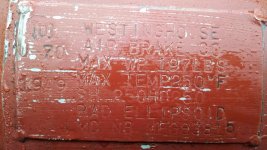
There's a tag. I know it showed a 197 working pressure. Not sure if the head/shell thickness is shown. I'll look. But its not going to be of much use is itbuntil it can be accurately corrected for corrosion and all the pressure cycling its gone through since 1949. That's really what's driving the need for the test. I trust it was safe when new. I am looking to see if it is 66 years later.
 

lakeroadster

Well-known member
Joined
Jan 19, 2015
Messages
5,166
Location
Central Colorado
There's a tag. I know it showed a 197 working pressure. Not sure if the head/shell thickness is shown. I'll look. But its not going to be of much use is itbuntil it can be accurately corrected for corrosion and all the pressure cycling its gone through since 1949. That's really what's driving the need for the test. I trust it was safe when new. I am looking to see if it is 66 years later.

Is there an ASME stamp, on the tank too?

Does the compressor mount to the tank? You could do some dye penetrant NDE testing of any brackets / supports to check for cracking.

As you have previously discussed the biggest issue may be wall thickness. Ultrasonic Thickness Testing (UTT) would be the best testing method. You might be able to rent a UTT meter locally for a very reasonable price. They are super simple to use.

If the NDE and UTT turn out ok & it is an ASME tank I wouldn't worry about the pressure cycles over the years. That is one of the advantages of an ASME tank.. they are robust. Robust enough that normal rated pressure cycling won't result in high enough stresses to cause cyclic issues.

I'd love to see a photo of the vessel tag... that's a piece of history you have there.

The first Boiler and Pressure Vessel Code (1914 Edition) was published in 1915, so you've got a first generation tank there if it's ASME.

https://www.asme.org/engineering-topics/articles/boilers/the-history-of-asmes-boiler-and-pressure
 
Last edited:
OP
Y

Yohahn

Member
Joined
Nov 22, 2015
Messages
14
Looks like head and shell are .250. See image.
 

Attachments

  • IMG_20151229_142521321.jpg
    IMG_20151229_142521321.jpg
    153.3 KB · Views: 63

lakeroadster

Well-known member
Joined
Jan 19, 2015
Messages
5,166
Location
Central Colorado
Neat... it has elliptical heads too.

The "U-70" means the vessel was built per the 1949 ASME Code as a "container".
 
Last edited:
To avoid these ads, REGISTER NOW!
Top Bottom