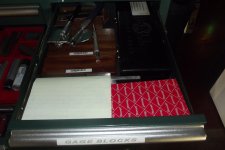
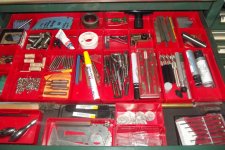
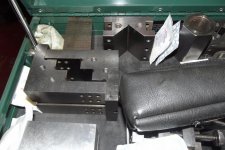
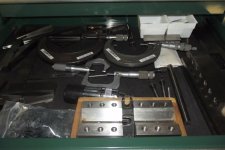
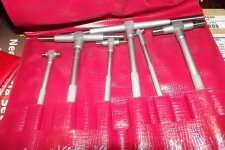
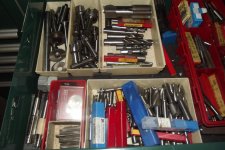
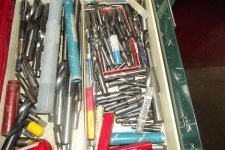
Metalhead......I'll snap some pics here shortly. I'll have to charge the batteries on my camera. As soon as they come off the charger, I'll post some up.
That is something that a lot of people entering the trade don't get. It is one of those things that you are either born with or not. If you aren't able to really visualize the interface and geometry/relationships, you will have a tough time in this trade. It's kind of a cascading thing that can really mess you up when you get to assembling the tools and things don't line up. You will see it in tools built by guys that need a lot of Michigan (missed again) screws. These are screws where the body of the screw is turned down a bit because the holes don't line up.
That's one thing I failed to mention before.......No two machines are the same. Each machine has their own characteristics. With the machines we had at work, some were Bridgeports, some Alliants with ProtoTrak retrofits, and then a factory ProtoTrak 3 axis. On a few occasions, a couple guys would tag team a fixture. I told them DO NOT drill holes on both machines for dowel pins. For the ones that are not real far into machining.....when you build a tooling fixture, all of the components get dowel pins to insure that everything lines up, and if it has to come apart for rework, it will go back in the same place. Bolts only will let parts adjust all over the place. When it comes to machining, if you have a .005 to a .010 tolerance, that is a lot. If you have .030 tolerance, that is a shitload of room for mistakes.
When you dowel a part, it's guaranteed to go back in the same place every time, if you have to disassemble it. But when it comes to machines, and like I said, each machine is different, and each machine has it's own characteristics. One machine may be off by .002 in one direction over 6"-10". The next machine, although they are identical may be off .002 on the minus side over the same distance. That is why when a precision fixture is built, it needs to all be built off of one machine only.
I don't care how precise a manufacturer of a machine says his accuracy is, and he may advertise it as .0001 repeatability, but that is repeatability for that machine. Parts have a tolerance for a reason. And Geometrical Dimensioning and Tolerancing came into play years ago to avoid stackup problems at assembly. GD&T is the short wording for it. In a perfect world, everything would be exact. But we don't live in a perfect world. Tolerancing let's us get by. So a machine is no different than making parts off of that machine. When that machine was built, the parts were made with cutters of all kinds. Each and every cutter will wear, and each and every cutter will wear differently.
Everything is like a snowball effect in reverse. Starting with a part, you use cutters to make a part, those cutters were made by machines, those machines were made by cutters, and each and every component starting out with the very first cutter to make a machine, to make a cutter, to make a machine, to make a part, all had tolerances.
That is why I always say...."become one with the machine, become one with the part. Understand, and "SEE" in your mind what everything is doing. Once you understand what things are doing, then you can eliminate certain variables. Bridgeports are damn fine machines. But I bet that I could walk into any factory that is making precision parts, or making precision tooling, check the TRAM on the mill, and each and every one would be out of tram. By how much.......it could be .0001, or it could be .005. That is because what is used to check it, may be out itself somewhat.
For some of the newer machinist that knows what "tram" is......a lot of you will tram a mill, and use a piece of paper to allow the indicator to slide over the bolt slots in the table of the mill. Nothing wrong with that at all. The vise is off of the table, you have cranked the table up quite a ways. You put the indicator in the quill and lower the quill maybe an inch to check tram. Congrats......you are trammed in with a half though indicator, and the needle on the dial barely fluctuates. Now drop the table down 5" and bring the quill down and zero in. Check tram and it is off by maybe a thou or two.
So if a person is using two mills to make a precision fixture, or a part, just depending on how close the tramming has been on both, will not allow the two pieces to go together perfectly. You have added more tolerance into things that shouldn't be. Just thing of a complicated part that has to run across multiple machine to get completed. Each and every setup, changes something towards the worse, not towards the better. And worse yet.....factor in HUMAN INTERACTION. No two people are identical, plain and simple. Each and every human being has tolerances. Take two absolute identical twins. Have one run a multiple setup part on a Bridgeport using nothing but a KURT Vise. Next have the second twin run the same exact part with the same exact tooling. Both parts when checked will be different. All for the fact that one may move the dial a couple of thousandths more than the other twin. One may tighten the vise just a tic tighter, which may throw a slight bow in a part, therefore the part will have more or less material removed.
So for the absolute most precision that one can get, is one person, one machine, become one with the machine, become one with the part. Eliminate as much setups as you can. Always find the edge of your part off of a stationary jaw. If you start building a tool, do not use multiple edge finders. Use the same one for each piece of material that goes into the fixture or part that is being made. At the end of the day, NEVER stop in the middle of a part, then finish it up the next day. The dimensions that you THOUGHT you were going to have, will not happen. WHY????? Heat changes everything. If you run 3/4's of the part today, then come back in the next morning to finish it.....the machine is cold, the part is cold, the bearings are cold. So like the "snowball effect".......Bearings may change things by .0005. A few thousandths cut to finish the part is not like yesterday when you were taking .100 cuts and heating the part up.
And again, that's why I always say become one with both the part and machine. If a lot of people that runs mills, or lathes.....if you ever watch a great, surface grinder person, not good, but "great"....you would notice that before they ever start grinding, they let the machine run for a while to get the bearings and races seated in to the point that they will not change from part to part. Shutting a grinder off, going to lunch, then coming back to grind on a part, you will find that the part is not grinding the same. The grinding wheel may be bouncing a little. That's because everything has cooled down. The wheel, the spindle, and the part. Heat expands, cool contracts. That is what you need to see in your head.
Well I may have gotten clear off track, and I'm not going back to reread where I derailed myself

, but when I start talking about machining, I can go on and on.

I'll go get the batteries for the camera and snap some pics instead of babbling on


 I wear them cutting grass, blowing leaves etc.