I will be putting up an I beam in my shop for a trolley. The beam is 8" x 4" with a .25" web and is 16' long between posts. Most of the time it would only be moving loads around 300 pounds but occasionally (rarely) Id move something around 1000 pounds. With a span of 16' can I safely move 1000 pounds with that size of beam? If necessary I can double up the beams since I have plenty of material (and room) by setting one on top of the other and bolting them together but if I can get away with one Id rather just use one.

You are using an out of date browser. It may not display this or other websites correctly.
You should upgrade or use an alternative browser.
You should upgrade or use an alternative browser.
I Beam Strength
- Thread starter bigcreek
- Start date
Hilltopmasonry
Well-known member
- Joined
- Oct 12, 2015
- Messages
- 2,172
I will be putting up an I beam in my shop for a trolley. The beam is 8" x 4" with a .25" web and is 16' long between posts. Most of the time it would only be moving loads around 300 pounds but occasionally (rarely) Id move something around 1000 pounds. With a span of 16' can I safely move 1000 pounds with that size of beam? If necessary I can double up the beams since I have plenty of material (and room) by setting one on top of the other and bolting them together but if I can get away with one Id rather just use one.
Whole lot of variables to get an exact number but 1000 lbs is not that much weight for any steel i beam
I use shoring scaffold with thin/lightweight i beams that are easy to carry and they individually have a capacity rating of over 10,000 lbs each, but they are not 16ft long they are only 5 ft..
Of course a steel guy would have better specs than my round about answer
Sent from my iPhone using Tapatalk
Last edited:
fnieto
Well-known member
You could also reduce the span temporarily by using two 4" x 4" posts cut 1/2"-1" short and use two wedges at the bottom of each posts to snug them up for the heavier loads.
You could also reduce the span temporarily by using two 4" x 4" posts cut 1/2"-1" short and use two wedges at the bottom of each posts to snug them up for the heavier loads.
That is true I could but I want to build it and be done with it and not have to worry about putting supports under it at times. Ive got some 3/4" x 6" flat bar that I could weld on edge on top of the I beam in the middle for 12 feet or so and that should really improve its strength Id think if I welded it good. Shoot if I were to do that Id just bolt another I beam on top of the one.
So I used your dimensions as 8" tall by 4" wide and .25" web thickness and in the I-beam charts it looks like a W8x15lb. beam most closely matches. The section modulus is 11.8 in^3. So basic point load beam stress calculation, (S, psi)=((point load, lbs)*(Total length, inches))/((4)*(11.8in^3)= 4,070 psi. Figure a yield strength of about 36,000 psi for the structural material which is pretty normal. You have a safety factor of about 9. Cranes and hoist are typically designed with safety factors of 2.5 to 5. Your good....
BD1
Well-known member
Checkout a gantry site for what they use. Here is Wallace Gantry.
http://www.wallacecranes.com/thrftste_adjust.htm
http://www.wallacecranes.com/thrftste_adjust.htm
LX-Markham
Well-known member
Does the trolley have a manual or electric hoist? And what is the hoist capacity?
We usually design beams for the hoist capacity, even if the client says they are only lifting X lbs.
We usually design beams for the hoist capacity, even if the client says they are only lifting X lbs.
sberry
Banned
Milton Shaw
Well-known member
- Joined
- Feb 11, 2011
- Messages
- 4,845
What is your ceiling height. The beam, trolley, hoist all take away height you can lift. If you double the beam you loose even more. so check your numbers to make sure you can still lift what you want too. With 12 foot ceilings you have room, with 8 foot you probably won't even be able to lift a load from a pickup.
PAToyota
Well-known member
The other pertinent question - how are you supporting the beam?
readhead
Well-known member
He said I beam. Could be an S8x18.4. Still would be ok.
readhead
Well-known member
One has to wonder why I beams are S's, H beams are W's and piles are HP's. The last one kind of makes sense. Then throw in M's and everyone is confused.
Andy
Andy
lakeroadster
Well-known member
In my experience, for most folks, those are all I-beams......
You'll hate the first paragraph of this Andy..... https://en.wikipedia.org/wiki/I-beam
You'll hate the first paragraph of this Andy..... https://en.wikipedia.org/wiki/I-beam
readhead
Well-known member
You can always count on wikipedia for the truth. Wait, rolled steel joist? How did that get in there?
Andy
Andy
LX-Markham
Well-known member
^^^rolled steel joist chords.
not used very much anymore. I've only seen them on older buildings.
not used very much anymore. I've only seen them on older buildings.
PAToyota
Well-known member
One has to wonder why I beams are S's, H beams are W's and piles are HP's. The last one kind of makes sense. Then throw in M's and everyone is confused.
Andy
S-beams = American Standard Beams
W-beams = American Wide Flange Beams
HP = H-shaped Pile
And the profile of a W (which you say are H-shaped) typically has different thicknesses for the web and flange while an HP is a consistent thickness for both. And an S has tapered flanges.
That was an easy one!

readhead
Well-known member
That is very helpful. I know about the properties of the shapes but never knew where the designations came from. I went to the AISC book and it doesn't speak to the designations.
Does the trolley have a manual or electric hoist? And what is the hoist capacity?
We usually design beams for the hoist capacity, even if the client says they are only lifting X lbs.
I have two electric hoists which will go on it. One is rated for 500 lbs and one is rated for 4000 lbs.
Does the trolley have a manual or electric hoist? And what is the hoist capacity?
We usually design beams for the hoist capacity, even if the client says they are only lifting X lbs.
What is your ceiling height. The beam, trolley, hoist all take away height you can lift. If you double the beam you loose even more. so check your numbers to make sure you can still lift what you want too. With 12 foot ceilings you have room, with 8 foot you probably won't even be able to lift a load from a pickup.
The ceiling is 14' so there is plenty o room.
You can always count on wikipedia for the truth. Wait, rolled steel joist? How did that get in there?
Andy
LOL right
lakeroadster
Well-known member
I have two electric hoists which will go on it. One is rated for 500 lbs and one is rated for 4000 lbs.
 Yeah.. that's scary.
 manwithtools
ALLIANCE MEMBER
Rolled Steel Joist or Universal Beam RSJ is the term used in the UK to identify what we call I-Beams in the States. Wikipedia is not so crazy in this instance.
matt_i
Well-known member
The beam calculator John posted above looks good. As I get older I realize there are two ways to proceed. Calculate max bending stress and make sure safety factor of about 4 is in place, OR analyze beam deflection and make sure that its less than L/480.
Otherwise the beam will deflect so much that the trolley will be difficult to push uphill and potentially won't stay in place (wanting to roll back downhill towards the center)
Otherwise the beam will deflect so much that the trolley will be difficult to push uphill and potentially won't stay in place (wanting to roll back downhill towards the center)
The other thing that will help me is all the weight wont be on one trolley but will be spread out over 10 feet since that is the length of sheet/plate I use to load onto the cnc table. Sometimes I use 20' sheets as well so a hoist will be at each end of the sheet/plate. Well not so much with the 20' sheet but it would be at each end of the 12' and shorter sheets. What I do is load a sheet onto a roller table with a forklift then roll it up the few feet to the cnc table where it will be below the end of the beam and I can lift that end of the sheet up with a hoist with an electric trolley and lift it a bit and roll it over the table until the opposite end of the sheet is under the end of the beam where the other hoist can lift it up and move it onto the table. Light sheet can be done by hand easy enough but heavy stuff like 1/4" and heavier can be a real bear without some assistance.
Last edited:
racer-john
Well-known member
Bigcreek et al: If you have need of reinforcing a beam, you add the flat bar on the bottom of the beam. (should be about 2/3 rds the width of the flange) This is the tension side of the beam.
Do not add to the top flange which is in compression.
Do not add to the top flange which is in compression.
You guys probably know the answer to my question too. I bought a new 18' car hauler a few years back and it has bowed! When I strap a 2X12 vertically to the front of the trailer, there is a 3" gap between the 2X12 and the floor at the back of the trailer. I have been thinking of adding a 3/8 X8 flat strip of metal vertically to the sides of the trailer. Would a 5/16 piece be satisfactory? Would 6" be enough?
f150skidoo
Well-known member
You guys probably know the answer to my question too. I bought a new 18' car hauler a few years back and it has bowed! When I strap a 2X12 vertically to the front of the trailer, there is a 3" gap between the 2X12 and the floor at the back of the trailer. I have been thinking of adding a 3/8 X8 flat strip of metal vertically to the sides of the trailer. Would a 5/16 piece be satisfactory? Would 6" be enough?
Are you trying to get the trailer back to flat or just reinforce it as it is?
Are you trying to get the trailer back to flat or just reinforce it as it is?
Yes, I plan to block under the corners and put on a weight,( like my backhoe) in the middle, heat it with the acetylene torch to flatten it before welding in metal for more strength so it doesnt happen again.
06 DIESEL
Well-known member
You guys probably know the answer to my question too. I bought a new 18' car hauler a few years back and it has bowed! When I strap a 2X12 vertically to the front of the trailer, there is a 3" gap between the 2X12 and the floor at the back of the trailer. I have been thinking of adding a 3/8 X8 flat strip of metal vertically to the sides of the trailer. Would a 5/16 piece be satisfactory? Would 6" be enough?
Have you pulled a string to see how far it has bowed? If you bowed the trailer you either overloaded it or it was built with **** material. Either way, you should be able to brace the ends, level, and then get the trailer to bow back. Put some 2x2x.25 tube steel along the bottom frame and weld it in place. I know this hurts your ground clearance but it will help more than stitching a piece on the side of the frame.
f150skidoo
Well-known member
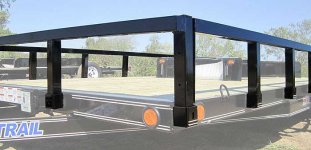
I'm assuming the frame rails are angle iron since those trailers are more prone to bend then channel or tube frames. The best way to add strength is to add ladder sides to the trailer. The further up the top rail tube is equals a more rigid trailer, Adding short sides out of tube have more strength then adding flat bar of the same height.
For some reason I originally thought your trailer was enclosed, Not sure why I imagined that.
I mean sides like these but you could make them shorter.
For some reason I originally thought your trailer was enclosed, Not sure why I imagined that.
I mean sides like these but you could make them shorter.
Attachments
lakeroadster
Well-known member
You guys probably know the answer to my question too. I bought a new 18' car hauler a few years back and it has bowed! When I strap a 2X12 vertically to the front of the trailer, there is a 3" gap between the 2X12 and the floor at the back of the trailer. I have been thinking of adding a 3/8 X8 flat strip of metal vertically to the sides of the trailer. Would a 5/16 piece be satisfactory? Would 6" be enough?
Your description means it is bowed up, correct? Are they not built that way intentionally so that when a car, or whatever, is loaded onto it the trailer will then be flat?
f150skidoo
Well-known member
Your description means it is bowed up, correct? Are they not built that way intentionally so that when a car, or whatever, is loaded onto it the trailer will then be flat?
Only semi trailers are built like that, I've never seen trailers that are towed by pickups built with a camber.
Bigcreek et al: If you have need of reinforcing a beam, you add the flat bar on the bottom of the beam. (should be about 2/3 rds the width of the flange) This is the tension side of the beam.
Do not add to the top flange which is in compression.
Interesting thanks for the info. That wont work with a trolley but good to know.
WNYflyer
Well-known member
There are a number of different AISC beams that are close to your "8" x 4" with a .25" web"
W8x15: 8" tall, 4.015" flg width, 0.314" web, 0.245" flg th
W8x13: 8" tall, 4.000" flg width, 0.254" web, 0.230" flg th
W8x10: 8" tall, 3.940" flg width, 0.204" web, 0.170" flg th
Lets assume it's a W8x10 to be conservative
Please confirm that is what you have. Assuming that's what you have... your 1,000 pound load will be fine.
http://www.engineersedge.com/beam_bending/calculators_protected/beam_deflection_2.htm


The beam calculator John posted above looks good. As I get older I realize there are two ways to proceed. Calculate max bending stress and make sure safety factor of about 4 is in place, OR analyze beam deflection and make sure that its less than L/480.
Otherwise the beam will deflect so much that the trolley will be difficult to push uphill and potentially won't stay in place (wanting to roll back downhill towards the center)
The assumed lateral un-braced length of the compression flange means everything in a beam calculation. A W8x10 with a point load of 1000# at mid point of a 16' span has a stress of 6000 psi. The allowable stress is only 6400 psi if the compression flange (top flange for simple span) is laterally un-braced for 16'. If the compression/top flange was essentially fully laterally braced the allowable would be 24,000 psi for A36 (FY=36,000 psi)steel. The lateral unbraced length of beam flanges as well as columns has a huge effect on the allowable strength/stress. Not to mention for a monorail the potential side sway and thus lateral load as well as the local wheel load on the bottom flange.
Equations above and most published on the net do not account for anything other than a fully laterally braced compression flange thus often are not appropriate for many real world situations. Most monorails use "S" sections which have narrower thicker flanges than "W" sections such that the flange can take higher trolley wheel loads.
Last edited:
lakeroadster
Well-known member
Still haven't heard back from the OP just exactly what type of beam he has...
The beam calculator John posted above looks good. As I get older I realize there are two ways to proceed. Calculate max bending stress and make sure safety factor of about 4 is in place, OR analyze beam deflection and make sure that its less than L/480.
Otherwise the beam will deflect so much that the trolley will be difficult to push uphill and potentially won't stay in place (wanting to roll back downhill towards the center)
Don't you have to do both? You have to calculate the stress like bigguns did to know you're not going to have something fall on top of you. (Safety). Deflection is a failure mode if it is too high, like you say, too much and the load won't stay in place.