To avoid these ads, REGISTER NOW!

I don't know what I'm doing - Weaver 72 Rebuild

mritchie77

Well-known member
Joined
Aug 8, 2020
Messages
365
Location
Cottonwood Shores, TX
Hey guys,

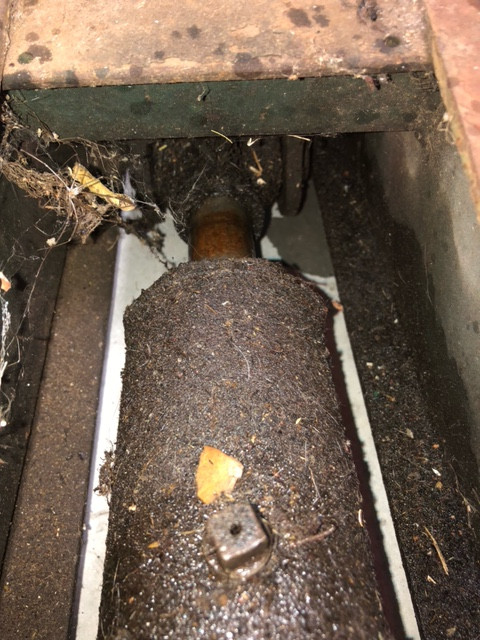
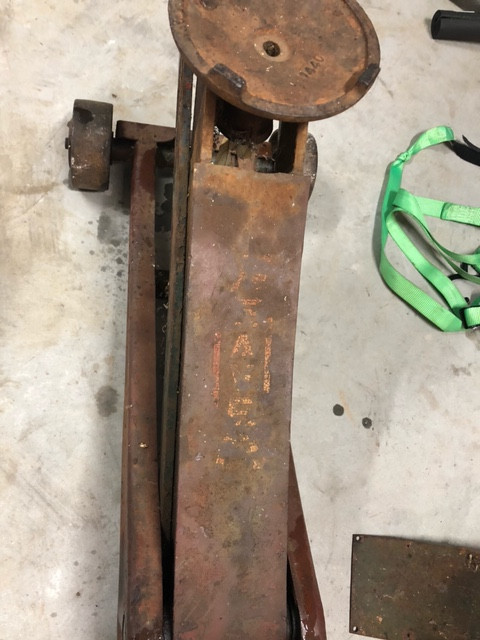
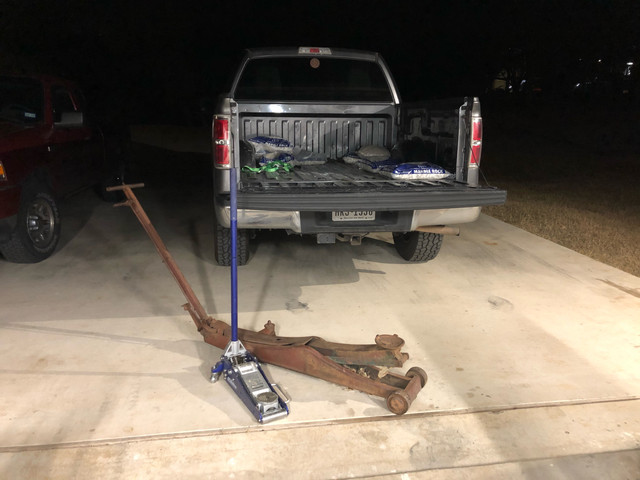
After looking for a pretty much non-existent USA made jack that could be tall enough to lift my F150 easily, I found this on FB marketplace a couple weeks ago. I've never rebuilt a jack, but do all my own auto work and house repairs so I figured I'll probably be able to figure this one out.

After pouring through Castle Equipment's website, I found manuals and parts lists for the 72, 72A, and 72B models. I THINK this is a B model but I'll dig into it tonight and get the serial number to send to Castle for confirmation.

Testing it, it appears to go 6-7 inches before stopping. It does not settle over time (from my observation last night) so I believe it's holding pressure well enough. The entire hydraulic unit it covered in dirty oil, so the seals are pretty well shot. The wheel/casters spin relatively freely, but I'll take them apart to clean and repack (I assume it will be similar to re-packing wheel bearings on my Ranger).

Either way, a definite project that will pay off in the end I think. Seller wanted $75 but as I was driving 65 miles I offered $50 and he accepted. Picked it up late and got home around 9pm. Unloading was a challenge as I am only 5'9" and 150lbs...dang thing weighs just about what I do.

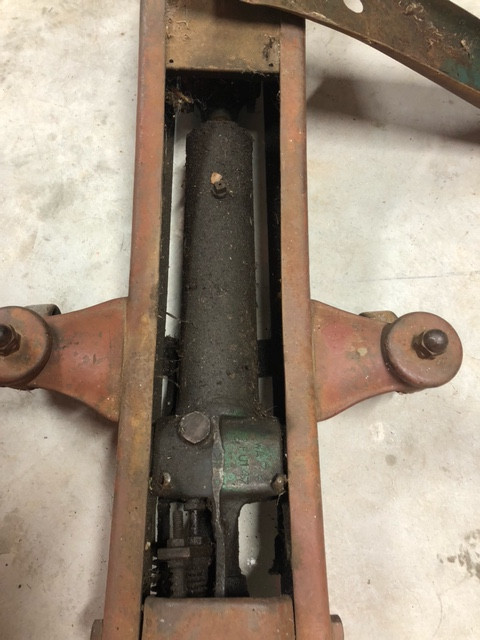
Anyway, here are the sellers pictures along with one of it home with my current 2 ton jack that it's replacing.


Last edited:
To avoid these ads, REGISTER NOW!

ajchien

Well-known member
Joined
Sep 3, 2010
Messages
2,651
Location
Los Angeles, stuck on the 60 freeway.
I think you came to the right place, I think HiBall’s favorite jack brand is Weaver so he should drop in sooner or later.

I wouldn’t condemn the seals as bad yet with that story unless you’re seeing a leak/puddle of oil when using the jack or if the jack doesn’t hold pressure. Going up only 6-7 inches and holding steady could simply be low on oil. I think that jack may have a vented reservoir so it’s possible that there is oil loss through that over many years. It also has packing with a gland nut sealing the pump piston, if the gland nut backs off over the years the jack could also seep out from that source with seals still being intact.

I do wonder about the color though, is that a mauve colored paint or is that patina and rust?

Perhaps opening up the reservoir fill hole / vent and looking inside to see how much oil there is in there would be a good first step. I would add oil if needed and retest the jack to see how it’s functioning with a proper oil level. If the oil level was low you might have to cycle the jack up and down a few times to bleed the air out of the circuits.
 
OP
M

mritchie77

Well-known member
Joined
Aug 8, 2020
Messages
365
Location
Cottonwood Shores, TX
I do wonder about the color though, is that a mauve colored paint or is that patina and rust?

Perhaps opening up the reservoir fill hole / vent and looking inside to see how much oil there is in there would be a good first step. I would add oil if needed and retest the jack to see how it’s functioning with a proper oil level. If the oil level was low you might have to cycle the jack up and down a few times to bleed the air out of the circuits.

Thanks for the advice! I didn't have time to stop by and get more hydraulic oil today, but I did mess around for a couple of minutes after dinner. I can get the jack about 12 inches (with many pumps) but that's about as high as it goes. Standing on it, it does not loose pressure. I think that's a good sign.

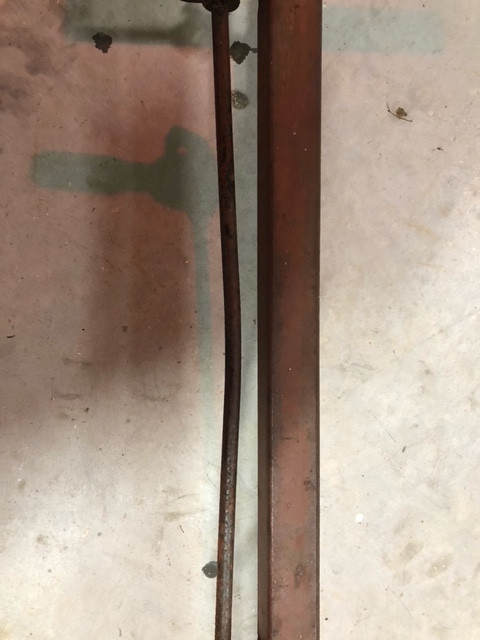
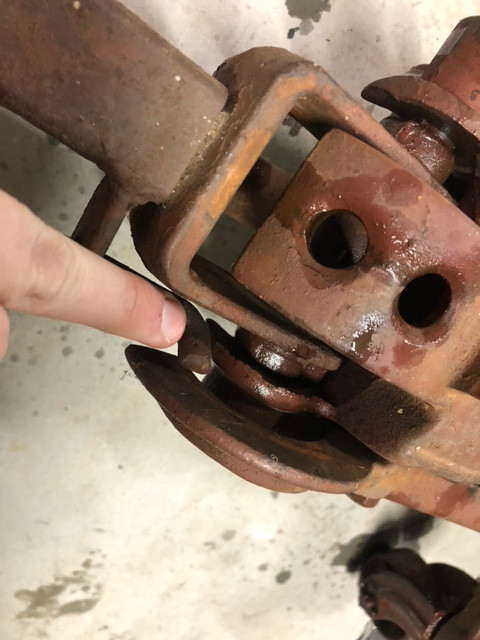
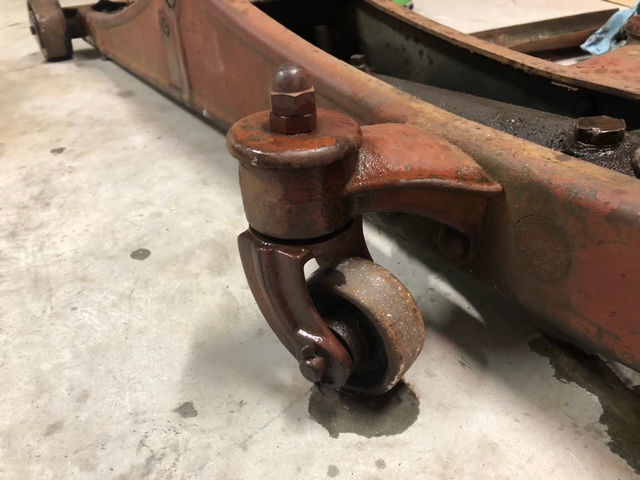
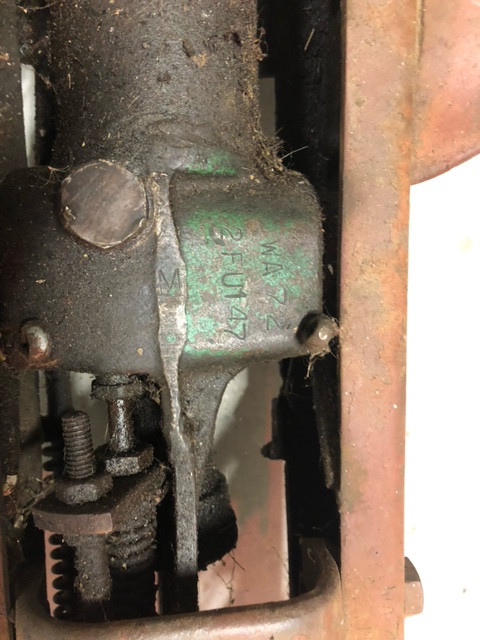
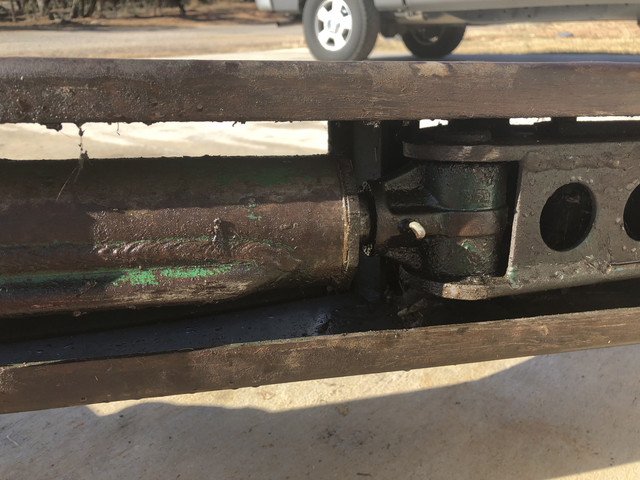
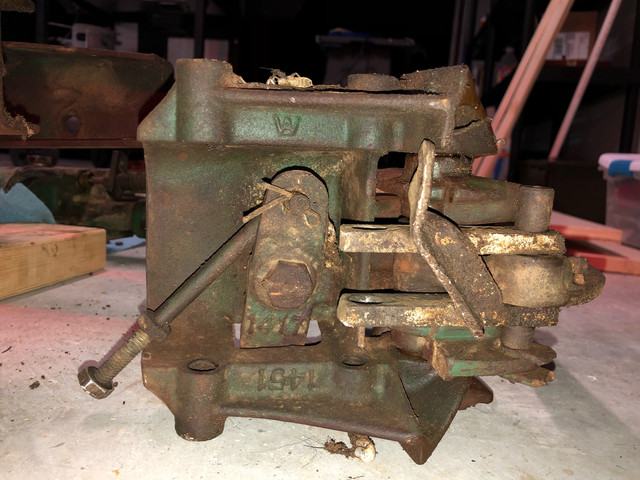
On the other hand, I cannot get it to release. Examining the lever, I THINK it's supposed to engage this curved piece at the bottom and lift as one lifts on the lever. If that's the case, I think it's bent too much because I cannot get the "lip" of the rod under this piece. (see pic 1). Also can anyone explain these caster nuts? It appears that there is a stud that goes through and tightens down with a nut (bottom) with a hexagonal cap on top. OR it could be a double nut? Not sure, but it sure didn't budge when I attacked it with reversing wrenches.

It looks like this was the original green, and the red is a mixture of surface rust and a shody red paint somewhere along the line.

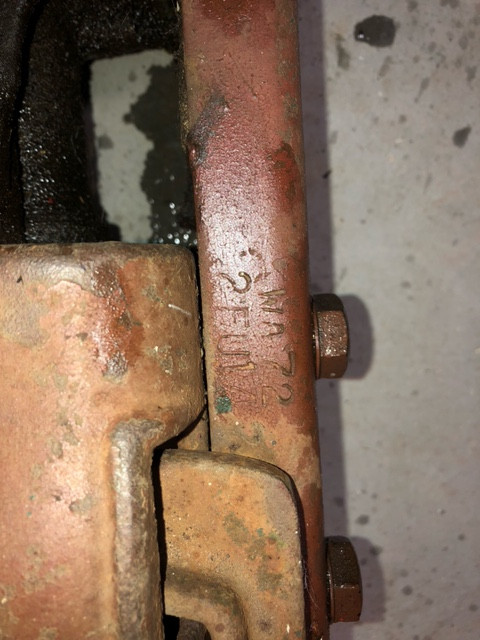
Getting the serial number off the frame and the hydraulic unit showed matching numbers, but also WA72. I am unsure if the A or B models noted that there. I hope this is a B model as parts seem easier to find. Serial number was 2FU147

Other than some basic examination, I sprayed all contact points and bolts with penetrating fluid to help loosen up as I move forward.


ajchien

Well-known member
Joined
Sep 3, 2010
Messages
2,651
Location
Los Angeles, stuck on the 60 freeway.
I’m not sure how far I can take you on the Weaver before reinforcements show up. I’m much more of a Walker-Lincoln-SFA Hein Werner fanboy.

Regarding the release, I think(???) you might have to put the handle in a position where the handle position locks and is engaging one of the holes. I believe the release should then mate up with the curved piece on the very right of pic#1. It may need to be turned to mate up.

On your last pic in post#3, on the bottom left is the release piston. It has a nut, a spring, and I think should be attached to a guide. It pulls back to release the hydraulic fluid from the main ram cylinder. You might have to tip the jack on its side to see a series of connections that will lead to the release lever.

Of note, I would not adjust the nuts on that release piston until folks with more knowledge about weaver jacks show up. I think those nuts you see are an adjustment for the overload safety bypass - IIRC the weaver’s release circuit and the overload circuit were the same passages.
 

Hiball

Well-known member
Joined
Apr 30, 2009
Messages
14,031
Location
Missery
The 90 degree piece at the bottom of the release rod doesn’t “go under” the side piece, it pushes it outward, which causes the release stem to retract ever so slightly and release the jack.

The weaver jack frames are welded, so no disassembly to remove the hydraulic unit.

1. Pull the two cotter keys.
2. Unhook the pump linkage, release linkage.
3. Pull the lift arm up far enough to gain access to the cotter key that holds the ram into the swivel lift assembly. Remove cotter key and grabs
chisel to aid in separating the ram from the assembly as they are normally stuck together. I always hit it with a wire wheel/bearing grease upon reassembly.
 
To avoid these ads, REGISTER NOW!

cubfarm 1

Well-known member
Joined
Jan 16, 2011
Messages
190
also... that release stem IS the overload also. in your last picture the distance between the packing nut and the ajustment nut. a quick measurement with calipers will let you re-sit this to original. when you get the unit apart look into the bore for the piston very carefully. they are pitted now and then. that bore is a two stage as the front half is the fluid reservoir . this does make the ram with a new seal easy to install.that ajustment measurement and the honing the tube are important. there is a trick to squeesing the spring for the foot pedal. can help with that if you like. Metal parts are still available from Weaver. a 50 year old jack looks just like a new one. a great design they see no need to change. 2 ton through 20 ton they are very much the same from across the room... they just get bigger
 
OP
M

mritchie77

Well-known member
Joined
Aug 8, 2020
Messages
365
Location
Cottonwood Shores, TX
The 90 degree piece at the bottom of the release rod doesn’t “go under” the side piece, it pushes it outward, which causes the release stem to retract ever so slightly and release the jack.

The weaver jack frames are welded, so no disassembly to remove the hydraulic unit.

1. Pull the two cotter keys.
2. Unhook the pump linkage, release linkage.
3. Pull the lift arm up far enough to gain access to the cotter key that holds the ram into the swivel lift assembly. Remove cotter key and grabs
chisel to aid in separating the ram from the assembly as they are normally stuck together. I always hit it with a wire wheel/bearing grease upon reassembly.

Thanks for the instructions. I followed this to get the hydraulic unit out today. I was "sick" so I got to stay home. The whole unit came out surprising easy. I had a couple of chisels ready for the ram but once the cotter key came out, I was able to use my hands to compress the piston without the need for a chisel.

Overall, the jack actually works very well. After reading on here how to use the release, it tested and it worked perfectly. After my messing around with it, I did get some oil leakage from somewhere (couldn't pinpoint) but regardless I think I'm going to do a full restoration on this before I put it back into service.

I sent an email last night to castle to date the thing, but haven't heard back yet. I'm curious as to what year/model this is. I'm pretty sure it's a 72A due to the double cotter keys.

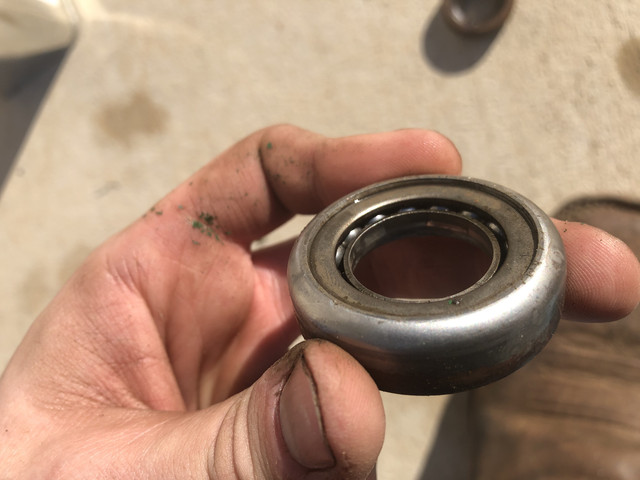
I also took apart one of the casters to test the bearings. The upper bearing was rusted stuck, and the lower has cracks in the inner race. I guess I will be buying all new bearings for this bad boy as well.

As you can see, quite a bit of the original green paint is left on the inside, seems like it was painted over with red paint sometime in its life.


OP
M

mritchie77

Well-known member
Joined
Aug 8, 2020
Messages
365
Location
Cottonwood Shores, TX
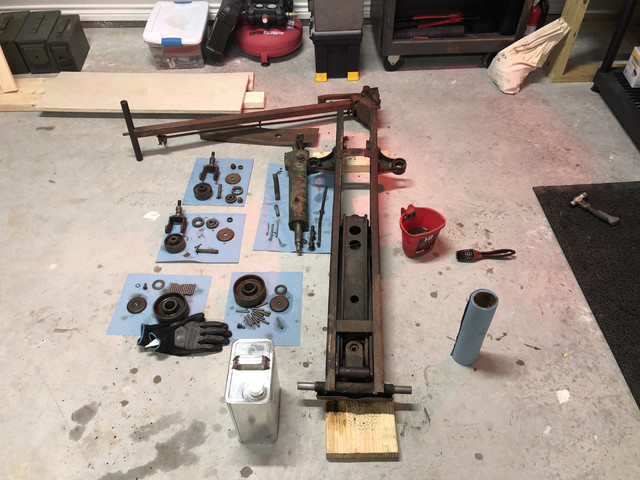
Spent a little time and got things disassembled a bit more along with giving most things a good bath in mineral spirits.

After examining, I don't think I am going to break the handle down further than the complete unit as you can't see the internals with installed. After looking at the two springs in the lift assembly, I'll probably leave that alone as well. They are pretty stout and return well (my foot found out when I tried to hold it up) and since you can't see them anyway it doesn't matter to me much.

After speaking with Castle, it appears that I have an original 72 model (not A or B) from 1958 (6 years older than my parents!!). It looks pretty good for its age.

With everything apart, it appears that all 4 caster bearings will need to be replaced. Checking a 1965 parts guide it appears that Castle still makes those bearings (S-11758) but I'm stumped on the front wheel bearings. When I pulled them apart, it appears to be 13 needle bearings. According to the old parts guide, these appear to be #S-347 that has been discontinued as the newer models use sealed bearings? I can't find that part on any of the newer parts lists. I would just re-use them with new grease but the inner end of the bearings appear to be worn at a 15 degree angle as the inner washer was cupped. Can anyone confirm if these are supposed to be like this or not? My first thought would be that the washer should be flat along with the end of the needle bearings...but I'm not sure.

I'm a bit in the boonies, but I'm going to be looking for a sandblasting company locally to see about getting all of these parts sandblasted so I can paint them. Hopefully that won't be too much $$.


fourjeepin

Well-known member
Joined
Feb 12, 2011
Messages
3,667
Location
Atlanta, GA
Seeing the rebuilds of these awesome old jacks always makes me want one.

And hello to Marble Falls! My grandmother lived there for many, many years. House was right at the end of a big lake. I don’t remember the name of the lake or her street, but her house was at the end of a hairpin curve and there was an octagonal house diagonally across from her. A rather eclectic neighborhood. Somewhere I have a picture I took of about 18 deer in her half acre lot.
 

Hiball

Well-known member
Joined
Apr 30, 2009
Messages
14,031
Location
Missery
I’d be willing to bet the old needle bearings and some New grease would be fine, Might get a little wild above 65Mph, but should be fine at shop speed.
 
To avoid these ads, REGISTER NOW!
Top Bottom