

You are using an out of date browser. It may not display this or other websites correctly.
You should upgrade or use an alternative browser.
You should upgrade or use an alternative browser.
I guess compressors really can 'splode!
- Thread starter thebeekeeper1
- Start date

daparrothead
Well-known member
- Joined
- Dec 21, 2013
- Messages
- 200
Wow, luckily nobody was hurt.
The tank originally was probably rated for 150-175 psi, but when the rust eat's away half the thickness along the bottom this can happen very easily at a much lower pressure than the tank is rated for. And the tank more than likely wasn't drained regularly as it should have been.
The tank originally was probably rated for 150-175 psi, but when the rust eat's away half the thickness along the bottom this can happen very easily at a much lower pressure than the tank is rated for. And the tank more than likely wasn't drained regularly as it should have been.
soloz2
Well-known member
Wow! Does anyone know more about this auto drain mentioned in that thread?
Sent from my GT-N5110 using Tapatalk 4
Sent from my GT-N5110 using Tapatalk 4
daparrothead
Well-known member
- Joined
- Dec 21, 2013
- Messages
- 200
Check this one out, about as reasonably priced as I have found. I will be ordering one for my new compressor next week.
http://www.ebay.com/itm/AUTOMATIC-E...212?pt=LH_DefaultDomain_0&hash=item3f021a1c1c
http://www.ebay.com/itm/AUTOMATIC-E...212?pt=LH_DefaultDomain_0&hash=item3f021a1c1c
rmmiller
Well-known member
Back in the late 80's a machine shop down the road from the parts store I worked at had theirs go boom. It was an outside unit and somebody forgot to turn it off on Friday. The pressure cut out froze being it was outside and it ran and ran and ran until it blew. It took out most of the back wall and there were pieces half a block away. Dang good thing they were closed!
Cadillac fan
Well-known member
something similar happened to my friend's dad who owns a mechanics/bodyshop. Their old compressor died and they had it replaced with a new one and there was a fault with it.
something to do with shutting the motor off when the tank is full.
Well they were working one day and they could hear the compressor making a really weird sound. Everyone got out of there because they had a feeling it was going to blow. 5 minutes later there was a really loud bang. Destroyed the wall it was behind and made thousands of dollars worth of damage.
sorry I couldn't be more specific but I am clueless about air compressors.
something to do with shutting the motor off when the tank is full.
Well they were working one day and they could hear the compressor making a really weird sound. Everyone got out of there because they had a feeling it was going to blow. 5 minutes later there was a really loud bang. Destroyed the wall it was behind and made thousands of dollars worth of damage.
sorry I couldn't be more specific but I am clueless about air compressors.
Fixnair
Well-known member
People just don't realize how much energy is stored in a compressed air tank! When it is released all at once it's devastating.
That wasn't a very old compressor. It must have had a structural defect in the cylinder.
Glad no one was hurt.
That wasn't a very old compressor. It must have had a structural defect in the cylinder.
Glad no one was hurt.
454ragtop
Well-known member
Well, I for one am not convinced this was just caused by rust. Not saying it wasn't, but not convinced it was either. Was that an ASME tested and rated tank? I wonder if 2 over pressure safety relief valves wouldn't be a good idea, double the odds of it actually opening in an over pressure situation.
Jim
Jim
my '46 dated ASME tank started leaking next to the drain plug ~ 5 years ago......
shut it off, tipped it up on to one end, removed the drain ****, knocked the fitting loose, prepped it and MIG welded the POS back in....
50 years from now somebody else can do it again

shut it off, tipped it up on to one end, removed the drain ****, knocked the fitting loose, prepped it and MIG welded the POS back in....
50 years from now somebody else can do it again
daparrothead
Well-known member
- Joined
- Dec 21, 2013
- Messages
- 200
Well, I for one am not convinced this was just caused by rust. Not saying it wasn't, but not convinced it was either. Was that an ASME tested and rated tank? I wonder if 2 over pressure safety relief valves wouldn't be a good idea, double the odds of it actually opening in an over pressure situation.
Jim
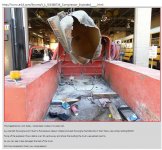
In the original post it says the compressor was 15yrs old, plenty old enough to be rusted out from the inside especially if it was left sitting with water in it. I believe a big factor in this is it was a horizontal tank, so the trapped water was actually standing on the tank wall the full length for no telling how long. If this had been a vertical tank it would have been less likely to rust out thin enough to do this because the end caps are thicker than the tank usually, plus it wouldn't have near as long of a surface area to weaken. Looking at the pic, the tank is literally split from one end to the other the full length of the tank.
Last edited:
pepi
Well-known member
Wow! Does anyone know more about this auto drain mentioned in that thread?
Sent from my GT-N5110 using Tapatalk 4
You want a Moisture Minder, developed around truck air brake systems.
Stainless steel parts, dumps every time the compressor starts and stops, totally pneumatic operated no electric components to fail or timers to fiddle with. By far the best on the market.
have a look here, pick your poison, I am only a user and have no dog in the race btw.
http://www.garagejournal.com/forum/showthread.php?t=181031&highlight=moisture+minder&page=2
***************
daparrothead
Well-known member
- Joined
- Dec 21, 2013
- Messages
- 200
I also wouldn't jump to conclusions and say it rusted out.
Since this compressor was in a service truck I wonder if freezing weather was a factor. (ie frozen relief valve or pressure switch).
The original post on the AR15 forum said the bottom of the tank was rusted from the inside out, very thin.
Charles (in GA)
Well-known member
I also wouldn't jump to conclusions and say it rusted out.
Since this compressor was in a service truck I wonder if freezing weather was a factor. (ie frozen relief valve or pressure switch).
Gasoline engine driven compressor. It doesn't use a pressure switch, but rather a load/unload valve that controls the throttle. It reduces engine speed and bypasses the compressor output away from the tank when set pressure is reached.
OP stated the tank had pumped up and the engine idled back prior to the explosion.
This is a compressor commonly found on service trucks, almost always out in the open.
OP on the AR15 forum also stated the truck had been inside the shop and was not exposed to freezing temps the night before this happened.
Linear weak area in the tank due to rust and this split open, then tearing the rest of it.
Charles
John in OH
Well-known member
This potential hazard has been discussed here on GJ numerous times before, but it's never a bad idea to bring it up again.
There is no reason that any of us should not blow-down the compressor air receiver tank at the end of each day. Five minutes of time could prevent a catastrophe. Also, I think all of us could afford, at the very least, one of these HF automatic tank drains for $10. I admit that I don't own one so I can't vouch for its effectiveness or reliability (I think I'd still do a manual blow-down daily), but it's on my list for purchase next time I go to HF:
http://www.harborfreight.com/automatic-compressor-drain-kit-68244.html

There is no reason that any of us should not blow-down the compressor air receiver tank at the end of each day. Five minutes of time could prevent a catastrophe. Also, I think all of us could afford, at the very least, one of these HF automatic tank drains for $10. I admit that I don't own one so I can't vouch for its effectiveness or reliability (I think I'd still do a manual blow-down daily), but it's on my list for purchase next time I go to HF:
http://www.harborfreight.com/automatic-compressor-drain-kit-68244.html
rlitman
Well-known member
There is no reason that any of us should not blow-down the compressor air receiver tank at the end of each day.
No reason? Here's my reasoning why I do not:
1) I use my compressor regularly. I don't feel like waiting several minutes for it to be ready before each first use of the day.
2) If I blow down my compressor each day I use it, that also means that I need to fill it each day I use it. Each filling introduces more moisture. If I just use it, I may use way less than the tank full and introduce less moisture.
3) Each time you pressure cycle the tank, you're using up some of its fatigue life. Leaving it at pressure is less likely to fatigue the metal.
I have a 1/4" galvanized pipe running from my tank bottom to a valve that I operate pretty regularly. Water should never be standing on the bottom of my tank.
I used to have that HF automatic drain on my last compressor, but it failed to operate when it clogged with ****. My current tank pressure (175PSI) is too much for that valve to be safely used, so I manually drain.
I have a 1/4" galvanized pipe running from my tank bottom to a valve that I operate pretty regularly. Water should never be standing on the bottom of my tank.
I do the same thing. I think most of the water I drain out is contained in the pipe vs. the tank.
It might even make sense to increase the pipe size to make sure it's containing ALL the water.
rlitman
Well-known member
I do the same thing. I think most of the water I drain out is contained in the pipe vs. the tank.
It might even make sense to increase the pipe size to make sure it's containing ALL the water.
I've thought about that. My biggest concern is if the pipe fills with water and freezes. A rupture in 1/4" pipe is preferred to one in something larger.
I'm actually thinking about hanging some pex below the ball valve at the bottom of my tank, and installing a new ball valve below that. At least if water freezes in the pex, it won't burst anything.
John in OH
Well-known member
No reason? Here's my reasoning why I do not:
1) I use my compressor regularly. I don't feel like waiting several minutes for it to be ready before each first use of the day.
2) If I blow down my compressor each day I use it, that also means that I need to fill it each day I use it. Each filling introduces more moisture. If I just use it, I may use way less than the tank full and introduce less moisture.
3) Each time you pressure cycle the tank, you're using up some of its fatigue life. Leaving it at pressure is less likely to fatigue the metal.
I have a 1/4" galvanized pipe running from my tank bottom to a valve that I operate pretty regularly. Water should never be standing on the bottom of my tank.
I used to have that HF automatic drain on my last compressor, but it failed to operate when it clogged with ****. My current tank pressure (175PSI) is too much for that valve to be safely used, so I manually drain.
No, no ... you don't understand what I'm saying. I agree it would be a total waste to completely de-pressurize the receiver tank daily.
The term "blow-down" does not mean to totally de-pressurize the air tank. The term "blow-down" means to open the tank drain valve (with the tank pressurized) for a short period sufficient to blow out all of the moisture that has accumulated at the bottom of the tank. Keeping the moisture from accumulating and sitting in the bottom of the tank will greatly reduce the tank corrosion.
The term "blow-down" is a common term used in the steam power industry to describe the opening of a drain or exhaust valve for a short time to expunge or flush out any undesirable material that has accumulated in a tank, vessel or boiler. It does not mean "de-pressurize". Daily, or shift, "blow-down" of boilers and air receiver tanks was a regular task of plant operators at every power plant I ever worked at.
Back in the late 80's a machine shop down the road from the parts store I worked at had theirs go boom. It was an outside unit and somebody forgot to turn it off on Friday. The pressure cut out froze being it was outside and it ran and ran and ran until it blew. It took out most of the back wall and there were pieces half a block away. Dang good thing they were closed!
kinda makes me wonder whta kind of boom that plant tanks we run would do.... i think they are about 20' tall and 8' diameter.......
shooting4life
Well-known member
- Joined
- Nov 19, 2012
- Messages
- 334
No, no ... you don't understand what I'm saying. I agree it would be a total waste to completely de-pressurize the receiver tank daily.
The term "blow-down" does not mean to totally de-pressurize the air tank. The term "blow-down" means to open the tank drain valve (with the tank pressurized) for a short period sufficient to blow out all of the moisture that has accumulated at the bottom of the tank. Keeping the moisture from accumulating and sitting in the bottom of the tank will greatly reduce the tank corrosion.
The term "blow-down" is a common term used in the steam power industry to describe the opening of a drain or exhaust valve for a short time to expunge or flush out any undesirable material that has accumulated in a tank, vessel or boiler. It does not mean "de-pressurize". Daily, or shift, "blow-down" of boilers and air receiver tanks was a regular task of plant operators at every power plant I ever worked at.
This is what I do every day I use my air compressor. I also put an extra long ****** before the purge valve at the bottom of the vertical tank so that any water that does sit is in the pipe and not in the tank.
I also regularly check the pressure release valve to make sure it is not stuck. I might follow the advice posted above to add a second valve.
Shop I used to work at had a tandem-tank setup (tank from the old compressor left in place and connected in series to the new one).
One morning the drain fitting blew out of the old tank. No huge explosion, didn't even hear it. We probably wouldn't have known for a while if I hadn't been using an air file when the tank let go.
One morning the drain fitting blew out of the old tank. No huge explosion, didn't even hear it. We probably wouldn't have known for a while if I hadn't been using an air file when the tank let go.
This is what I do every day I use my air compressor. I also put an extra long ****** before the purge valve at the bottom of the vertical tank so that any water that does sit is in the pipe and not in the tank.
I also regularly check the pressure release valve to make sure it is not stuck. I might follow the advice posted above to add a second valve.
this seems like a good practice that is kinda a wtf moment. why more manufacturers don't actually put a water catch container like a smaller compressor tank at the bottom of the compressor to contain water, something that can be replaced over time for cheap, to extend compressor tank life
soloz2
Well-known member
I don't use my compressor daily so I drain it after each use. It's only like 6gal so not a huge deal. Once I have a garage of my own I plan to get a 60gal or so.. So ill prob need to look into an auto drain for that.
Sent from my SAMSUNG-SGH-I747 using Tapatalk
Sent from my SAMSUNG-SGH-I747 using Tapatalk
Unless the amount of water in the tank is reduced enough to prevent condensation when the tank cools, what is the point? Its not the amount of water that condenses, its the fact that ANY water is condensing that makes rust.
b-body-bob
Well-known member
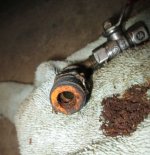
I had a compressor apart for repair with the tank open to the atmosphere for about a month (yeah I'm slow) and you could stick your finger in where the check valve goes and there'd be water on the inside wall that never made its way out of the tank.
Then there's the people who think they're draining the tank and getting very little water out, when in fact the drain is blocked and only letting drips out while water stands in the tank.
Then there's the people who think they're draining the tank and getting very little water out, when in fact the drain is blocked and only letting drips out while water stands in the tank.
Attachments
djjsr
Well-known member
Unless the amount of water in the tank is reduced enough to prevent condensation when the tank cools, what is the point? Its not the amount of water that condenses, its the fact that ANY water is condensing that makes rust.
You may have surface rust on the upper walls from condensation but structural failure will begin at the bottom where the water pools.
I don't think you can totally eliminate rust unless you coat the inside of the tank. And I'm surprised that some manufacturer doesn't do that.
I put a 3/8 drain pipe and lever actuated drain valve on my IR 80 gallon vertical. I drain a quick blast of air out before and after use, can hear when the water has been cleared out. The drain is piped outside too.
98ramtough
Well-known member
- Joined
- Nov 13, 2013
- Messages
- 64
After reading this thread I remembered I haven't drained my compressor for about 5-7 weeks. I ran it down last night and drained it and got not one drop of water. Just a slightly darker spot on the concrete when the air was coming out from some moisture. It's a Puma 20 Gallon compressor. Really been impressed with this thing. Guessing it's cause I live in such a dry area with low humidity?
b-body-bob
Well-known member
After reading this thread I remembered I haven't drained my compressor for about 5-7 weeks. I ran it down last night and drained it and got not one drop of water. Just a slightly darker spot on the concrete when the air was coming out from some moisture. It's a Puma 20 Gallon compressor. Really been impressed with this thing. Guessing it's cause I live in such a dry area with low humidity?
See my post above. That's exactly how the guy who had the compressor with the clogged drain valve felt. He couldn't understand why I was getting a half-cup of water out of mine but he hardly had any, but thought it was a problem with my compressor, not his.
djjsr
Well-known member
It's a Puma 20 Gallon compressor. Really been impressed with this thing. Guessing it's cause I live in such a dry area with low humidity?
You guessed right. It's not the quality of the compressor, it's the humidity of the incoming air.
During the winter, I use electric heat and the humidity in my shop is around 15%. I get very little water in the compressor tank. Take the same compressor outside in 80% humidity and I'll get a LOT more.
98ramtough
Well-known member
- Joined
- Nov 13, 2013
- Messages
- 64
See my post above. That's exactly how the guy who had the compressor with the clogged drain valve felt. He couldn't understand why I was getting a half-cup of water out of mine but he hardly had any, but thought it was a problem with my compressor, not his.
Mine does not have anything clogged or any rust for sure. The air comes out very quickly and you can feel in there that there is no blockage. I just live in a very dry climate.
You guessed right. It's not the quality of the compressor, it's the humidity of the incoming air.
During the winter, I use electric heat and the humidity in my shop is around 15%. I get very little water in the compressor tank. Take the same compressor outside in 80% humidity and I'll get a LOT more.
Yeah I wasn't referring to the quality of the compressor having anything to do with it. Just saying I have been impressed with this little guy for the cost.
I think another reason I get very little water is I just don't use it much. Maybe twice a week and most times it won't even need to cycle.
I bought my first compressor last summer, a dewalt 200psi vertical 15 gallon. I live in Minnesota, and the compressor is in my unheated detached garage. I've noticed no air comes out when I blow down the tank (worked fine in the summer). I figured water is frozen at the bottom of the tank.
Short of bringing it inside to thaw, any solutions/concerns?
Short of bringing it inside to thaw, any solutions/concerns?
You guessed right. It's not the quality of the compressor, it's the humidity of the incoming air.
I'm sure it's also the quality of the air.
Over at the coast, air is moist/humid and full of salt from the ocean. That's bound to be a worst case scenario for a compressor tank.
OP
thebeekeeper1
Well-known member
I bought my first compressor last summer, a dewalt 200psi vertical 15 gallon. I live in Minnesota, and the compressor is in my unheated detached garage. I've noticed no air comes out when I blow down the tank (worked fine in the summer). I figured water is frozen at the bottom of the tank.
Short of bringing it inside to thaw, any solutions/concerns?
I would put a heat lamp on it and get it out. Water is simply BAD inside a tank.
djjsr
Well-known member
I bought my first compressor last summer, a dewalt 200psi vertical 15 gallon. I live in Minnesota, and the compressor is in my unheated detached garage. I've noticed no air comes out when I blow down the tank (worked fine in the summer). I figured water is frozen at the bottom of the tank.
Short of bringing it inside to thaw, any solutions/concerns?
A stick-on heating pad. They make them to keep the oil warm too.
https://www.wolverineheater.com