To avoid these ads, REGISTER NOW!

I-joists question

FORDification

Well-known member
Joined
Mar 22, 2014
Messages
59
Location
Nebraska
I'm in the planning stages right now of converting a big old 3-story barn into a workshop. There is no 'hayloft' or second floor...it's completely open from ground to peak. Therefore, I essentially need to create a loft which spans about 23 feet, which will serve as the ceiling for the ground-floor and create the floor for the second story, which I was tentatively planning on doing with I-joists.

AFAIK in most cases where I-joists are used, the object is a clear span, with no visible supports from the side walls up to the joists. In my case, this isn't a problem at all. Since the barn is so tall, height is not an issue. Therefore, I was thinking I could get away with using slightly smaller I-joists and then adding diagonal supports from the side walls up to the I-joists (as pictured in my crude Photoshop rendering here) with each support connecting at roughly 1/3 of the span. The supports would connect to the wall high enough that I wouldn't hit my head on them but would still give me enough room in the center of the room for a car lift. (Use of the diagonal supports might even allow me to space the I-joists out a bit more too?)

Before I start on anything, I will definitely be running my ideas past someone with the proper engineering background who can steer me in the right direction. In the meantime, while some of these ideas are floating around in my head, I thought I'd ask you folks for a general consensus to the question:

Is there any way of determining how much adding the diagonal supports will affect the size of the I-joist required?

I know this is a complicated topic in general and I'm just now beginning to explore my options, so let me know your thoughts. Thanks!
 

Attachments

  • ijoist-supports.jpg
    ijoist-supports.jpg
    31.1 KB · Views: 60
To avoid these ads, REGISTER NOW!

Rock knocker

Well-known member
Joined
Aug 14, 2014
Messages
704
Is there any way of determining how much adding the diagonal supports will affect the size of the I-joist required?

Yes.


You may as well cut to the chase and call your engineer. As the walls get higher and the bracing gets longer, the outward reaction on your walls increases. It could be not even worth doing.
 

Cyberbear

Well-known member
Joined
Nov 23, 2013
Messages
1,524
Location
California
I had a relative that used wood I-Joists for his ceiling and roof, and as I remember he had little difficulty finding the proper size for the clear span. Your 23 feet is smaller.
Since you seem to have plenty of overhead space, you may wish to investigate commercially available I-Joists that will adequately support the second floor loading per square foot. It may be as easy as checking local code for floor loading, and with the joist manufacturer to obtain size needed and spacing. The rest is simple math, but consulting a civil engineering firm can be costly, been there, done that, twice.
 

Thumper68

Well-known member
Joined
May 16, 2013
Messages
5,134
Location
Duluth MN
I would go to a local lumber yard (Not a big box) and ask them, they will call the manufacturer they deal with and get the proper I-joists for your span, I would skip the braces, I-joists are cheap and even if you had to put them on 12" centers that would be easier than trying to deal with bracing and seat of the pants engineering.
 

boobag

Well-known member
Joined
Aug 15, 2010
Messages
397
i would avoid the angles braces. i think they will cause a lot of issues. when the floor deflects, the wall will push out where the brace is attached.
look at some span charts, and you probably need to go with a 14"tall tji.
 

fastjohnny

Well-known member
Joined
Sep 3, 2011
Messages
261
Location
SW Michigan
Using a brace with a TJI will not be a good solution in my book. What are your loads going to be? Hopefully not hay bales... Just use the appropriately rated joist for your span and loads. I spanned 26' with a 14" TJI, and while it was rated for this, the floor was too bouncy for my liking, so I added a center beam underneath, now it's rock solid.
 

jimp

Well-known member
Joined
Nov 20, 2010
Messages
561
Location
oo
Go to a real lumber yard and tell them what you want to do. They will either size the floor joist or have the supplier do it, it's always been free when I have had it done. Then you can proceed with some size and cost data.
 

joshgn

Well-known member
Joined
Nov 29, 2008
Messages
87
Location
Central Oklahoma
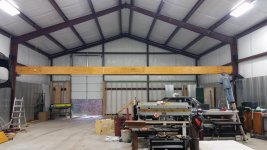
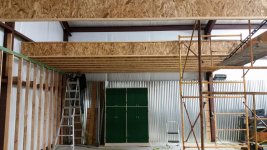
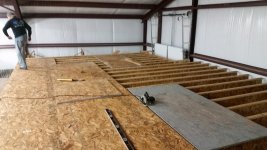
I just did something similar to this...

Load is 60/20... 20ft 16in I beam o/c 16in... (3)1 5/8 x 16in x 39ft LVL across the front.

Just needs 1 post to support middle.
 

Attachments

  • 2014-12-06 16.02.40.jpg
    2014-12-06 16.02.40.jpg
    141.8 KB · Views: 151
  • 2014-12-08 16.36.51.jpg
    2014-12-08 16.36.51.jpg
    154.3 KB · Views: 133
  • 2014-12-09 09.34.46.jpg
    2014-12-09 09.34.46.jpg
    145.6 KB · Views: 138
  • 2014-12-10 18.04.21.jpg
    2014-12-10 18.04.21.jpg
    147.2 KB · Views: 123
Last edited:
To avoid these ads, REGISTER NOW!

K'ledgeBldr

Well-known member
Joined
Aug 22, 2011
Messages
1,925
Location
Johns Creek, GA
No Bracing! That's loading the wall framing in a way it wasn't intended.

You're best method; build a supporting 2X4 wall to the inside of the existing wall (or within the existing wall). If you want 10-12' of headroom build the walls @12" o/c.

The I-joist you would need (for clear span) would be 16" deep (1-1/2" flange is pretty standard). But I'd use a different series with a 3 to 3-1/2" wide flange. At 16" o/c, that you give you a 40/10/480- way stiffer than typical residential requirements.
 

Rock knocker

Well-known member
Joined
Aug 14, 2014
Messages
704
Or use LVL's or a wood truss floor.

But whatever you do, you probably need somebody to crunch the numbers, whether an arch, engineer you pay or on the pay roll of the truss manufacturer.
 
Last edited:

DekeT

Well-known member
Joined
Aug 12, 2011
Messages
2,234
Location
USA
23 feet is not a long span for the correct depth I joist. You are making this way more complex than it needs to be. Go to the lumber yard and let them have the I-joist manufacturer do the math.
 

Rock knocker

Well-known member
Joined
Aug 14, 2014
Messages
704
Of course the OP will have to have some idea about the loading. Nobody can do any math without the basic numbers
 

boobag

Well-known member
Joined
Aug 15, 2010
Messages
397
also, not sure what the intended load or use of the floor will be, but if you dont want the floor to be bouncy, dont build to minimum spec.
 

toplessHO

Well-known member
Joined
Oct 20, 2014
Messages
14,013
Location
central florida
Using a brace with a TJI will not be a good solution in my book. What are your loads going to be? Hopefully not hay bales... Just use the appropriately rated joist for your span and loads. I spanned 26' with a 14" TJI, and while it was rated for this, the floor was too bouncy for my liking, so I added a center beam underneath, now it's rock solid.

I used 12 inch TJI 16"OC and used 3/4 floor decking with sub floor adhesive,
nails and screws. I can jump on it and it doesnt move.
Key is the combo of the subfloor adhesive,screws and tongue and groove floor decking with staggered joints.
 

6768rogues

Banned
Joined
Nov 28, 2007
Messages
4,524
Location
Western NY
As said, a good lumber yard will have their supplier do the calculations and make recommendations. Be sure to get information about bridging between the joists, if the manufacturer recommends it. Joists do not usually bend and break, they rotate and fail. The bottom is in tension and the top is in compression, so they try to equalize by rotating. Bridging stops rotation and makes the floor stiffer.
 

theoldwizard1

Well-known member
Joined
Feb 22, 2011
Messages
43,114
Location
SE MI
Therefore, I was thinking I could get away with using slightly smaller I-joists and then adding diagonal supports from the side walls up to the I-joists (as pictured in my crude Photoshop rendering here) with each support connecting at roughly 1/3 of the span. The supports would connect to the wall high enough that I wouldn't hit my head on them ...
The big problem with this solution is there really is not "good" way to attach the I-joist or diagonal support to the walls. Nails, screws or even lag bolts won't cut it.

Worse, if the connection between the I-joist and the wall slips it will put additional load on the diagonal which will kick the wall out and you will have a total wall failure.
 

theoldwizard1

Well-known member
Joined
Feb 22, 2011
Messages
43,114
Location
SE MI
You're best method; build a supporting 2X4 wall to the inside of the existing wall (or within the existing wall). If you want 10-12' of headroom build the walls @12" o/c.

ABSOLUTELY the best solution !

Assuming the existing wall is 2x4 construction with an unfinished interior, I would use 2x6s sistered next to the existing 2x4 so that they are sticking out into the interior. Then set a 2x10 (or 2x12) across the top of those 2x6. You can nail them to the 2x4 because the load will be transferred directly to the vertical 2x6 and then to the floor (you need a PT spacer under 2x6 to take up the space of the original bottom plate). Use the appropriate joist hangers to attach the I-beams to 2x10 "band joist".

Yes, this is more expensive, but it is BY FAR the strongest solution.
 
To avoid these ads, REGISTER NOW!
Top Bottom