To avoid these ads, REGISTER NOW!

I need help identifying this.

Mcdieselsauce

Member
Joined
May 7, 2026
Messages
13
Location
Orlando
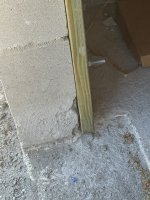
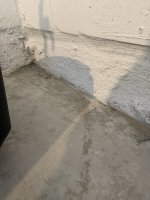
I don't think it's all effloresce, it's 120 day old build in florida concrete block and the other garages still being built seem to have some kind of coating applied around the bottom block. It's not uniform, one piece broke off and had a sandy dark textured material behind it, it's a void that goes atleast an inch behind where my brain tells me the block should be. Half the bottom block would be below ground level. Builder wants to send painters to caulk and paint over it. IMG_3297.jpgIMG_3292.jpegIMG_3293.jpeg
 
To avoid these ads, REGISTER NOW!
OP
M

Mcdieselsauce

Member
Joined
May 7, 2026
Messages
13
Location
Orlando
Very strange indeed! Are there homes by this builder currently under construction where you can see their "process" in the garage?
There is a few! I walked down the street and snuck in and took some pictures, the bubbly residue uneven texture was only on the wall nearest the quikrete bag, the other three walls were the dull smooth that i'd expect to see. It also seems to be uniformly below the first full block inside the garage which made me believe it was intentional. IMG_3298.jpegIMG_3300.jpegIMG_3301.jpegIMG_3305.jpegIMG_3304.jpegIMG_3306.jpegIMG_3307.jpeg
 

coldh2o

Well-known member
Joined
May 21, 2013
Messages
1,413
Location
Ontario, Canada
Is the layer of unknown material tapered from back to front (thicker at front of the garage)?

My guess is the slab was poured with a slope to drain out the door, and a tapered layer of grout was used to level up the bottom course of block.
 
OP
M

Mcdieselsauce

Member
Joined
May 7, 2026
Messages
13
Location
Orlando
Is the layer of unknown material tapered from back to front (thicker at front of the garage)?

My guess is the slab was poured with a slope to drain out the door, and a tapered layer of grout was used to level up the bottom course of block.
That's an interesting idea but no it's really thick on one wall (Like 2 inches thick) but besides that it's kind of seems random, on of the front walls looks like almost nothing was added. You can see the block is semi floating. I think that might explain why the hole goes so far back, it's on the other side of the door if the block sits in the same spot it this mystery fill would be deeper there. IMG_3308.jpeg
 
OP
M

Mcdieselsauce

Member
Joined
May 7, 2026
Messages
13
Location
Orlando
I don’t see evidence of there being a bottom (at floor level) block at all. Am I missing something?
I have no idea what I'm talking about, i figured block construction would have blocks straight down to the pad I didn't think otherwise until I walked down to the site still under construction and saw the pad seems to extend upward.
 

jack stand

Well-known member
Joined
Feb 29, 2012
Messages
3,300
Location
Lakes Region Maine
I guess that in FL you simply pour them (footers) on the grade with no concern of frost.
The builder is saving a course of block around the perimeter and possibly a little more with no excavation of the footings.
On the bright side as long as they don't backfill the block on the outside, there's little chance of having water penetrate the block and migrate onto the slab.
 
OP
M

Mcdieselsauce

Member
Joined
May 7, 2026
Messages
13
Location
Orlando
So is this section actually considered a stem wall it's just been covered with something that crumbled off into a sandy substance and possibly is actually effloresce? It seems to stop at the joint on all the houses i looked at.
 

coldh2o

Well-known member
Joined
May 21, 2013
Messages
1,413
Location
Ontario, Canada
That's an interesting idea but no it's really thick on one wall (Like 2 inches thick) but besides that it's kind of seems random, on of the front walls looks like almost nothing was added. You can see the block is semi floating. I think that might explain why the hole goes so far back, it's on the other side of the door if the block sits in the same spot it this mystery fill would be deeper there.

OK, then I still have a question on the flatness of the slab. Assuming the first row of block is level, and there is a random thickness of grout (or whatever) between that row of block and the slab - the slab must be very uneven?

A wider view photo capturing your garage walls and floor interface would help.
 
OP
M

Mcdieselsauce

Member
Joined
May 7, 2026
Messages
13
Location
Orlando
OK, then I still have a question on the flatness of the slab. Assuming the first row of block is level, and there is a random thickness of grout (or whatever) between that row of block and the slab - the slab must be very uneven?

A wider view photo capturing your garage walls and floor interface would help.
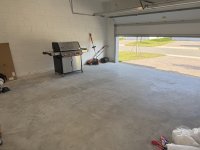
How do these work? It looks like after viewing the build in progress and comparing to mine the 1st row of block starts about 6 inches up. You can see in a few of these the thickness is quite variable. It's type B drainage and I'm pretty sure the floor is level the slope doesn't start until the driveway. IMG_3313.jpegIMG_3309.jpegIMG_3310.jpegIMG_3312.jpeg
 
To avoid these ads, REGISTER NOW!

Viper98912

Well-known member
Joined
Oct 20, 2012
Messages
1,123
Location
GA
I'm confused by the confusion in this thread.

The garage pad is poured with a slope, and then a stem wall is poured on top of the pad so there's a level surface for the cinder block to sit on. Since the ground doesn't freeze (typically) in FL, stem walls aren't poured independently of the "inside" pad like they do in northern states.

As for the "dirt" looking mix that's causing a hole, that looks like poor workmanship where there was maybe a large hole left after removing the forms and the contractor stuffed it with whatever he could find on the ground.
 

coldh2o

Well-known member
Joined
May 21, 2013
Messages
1,413
Location
Ontario, Canada
I'm confused by the confusion in this thread.

The garage pad is poured with a slope, and then a stem wall is poured on top of the pad so there's a level surface for the cinder block to sit on. Since the ground doesn't freeze (typically) in FL, stem walls aren't poured independently of the "inside" pad like they do in northern states.

As for the "dirt" looking mix that's causing a hole, that looks like poor workmanship where there was maybe a large hole left after removing the forms and the contractor stuffed it with whatever he could find on the ground.

Exactly what I said, and seems to be the case from the latest photos.
 
OP
M

Mcdieselsauce

Member
Joined
May 7, 2026
Messages
13
Location
Orlando
I'm confused by the confusion in this thread.

The garage pad is poured with a slope, and then a stem wall is poured on top of the pad so there's a level surface for the cinder block to sit on. Since the ground doesn't freeze (typically) in FL, stem walls aren't poured independently of the "inside" pad like they do in northern states.

As for the "dirt" looking mix that's causing a hole, that looks like poor workmanship where there was maybe a large hole left after removing the forms and the contractor stuffed it with whatever he could find on the ground.
Okay, so what is this material they covered the stem wall in, I dont really understand why theyd do that. Can i just remove it and take it back to the stem wall? Its like a grey powder substance under the paint. Thank you to you and coldh29 its very helpful.
 

Old Man Roger

Well-known member
Joined
Apr 6, 2017
Messages
17,387
Location
Palm Coast Florida
Florida garage stem walls are raised foundation structures—typically concrete block or poured concrete—used to elevate the garage floor above grade. They offer essential protection against tropical moisture, flooding, and termites while providing stability on, often, uneven Florida soil. Unlike monolithic slabs, stem walls are built on separate footings and filled with compacted dirt
 
OP
M

Mcdieselsauce

Member
Joined
May 7, 2026
Messages
13
Location
Orlando
Now im back to being confused. Picture 2 bare stem wall, picture 3 stemwall covered in some masonry material? Or is the bubbly/ cracking material of varying thickness actually just a badly set stem wall full of compacted dirt and thats why when it got a hole dirt came out? Picture 1 IMG_3297.jpeg

IMG_3301.jpegIMG_3308.jpeg
 

Viper98912

Well-known member
Joined
Oct 20, 2012
Messages
1,123
Location
GA
That rough surface texture looks like an additional pass of concrete or grout, possibly by the block layer. Not sure why'd they'd do that, but for some reason I feel like I've seen it before. I also wonder, maybe the stem wall was not wide enough for the block and they tried to add thickness (width) by hand with a trowel after laying the block to make it all line up.
 
OP
M

Mcdieselsauce

Member
Joined
May 7, 2026
Messages
13
Location
Orlando
That rough surface texture looks like an additional pass of concrete or grout, possibly by the block layer. Not sure why'd they'd do that, but for some reason I feel like I've seen it before. I also wonder, maybe the stem wall was not wide enough for the block and they tried to add thickness (width) by hand with a trowel after laying the block to make it all line up.
I think this may be right, i got someone to come look at it and they told me it's all concrete, they pour it in a few spots and that's why the walls are varying thickness. Someone mentioned this earlier but I misunderstood; she said she doesn't know why they didn't square it but i'm sure it saved them a $$/time since it's an unfinished area. Regardless I got the builder to send a concrete person out next week to patch and fill any loose spots and the hole.

It seems like taking it back is not an option so i might give it a light sanding to take off the paint and loose pieces and then use some vertical repair mortar to even it out? Or maybe i'll stop looking down.
 

jack stand

Well-known member
Joined
Feb 29, 2012
Messages
3,300
Location
Lakes Region Maine
Thanks, I think I've figured out what they've got going on.
I've been in residential construction forever, none of it without a design that includes starting below the local frost depth.
The builder is "economizing" where he can. My guess is the same condition exists on the outside but it's corrected/hidden with the stucco. Interior it's either hidden around the perimeter by some minor framing against the block wall for wiring and drywall or it's not there due to the elevation of the lower garage floor in relation to the living level. 👍
 
OP
M

Mcdieselsauce

Member
Joined
May 7, 2026
Messages
13
Location
Orlando
Thanks, I think I've figured out what they've got going on.
I've been in residential construction forever, none of it without a design that includes starting below the local frost depth.
The builder is "economizing" where he can. My guess is the same condition exists on the outside but it's corrected/hidden with the stucco. Interior it's either hidden around the perimeter by some minor framing against the block wall for wiring and drywall or it's not there due to the elevation of the lower garage floor in relation to the living level. 👍
Im happy someone understands it because i still do t really get how a sandy substance would be inside concrete unless its a packed hole like one person mentioned.

Isnt concrete poured using wood to form it, how is possible to make it so uneven and splotchy when it just fills the form?

Regardless do you think its fine to square off the inside walls so its all even with repair mortar?

Thanks!
 
Last edited:

jack stand

Well-known member
Joined
Feb 29, 2012
Messages
3,300
Location
Lakes Region Maine
To me, the quick and easy "footers" didn't match the block to allow the formed edge to match the blockwork on the inside of the garage.
The simple solution is to try to build it out flush primarily for aesthetics after all "its only a garage".
Having the opposite as in a normal footing/block wall build with the wall centered on the footing would also be objectionable and much harder to remedy.
Down and dirty "tract" building is what it is. I've seen worse things.
I imagine that the garage "repair" is the only area that needed this and only required 2 or 3 5 gallon buckets to complete. Much too small of a job for a mixer and got mixed by hand. This is why you see the sand.
 

tinmanwpk

Well-known member
Joined
Oct 21, 2015
Messages
438
Location
Jacksonville
Down and dirty "tract" building is what it is. I've seen worse things.
I imagine that the garage "repair" is the only area that needed this and only required 2 or 3 5 gallon buckets to complete. Much too small of a job for a mixer and got mixed by hand. This is why you see the sand.

Bingo. The sub who did this work just got in and got out. They met the bare (BARE!) minimum and here you are.
 

jack stand

Well-known member
Joined
Feb 29, 2012
Messages
3,300
Location
Lakes Region Maine
.... and got paid the bare minimum too. I always said that they only paid for an "ok" job. I shifted to builders paying for a "good" job or better. One that builds around 40-50 houses annually and the owner is involved in every aspect of the process.
The big national guys are an embarrassment to the title of builder.
 
To avoid these ads, REGISTER NOW!
Top Bottom