To avoid these ads, REGISTER NOW!

I was all set for mini split, but…

American Locomotive

Well-known member
Joined
Jan 8, 2017
Messages
10,928
Location
Rhode Island
My point was to just make certain the one you buy does, as not all do, many don't. Some people assume, then they are annoyed when the unit didn't have a feature they wanted.
Or sometimes the "low temp mode" is hidden behind some other mode that you may not want. For example, the Mitsubishi Hyper Heat units bottom at 61°F, unless you put them in "Smart Set" mode, where it will allow down to 50°F. But Smart Set can sometimes be problematic if you have multiple units in the same space, where one unit will go into cooling and the other into heating, and they will start fighting each other.
 
To avoid these ads, REGISTER NOW!

Steve W.

Well-known member
Joined
Mar 27, 2019
Messages
1,240
Location
Southwest oHIo
Did you mount yours on the ceiling? How does it look like with line sets exiting? Best option is high on wall like most. Trying to keep lower wall space clear
Yes, it's mounted to the ceiling. The only pictures I have are with it mounted, but before the lines are connected. I had to mount it away from the wall just a bit because my air lines run around the shop near the edge of the ceiling.

My original plan was to mount it to the wall just left of its current location. Then I discovered that it had to be mounted several inches below the ceiling for air inlet and filter access, which would place the discharge quite low. I only have 8' walls, so I wanted it as high as possible. Then I found the Flex-Mount option from Pioneer.

The air intake is near the wall, discharge is parallel to the ceiling. The long horizontal louver (shown closed) can be angled to keep air flow straight out or deflected just about straight down. It can be set to constantly moving or locked in place. There are also smaller louvers inside that will sweep side-to-side, which really distributes the air all over. For heat, I have the big one set to deflect air down a bit, for cooling, I have it set for straight out horizontal.

IMG_5023[1].JPGIMG_5025[1].JPG

Outside, it's just the standard lineset.
IMG_6188[1].JPG


EDIT: found a picture with the big louver open, showing the little ones.
IMG_6185[1].JPGIMG_6186[1].JPG

ONE MORE EDIT:

Just went out and got a picture to answer your question about plumbing.

It exits out the back, avoids my air line, then goes through the wall. It is conveniently just above the exit outside (which is as high as it can be against the soffit), giving it the required downward angle. If you should happen to need some room for a shelf, I don't see any reason it couldn't be mounted a bit farther from the wall, as long as you can maintain the downward angle for the condensate drain.
IMG_7016[1].JPG

.
 
Last edited:

like2wheel

Well-known member
Joined
Oct 29, 2014
Messages
1,693
Location
On an as needed basis
Or sometimes the "low temp mode" is hidden behind some other mode that you may not want. For example, the Mitsubishi Hyper Heat units bottom at 61°F, unless you put them in "Smart Set" mode, where it will allow down to 50°F. But Smart Set can sometimes be problematic if you have multiple units in the same space, where one unit will go into cooling and the other into heating, and they will start fighting each other.

I bought a cottage with 3 LG splits. The temp settings wouldn't go below 60 degrees. But eventually a found a "low ambient" toggle that keeps the temp at 50 degrees.
 

NitroGarage

Well-known member
Joined
Mar 2, 2016
Messages
203
Location
Cleveland, OH
Yes, it's mounted to the ceiling. The only pictures I have are with it mounted, but before the lines are connected. I had to mount it away from the wall just a bit because my air lines run around the shop near the edge of the ceiling.

My original plan was to mount it to the wall just left of its current location. Then I discovered that it had to be mounted several inches below the ceiling for air inlet and filter access, which would place the discharge quite low. I only have 8' walls, so I wanted it as high as possible. Then I found the Flex-Mount option from Pioneer.

The air intake is near the wall, discharge is parallel to the ceiling. The long horizontal louver (shown closed) can be angled to keep air flow straight out or deflected just about straight down. It can be set to constantly moving or locked in place. There are also smaller louvers inside that will sweep side-to-side, which really distributes the air all over. For heat, I have the big one set to deflect air down a bit, for cooling, I have it set for straight out horizontal.

IMG_5023[1].JPGIMG_5025[1].JPG

Outside, it's just the standard lineset.
IMG_6188[1].JPG


EDIT: found a picture with the big louver open, showing the little ones.
IMG_6185[1].JPGIMG_6186[1].JPG

ONE MORE EDIT:

Just went out and got a picture to answer your question about plumbing.

It exits out the back, avoids my air line, then goes through the wall. It is conveniently just above the exit outside (which is as high as it can be against the soffit), giving it the required downward angle. If you should happen to need some room for a shelf, I don't see any reason it couldn't be mounted a bit farther from the wall, as long as you can maintain the downward angle for the condensate drain.
IMG_7016[1].JPG

.
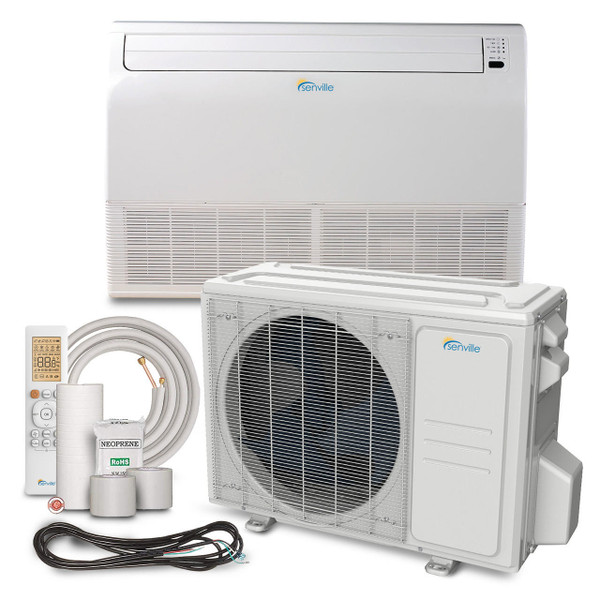
This looks just like the senville floor/ceiling unit I installed this week. Did the pioneer come with mounting hardware for the indoor unit?
 
To avoid these ads, REGISTER NOW!

Steve W.

Well-known member
Joined
Mar 27, 2019
Messages
1,240
Location
Southwest oHIo
Which Senville unit? I just looked at their site and found a floor-mount unit, but not one that could be hung from the ceiling.

Yes, it had some basic hardware, but I did a “custom” install. Because there were no trusses directly above where I mounted it, I installed flat steel straps above the OSB ceiling (accessed from the attic) to help distribute the load and ran some all-thread through holes through the straps and the ceiling. Used some fender washers and nuts to keep all that in place while I hung the air handler on more fender washers and nuts on the bottom end of the all-thread. Gave it all a couple of pats and said "That's not going anywhere". :cool:
 

C2F

Well-known member
Joined
Nov 5, 2018
Messages
101
Location
New Jersey
Mini splits are usually sized with the expectation that they will be on all the time. Gas heaters can be larger (more heat output). But if they're too large they short cycle which is not good for them. If you have a 24k btu mini split and a 24k btu gas heater, they will heat the space up at the same rate. The mini split can at least run at a much lower than maximum output instead of cycling on and off. That makes the heat more consistent and the space more comfortable.

Pulling a cold car into the garage probably cools it off more than the cold air that's let in.


A 24,000 BTU mini-split will not heat at the same rate as a 24,000 BTU gas heater.

A 24,000 BTU gas heater rated at 80% efficiency only delivers about 19,200 BTU/hr to the space

(24,000 × 0.80 = 19,200 BTU/hr). Higher-efficiency gas units deliver more, but nameplate BTU and delivered BTU are not the same thing.

With mini-splits, output is even more variable. Most standard mini-splits are rated at +5°F, and their actual heat output changes with outdoor temperature. A system will deliver significantly more heat at 40°F than it will at 10°F, and its efficiency (COP) is also much higher at 40°F than at 10°F.

That’s why climate matters. If your area regularly sees 10°F or lower, a standard unit may not keep up. In that case, a -20°F “hyper-heat” style system is a much better choice. In the Northeast, we’ve recently had multiple nights below 5°F in a row—more than I’ve seen in my lifetime. If you expect reliable heat during brutal cold, the system needs to be sized and selected accordingly.

Also important: when a mini-split is labeled “24K,” that number typically refers to its cooling capacity, not its guaranteed heating capacity. The actual heating output at different outdoor temperatures is shown in the manufacturer’s capacity tables.

Here’s an example submittal showing how heating capacity changes with outdoor temperature.


Bottom line: comparing BTUs between gas heat and mini-splits isn’t apples-to-apples. Delivered output, outdoor temperature, and system design all matter.
 

Highbeam

Well-known member
Joined
Feb 15, 2011
Messages
2,292
Location
Mt Rainier foothills, WA
You just go and look at the published output specs for the various ambient temperatures. No guessing and modern equipment makes very high output at very low ambient temperatures. You just pick the unit that delivers the BTU you need at your design temperature.
 

NitroGarage

Well-known member
Joined
Mar 2, 2016
Messages
203
Location
Cleveland, OH
Which Senville unit? I just looked at their site and found a floor-mount unit, but not one that could be hung from the ceiling.

Yes, it had some basic hardware, but I did a “custom” install. Because there were no trusses directly above where I mounted it, I installed flat steel straps above the OSB ceiling (accessed from the attic) to help distribute the load and ran some all-thread through holes through the straps and the ceiling. Used some fender washers and nuts to keep all that in place while I hung the air handler on more fender washers and nuts on the bottom end of the all-thread. Gave it all a couple of pats and said "That's not going anywhere". :cool:

Instructions show ceiling mount install as well as wall.
 
To avoid these ads, REGISTER NOW!
Top Bottom