To avoid these ads, REGISTER NOW!

ICF Question

bannerd

Well-known member
Joined
Nov 14, 2011
Messages
209
Location
Upstate NY
We have footers poured and are now putting the ICF together. I thought in my mind I would just pour the 8ft wall all in one shot but after reading the manual from the manufacture they want you to only do 4ft sections. I called them and they said only to do 4ft levels at a time. After the 4ft is poured with concrete and setup up, continue pouring the rest. Is this due to the foam causing a blow out? The company said even with bracing the foam might not hold together with that amount of weight.

Anyone run into this issue?
 
To avoid these ads, REGISTER NOW!

jetnow1

Well-known member
Joined
Jun 27, 2016
Messages
511
Location
CT.
Why would you not listen to what the manufacture says to do? Concrete is very heavy
and a hell of a mess if there is a blow out.
 
OP
B

bannerd

Well-known member
Joined
Nov 14, 2011
Messages
209
Location
Upstate NY
The way I was use to doing it was just pour the wall in lifts. Then come back and continue from the start. Guess we'll just go with what they say, just seems like there is going to be a weak spot pouring concrete on dry concrete.
 

Gmrhost

New member
Joined
Jul 12, 2016
Messages
4
Location
Neosho, MO/Mound City, KS
When I would help pour foundations, the contractor ran beads of concrete glue in wavy lines over the previously setup rise, saying it helped the wet bond to the dry. Plus, evn with framed forms, I don't recall us ever pouring over 4 feet at once, vertical. Tilt-ups, yes, but not vertical.
 
OP
B

bannerd

Well-known member
Joined
Nov 14, 2011
Messages
209
Location
Upstate NY
Does the manufacturer instructions say to put in a key way at the top of the pour for the next section/pour ?

Nothing about that, I don't think you can in ICF, there is nylon locks every 4 inches. Unless you took coffee cans and made a keyway every few inches. Otherwise you would hit the nylon locks. I'm thinking about doing vertical rebar to give it some support in-between.
 

Jon_E

Well-known member
Joined
Aug 19, 2015
Messages
575
Location
Southwestern Vermont
I poured my house foundation (Reward blocks) by starting in one corner, pumping in about two feet of concrete, and then continuing around the foundation until I got back to the start, then another lift, and so on until it was full. Did not wait for anything to set up or dry. No blowouts, no bowing, used manufacturer-recommended bracing.

However, I would suggest you follow your manufacturer or distributor's instructions. Your forms may be different and not as strongly reinforced.
 

GSRinmyCRX

Well-known member
Joined
Jun 10, 2014
Messages
201
Location
Western, NY
I have always thought a cold joint in your foundation was not allowed. I looked at NY codes but couldn't find anything.

might want to check that to be sure.

Levi
 

Jess

Well-known member
Joined
Oct 22, 2006
Messages
430
Location
Vancouver Island, BC Canada
Check the manufacturers web site for installation information. There are a lot of different manufacturers around and each is a little different. Some suggest an 8 ft wall is max, with the pour going around in no more than 2' lifts and not over vibrated to reduce the possibility of a blowout. If your contractor isn't comfortable with more than 4' at a time. then that's the way to go if he is doing it. Make sure that they leave lots of rebar to tie the next lift to the first. Location and distance from the concrete plant would be part of any decision to do it in stages. If concrete is easy to get, then as soon as the next blocks are up and braced, you could arrange four the pump and pour the next day.
 
To avoid these ads, REGISTER NOW!

theoldwizard1

Well-known member
Joined
Feb 22, 2011
Messages
43,243
Location
SE MI
It doesn't need to be dry just set for a day.

Do you have to wait that long ? How about 2-4 hours ?

Did you use anything to "bond" the 2 pours together ? I would worry about leaks at the seam, but i guess that is why you do exterior waterproofing (including dimple board) a "weeping tile" system and back fill with gravel.
 

NUTTSGT

Super Moderator
Staff member
Joined
Sep 14, 2009
Messages
51,087
Location
Northern Central Ohio
Nothing about that, I don't think you can in ICF, there is nylon locks every 4 inches. Unless you took coffee cans and made a keyway every few inches. Otherwise you would hit the nylon locks. I'm thinking about doing vertical rebar to give it some support in-between.

Most definitely on the vertical rebar, I'll agree with that.

Where's Doug when you need him, that guy has some serious concrete knowledge, including using ICF forms like he did on his concrete underground.
 

csp

Well-known member
Joined
Mar 23, 2010
Messages
5,720
Location
Franktown, CO
I called them and they said only to do 4ft levels at a time. After the 4ft is poured with concrete and setup up, continue pouring the rest.

You need them to clarify what they mean by "set up". This could mean anything from doing it in lifts where it starts to set or completely cured.

I can't see any ICF manufacturer that would recommend letting it set to the point of having a cold joint between pours.

Mine has 10' walls (vertical ICFs vs. the block type) and was done in 2' lifts and vibrated as we went around. Braced to the hilt and zero blowouts. My parents' home also uses ICFs (block type) and was done in 2' lifts. We had one blowout in a corner that was operator error due to a lack of bracing.
 

DougWil

Well-known member
Joined
Dec 29, 2015
Messages
547
Location
NW Montana
Wet concrete is basically a fluid, especially when you vibrate it and pressure increases with depth.
p=wh
p=pressure(psf)
w= weight of concrete(pcf)
h= height of pour(ft)

so p = 145pcf*4ft= 580lbs/ft squared.
at 8 ft = 1160 lbs/ft squared or 8psi,,, a lot to ask from a styrofoam cup.

You only have to wait until it sets up and is no longer plastic.
Even a cold joint won't do any harm, and acts as a crack but that is why you have rebar to resist tension forces.
 

ssdave

Banned
Joined
Apr 11, 2015
Messages
2,913
Location
Eastern Oregon
I've done two ICF houses. The first was done in 4 foot lifts, had one blowout and a few leaks. The second, we just went around and around the house, putting in 2 feet lifts, and the concrete is sufficiently set to not blow out by the time you get around to the next lift, but will still bond without problems. We had no problems and no blow outs with this technique. Stagger the delivery of concrete trucks if you need to give a hour or so between 2 foot lifts. Or, you can even go 4 foot lifts, as the manufacturer says. Just in my experience, 2 foot worked out, for the right amount of time between lifts to let it set up to not quite liquid and decrease the pressure on the icf to not cause blowouts.
 

MushCreek

Well-known member
Joined
Jan 14, 2015
Messages
9,814
Location
Upstate South Carolina
We built an ICF house with Fox Blocks. We did the 8' tall walls in three lifts, so roughly 2-1/2 to 3' lifts. We started in one corner, and by the time we got back to the starting point, it was set enough for the next lift. The total pour took about 4 hours for a 1400 square foot house.
 
OP
B

bannerd

Well-known member
Joined
Nov 14, 2011
Messages
209
Location
Upstate NY
Called them back and they recommend a day or an accelerator so the concrete can take the load when more concrete is added. As long as the concrete starts setting up at 4ft it can handle that, blow out wont happen with smaller set lifts. Since the blocks have vertical rebar every foot, cold is okay to do as well. A lot of their customers build entire buildings and there is just no way they can get concrete fast enough so it ends up being cold when they start the next lift.
 
Last edited:

theoldwizard1

Well-known member
Joined
Feb 22, 2011
Messages
43,243
Location
SE MI
I poured my house foundation (Reward blocks) by starting in one corner, pumping in about two feet of concrete, and then continuing around the foundation until I got back to the start, then another lift, and so on until it was full. Did not wait for anything to set up or dry. No blowouts, no bowing, used manufacturer-recommended bracing.
That is how I have always heard it should be done !
 

wssix99

Well-known member
Joined
Mar 2, 2011
Messages
5,162
Location
Chicago, IL
What system are you using?

I just built a 4 story house, with 60' walls all out of ICF. 4' lifts would have killed us.

Yes, blowouts are a problem and are a type of hell you never want to experience. (Especially if you are 60' in the air - fortunately, we had our last major one at 12'.) The block's max lift height will be a function of the design of the blocks the set rate of the concrete, and the skill of your mason. Not all block systems are the same - some are stronger. Faster setting concrete helps and it's also a best practice to walk the lift around the building so your lift goes up in layers. (If you load one area to the full height right away, it will stress that one point of the wall.) Also, shooting concrete in too fast with the pump will also help blow out the wall...

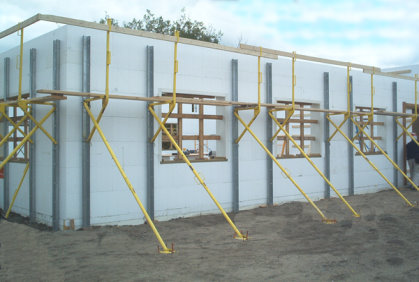
You also need a bracing system. No matter what you do, the ICF wall will bend when concrete is poured in. The wall will become wavy, will fall out of plumb, and will no longer be square. The more concrete goes in, the worse this problem is. Do you have a bracing system or are you not using one? If you don't have braces, you will need to limit yourself to very small lifts. (and more visits from the pumping company!)

tempphoto-2.jpg


Due to the importance of getting the first course of ICF "right", plumb, and square, we also did our first lift as a short one. It's a lot easier to do the higher lifts with the bracing system if there is a solid anchor at the bottom.
 
To avoid these ads, REGISTER NOW!
Top Bottom