I just bought a set of 3/8 metric deep well socket from icon for my road box they say they are made of Chrome Moly not Chrome Vanadium. I know impact sockets are made of chrome moly so theoretically can i use these on an impact and have no issue? The only thing wrong that I can think of is that the walls are thinner so they may loose some strength.


You are using an out of date browser. It may not display this or other websites correctly.
You should upgrade or use an alternative browser.
You should upgrade or use an alternative browser.
Icon Chrome sockets on Impact
- Thread starter unimog401
- Start date
the heat treatment is big difference and the chrome plating .
doesn't make huge difference on crv or crmo .
Use chromes on impact when needs must but don't keep doing it as trashes the chrome sockets and has increased chance of personal injury and possibility of damaging impact tool anvil/drive square if unlucky .
doesn't make huge difference on crv or crmo .
Use chromes on impact when needs must but don't keep doing it as trashes the chrome sockets and has increased chance of personal injury and possibility of damaging impact tool anvil/drive square if unlucky .
Last edited:
turnthewrench 2.0
Well-known member
It's not about Molly, but how you treat her.
Plenty of CrV impact sockets around, as said above.
Plenty of CrV impact sockets around, as said above.
Honestly, aside from safety concerns, non-impact sockets aren't ideal for impact applications due to their lack of mass. You'll end up using regular sockets more aggressively than impact sockets, which increases the risk of cracking.
Using them with a 1/4" impact driver is much different from using a mid-torque 3/8" wrench.
Using them with a 1/4" impact driver is much different from using a mid-torque 3/8" wrench.
Yes but a crv impact vs a crv chromed socket has thicker wall, different heat treatment and no chrome plating .You can obviously do whatever you want. There are plenty of impact sockets made from chrome vanadium and they don't explode into grenade like shrapnel despite what some think- they just crack like any other socket does.
Having seen many guys using expensive truck chrome sockets on impacts all the time I wouldn't recommend it, the broach and drive square gets chewed and wallowed and the chrome can flake on heavy contact spots .
You then end up with chrome sockets that fall off your ratchet or extensions and fit loosey goosey on the hex as wallowed out and can have issues with chrome splinters and potentially warranty issues if obvious miss use .
You can also damage the anvil square on the impact with chrome sockets if unlucky .
Do I use chrome on impact, yes but only when a must or light ugga-dugga action .
Last edited:
SwissMetric
Well-known member
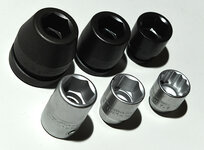
I already posted this pic as example of various 24 mm (slightly below 1") Stahlwille sockets, 3/8" , 1/2" and 3/4" non-impact and 1/2", 3/4" and 1" impact.
According to ISO standards the hardness range for impact (i.e. machine-driven) sockets is higher than the one for non-impact (i.e. hand-driven). Also as already mentioned by others, the wall thickness is different.
For low torque peaks, typically to unscrew already loosened parst it's not a problem to use non-impact sockets though they can fall off the driving square if there's no retaining clip as those sockets don't feature radial holes.
Applying regular impact torques can damage non-impact sockets and even presents an inury risk due to expelled debris when a socket fails catastrophically (never saw it myself though).
Overall it's a matter of common sense, the problem being that a regular socket can end damaged, also its female square can be damaged more easily due to its lower hardness.
According to ISO standards the hardness range for impact (i.e. machine-driven) sockets is higher than the one for non-impact (i.e. hand-driven). Also as already mentioned by others, the wall thickness is different.
For low torque peaks, typically to unscrew already loosened parst it's not a problem to use non-impact sockets though they can fall off the driving square if there's no retaining clip as those sockets don't feature radial holes.
Applying regular impact torques can damage non-impact sockets and even presents an inury risk due to expelled debris when a socket fails catastrophically (never saw it myself though).
Overall it's a matter of common sense, the problem being that a regular socket can end damaged, also its female square can be damaged more easily due to its lower hardness.
Attachments
dnschmidt
Well-known member
Impact sockets are so cheap why bother tearing up the drive end of chrome sockets to save $10. Not worth the aggravation. Don't be penny wise and dollar foolish. On 1/4" drive you'll not notice any difference. Once you get to the powerful modern 3/8 drive impact wrenches it's just not worth it. The latest model MIlwaukee Stubby puts out 500 ft-lb. Thin walled chrome isn't going to like that. Gray Pneumatic does make what they call dual sockets that they say can be used either manually or with an impact. Likely this is due to some compromise with respect to heat treatment.