

You are using an out of date browser. It may not display this or other websites correctly.
You should upgrade or use an alternative browser.
You should upgrade or use an alternative browser.
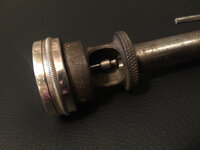
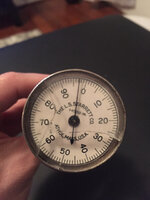
ID this Starrett guage use please
- Thread starter Mgm7890
- Start date


G_P
Well-known member
is the shaft hollow? Looks like it may slide over a rod to measure it.
Jim Johnstone
Well-known member
Tagging along, I've never seen an instrument like this.
Schurkey
Well-known member
Reminds me superficially of a valve seat concentricity gauge.
Long rod (pilot) to fit into the valve guide. The gauge slides down over the pilot. The little arm sets gauge preload, and rides on the valve seat. Spin the gauge 360 degrees on the pilot. If the seat isn't concentric, the little arm pushes the gauge up and down on the valve guide pilot, which results in the gauge needle deflecting.
OTOH, while it's common for concentricity gauges to use a 0-50-0 gauge, they're pretty worthless considering that a valve seat should be within one or two thousandths, not fifty thousandths. A 0-5-0 gauge makes more sense in that application.
I've also not seen a valve seat concentricity gauge that didn't use a standard valve guide pilot. Perhaps something along that line, but for a specialized application???
Or is the smaller-diameter rod with the hole in it installed upside-down? The part that would fit into the valve guide is jammed into the tool, while the through-drilled end should be the "top", with the drilling used for the valve guide pilot installer/remover tool. I lean towards this theory. At any rate, even if the gauge itself is repairable, it's a poor substitute for a 0-5-0 gauge; and the guide pilot is ruined from the rust. They're intended to be a precision-fit in the guide. In shop use, you'd have dozens of pilots to fit the various valve guides--from about 5mm or even smaller, through 3/8" for automotive stuff, and larger still for Diesel engines in trucks or off-road equipment. Each nominal SAE guide size will have perhaps 3 oversizes by .001 to allow for honing/reaming to achieve appropriate valve guide clearance. For example, if servicing a 5/16 valve guide, you'd want a 5/16 pilot, a 5/16 + .001, 5/16 +.002 and 5/16 + .003 pilots. Same for 11/32 valve guides, and 3/8 guides, and all the other sizes. On top of that, it used to be common to ream worn guides by 0.015 for re-use, so now you need the nominal size plus .015, .016, .017, and .018. Then, just to make things even more complex, the TOP of the pilot has to fit the reconditioning equipment. My stuff uses so-called "Sioux" size pilots at 0.385. I think Black and Decker seat grinders use pilots where the main stem is 0.375. Therefore, a concentricity gauge has to be matched to the pilot it's used with. This gauge seems to have a single pilot jammed ***-backwards into it.
I looked around on-line for a suitable photo of a concentricity gauge for valve seats, and didn't see one right away. Mostly, shops are either not checking concentricity (they rely on their expensive seat 'n' guide machine to do the cutting properly) or they've moved away from this style gauge to newer/better/far more expensive tooling.
Long rod (pilot) to fit into the valve guide. The gauge slides down over the pilot. The little arm sets gauge preload, and rides on the valve seat. Spin the gauge 360 degrees on the pilot. If the seat isn't concentric, the little arm pushes the gauge up and down on the valve guide pilot, which results in the gauge needle deflecting.
OTOH, while it's common for concentricity gauges to use a 0-50-0 gauge, they're pretty worthless considering that a valve seat should be within one or two thousandths, not fifty thousandths. A 0-5-0 gauge makes more sense in that application.
I've also not seen a valve seat concentricity gauge that didn't use a standard valve guide pilot. Perhaps something along that line, but for a specialized application???
Or is the smaller-diameter rod with the hole in it installed upside-down? The part that would fit into the valve guide is jammed into the tool, while the through-drilled end should be the "top", with the drilling used for the valve guide pilot installer/remover tool. I lean towards this theory. At any rate, even if the gauge itself is repairable, it's a poor substitute for a 0-5-0 gauge; and the guide pilot is ruined from the rust. They're intended to be a precision-fit in the guide. In shop use, you'd have dozens of pilots to fit the various valve guides--from about 5mm or even smaller, through 3/8" for automotive stuff, and larger still for Diesel engines in trucks or off-road equipment. Each nominal SAE guide size will have perhaps 3 oversizes by .001 to allow for honing/reaming to achieve appropriate valve guide clearance. For example, if servicing a 5/16 valve guide, you'd want a 5/16 pilot, a 5/16 + .001, 5/16 +.002 and 5/16 + .003 pilots. Same for 11/32 valve guides, and 3/8 guides, and all the other sizes. On top of that, it used to be common to ream worn guides by 0.015 for re-use, so now you need the nominal size plus .015, .016, .017, and .018. Then, just to make things even more complex, the TOP of the pilot has to fit the reconditioning equipment. My stuff uses so-called "Sioux" size pilots at 0.385. I think Black and Decker seat grinders use pilots where the main stem is 0.375. Therefore, a concentricity gauge has to be matched to the pilot it's used with. This gauge seems to have a single pilot jammed ***-backwards into it.
I looked around on-line for a suitable photo of a concentricity gauge for valve seats, and didn't see one right away. Mostly, shops are either not checking concentricity (they rely on their expensive seat 'n' guide machine to do the cutting properly) or they've moved away from this style gauge to newer/better/far more expensive tooling.
Last edited:
Schurkey
Well-known member
Fuller, or Fowler? Here's a Fowler:I'm not 100% sure what it is, but, it is a Starrett dial and the base is made by Fuller. I wonder if someone made this for a special application of some sort?
http://www.tooldiscounter.com/ItemDisplay.cfm?lookup=FOW72-644-200
Last edited:
Thank you all for your replies! And Schurkey, special shoutout to you because that was a hell of an explanation.
The tool came from a person that did a lot of machine work and automotive repair work for a shop in the 70-90s. So, I do like the sounds of your second theory.
It does appear that the lower rod is rusted in place.
Is this tool pretty much useless at this point then? The guage seems to operate nicely, and would just need a new watch glass.
Thanks!
The tool came from a person that did a lot of machine work and automotive repair work for a shop in the 70-90s. So, I do like the sounds of your second theory.
It does appear that the lower rod is rusted in place.
Is this tool pretty much useless at this point then? The guage seems to operate nicely, and would just need a new watch glass.
Thanks!
Last edited:
WhiskeyRanger
Well-known member
- Joined
- Mar 28, 2015
- Messages
- 398
It does look functionally similar to what we used to use to check seat to guide runout at the engine plant I used to work at. The last line that used dial indicators while I was there was installed in the 70's.
Schurkey
Well-known member
Brand-new, made-in-USA replacement is ~$80. Not Starrett, however.
I'd pull the Starrett gauge out of the rest of the tool, then pop the pilot free using a small hammer and punch from the gauge end. See what happens. You could probably polish the pilot enough to get an idea of how the thing worked, even if the pilot is no longer a precision-fit in the housing bore, or in the valve guide.
Realistically, I suspect that tool is now a paperweight--but you won't know until you clean it up. A new "glass" over the top shouldn't be too expensive. You could also contact Starrett for repair prices.
I'd pull the Starrett gauge out of the rest of the tool, then pop the pilot free using a small hammer and punch from the gauge end. See what happens. You could probably polish the pilot enough to get an idea of how the thing worked, even if the pilot is no longer a precision-fit in the housing bore, or in the valve guide.
Realistically, I suspect that tool is now a paperweight--but you won't know until you clean it up. A new "glass" over the top shouldn't be too expensive. You could also contact Starrett for repair prices.
Packard V8
Well-known member
You could also contact Starrett for repair prices.
Only if one is comparing the repair prices to new retail. Not for GJ garage sale tools.
jack vines
davethorik
Well-known member
Only if one is comparing the repair prices to new retail. Not for GJ garage sale tools.
jack vines
If you could find a use for it, the Starrett part of that is just a #196 back plunger indicator. Fairly common, they were adapted to a few other odd gages made by Starrett, such as the #170 dial sheet gage.
Only if one is comparing the repair prices to new retail. Not for GJ garage sale tools.
jack vines
I'm confused by what you mean by this.
If you could find a use for it, the Starrett part of that is just a #196 back plunger indicator. Fairly common, they were adapted to a few other odd gages made by Starrett, such as the #170 dial sheet gage.
Thanks for the information! I'll look into it.
Schurkey
Well-known member
He's saying the tool is probably "totaled", in that repair prices will exceed any rational value of the item once repaired.I'm confused by what you mean by this.
I have a Starrett bore gauge that needs repair. Starrett quoted minimum $80 plus shipping, and that was a decade ago. I don't like the tool that much; it's a clumsy design. Thus I have neither repaired it, nor used the good one I also own. Paperweights, both of them.
As is the tool you have. A clever person could replace the lens with sheet plastic that's maybe been heated and curved a bit. That's the easy part. The harder part is finding out if rust has destroyed the precision-fit between pilot and the main body of the tool. I'm fairly certain the pilot is now junk. Question is, how badly rusted/distorted is the tool body where the pilot slips inside? You won't know that until you pop the pilot out, and inspect the tool body.
Again, while 0-50-0 gauges are common on tools like this, their use has to be due to cost, since the indicator pointer should never move beyond .003 in actual use. The remaining travel of the needle is "wasted". A 0-5-0 gauge is much more suitable, yet less common. If an automotive valve seat is more than .002 out-of-true, it's toast. For performance work, less than that. Some folks allow as much concentricity variation as the valve guide has clearance to the valve stem. I'm not sure that's good practice. Point is, a gauge measuring to fifty thousandths when the tolerance is going to be exceeded at three thousandths isn't optimum.
Unless there's some sentimental value to this tool, clean it up and put it on a shelf as decoration.