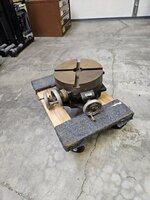
Hoping for some help with identification and value for this vice. My Father passed away last month and left a full machine shop of equipment. I can read Palmgren Products on the label and it appears 6235-1 is cast on the bottom. Any help with identifying it and a resale value would be appreciated.

You are using an out of date browser. It may not display this or other websites correctly.
You should upgrade or use an alternative browser.
You should upgrade or use an alternative browser.
Identification Question
- Thread starter ssickman
- Start date


four.cycle
Well-known member
^ The only resources available - to be honest - are the "sold" listings on ebay, but I'd posit that vises aren't a big seller on ebay - the shipping costs would be a deal killer.
A 6-inch Morgan went for $200 earlier today on a CL ad.
You might check your local CL listings and look at asking prices, but those may or may not be connected in reality to actual selling prices.
A 6-inch Morgan went for $200 earlier today on a CL ad.
You might check your local CL listings and look at asking prices, but those may or may not be connected in reality to actual selling prices.
That is a rotary table. It is hard to tell from the pictures but it looks like a cross slide rotary table. The specific model will depend on what size it is. http://vintagemachinery.org/pubs/2459/16572.pdf
I'd guess it would be worth $200-$400. Shipping would be pretty expensive and if I bought it I would want a custom wooden crate so it doesn't get damaged in shipping.
I'd guess it would be worth $200-$400. Shipping would be pretty expensive and if I bought it I would want a custom wooden crate so it doesn't get damaged in shipping.
paulsomlo
Well-known member
Where are you located?
LopezBart
Well-known member
Something like this? https://www.ebay.com/itm/2766100432...PtKP9UYT7DzjaG0WFFRtXSndIWdH|tkp:BFBM9Lfp_9Jk
four.cycle
Well-known member
^ That seller is going to lose money on that deal. Shipping isn't high enough. USPS just went up.
Orange County, CAWhere are you located?
That's pretty close. Here's a wider pic of it.
Attachments
Cruzan80
Well-known member
Yes, cross-slide rotary table. Later model, by the shape of the hand-wheels. It is missing the "hold-downs"/vise bits on top (frequently they go missing).
Can't directly comment on price, as it is location dependant. Do you want stuff gone, or higher prices (and willing to wait)?
Can't directly comment on price, as it is location dependant. Do you want stuff gone, or higher prices (and willing to wait)?
RoninB4
Well-known member
This type of cross slide rotary table was more popular prior to CNC machinery being common. It is still somewhat in use by the home shop crowd. However, this model is not very robust and will likely experience excess vibration in heavy cuts. Palmgren is a brand known for production fixtures and is NOT very well thought of for precision work. The backlash alone should be an indicator of how good it is/isn't. Not trying to be harsh or critical, what I'm saying is if a reasonable offer comes along I'd take it or you may be waiting a while for the next one,
LopezBart
Well-known member
This has been my experience as well. Once I went from a mill-drill to a Bridgeport, I bought a phase II rotary table - a much heavier and more rigid piece of tooling; I traded my mill-drill & Palmgren table to a friend for a nice welder. The Palmgren works for drilling; it's really too light for much milling, esp. in steel.This type of cross slide rotary table was more popular prior to CNC machinery being common. It is still somewhat in use by the home shop crowd. However, this model is not very robust and will likely experience excess vibration in heavy cuts. Palmgren is a brand known for production fixtures and is NOT very well thought of for precision work. The backlash alone should be an indicator of how good it is/isn't. Not trying to be harsh or critical, what I'm saying is if a reasonable offer comes along I'd take it or you may be waiting a while for the next one,
Phase II horizontal/vertical table.

RoninB4
Well-known member
-It's been my experience/opinion that most of the rotary tables that are small enough to lift aren't very good for milling steel. They may do aluminum or some of the red metals (brass) without much trouble but for long length end mills and/or heavy cuts the mass of the rotary table is important. The 12" and larger tables like Troyke, Moore, Bridgeport and Yuasa have more mass, less backlash, and better locks but are a bear to lift onto the machine.The Palmgren works for drilling; it's really too light for much milling, esp. in steel.
Cruzan80
Well-known member
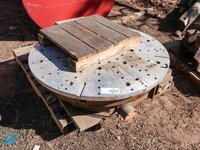
You mean like this Troyke that just showed up at auction?The 12" and larger tables like Troyke

Can't imagine what size machine could hold it...
Attachments
I have a HF lift table that is very useful swapping out vices for the RT.-It's been my experience/opinion that most of the rotary tables that are small enough to lift aren't very good for milling steel. They may do aluminum or some of the red metals (brass) without much trouble but for long length end mills and/or heavy cuts the mass of the rotary table is important. The 12" and larger tables like Troyke, Moore, Bridgeport and Yuasa have more mass, less backlash, and better locks but are a bear to lift onto the machine.
RoninB4
Well-known member
You mean like this Troyke that just showed up at auction?
Can't imagine what size machine could hold it...
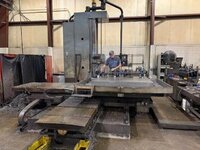
-There were many of the older, pre-CNC machines that could and did on a regular basis like this one

Modern machines, especially CNC boring mills, will often have an optional built-in rotary table that's driven by the control. I ran a larger version of this one you could park a small car on.
Rotary tables, especially the large/expensive ones like the Troyke in the previous post, are almost exclusively in the domain of manual machines. That's why there's many up for sale. Kind of sad to see a piece of precision tooling go for little more than scrap iron value but that's the way of machining.
RoninB4
Well-known member
-I've used plenty of lift tables for moving smaller stamping dies and wish I still had one for moving heavy objects around the shop. Some shops use a pair of ball bearing parallels like these for transferring vise/rotary tablesI have a HF lift table that is very useful swapping out vices for the RT.

If swapping out angle plates, tombstones, vises, rotary tables, etc. is fairly frequent some shops will have a sky hook crane mounted on the lift table to avoid possible back strain and allow thorough cleaning of the bottom surface. Good shops will have a floor/wall mounted crane that swings in/out between the machine and the fixture storage area. Sure beats carrying heavy tooling all day.

Just looking to list a fair price and not give the stuff away.Yes, cross-slide rotary table. Later model, by the shape of the hand-wheels. It is missing the "hold-downs"/vise bits on top (frequently they go missing).
Can't directly comment on price, as it is location dependant. Do you want stuff gone, or higher prices (and willing to wait)?
In the 70's I worked in prototype/model work for a couple of manufacturers. One of the prizes in the shop was a precision Troyke with a cross slide on TOP of the rotary movement. The machine xy motion on a vertical mill located the rotation axis to the cutting tool and the top cross slide allowed for manipulation of the work-piece over the axis. Was able to do some very interesting and seemingly difficult machining without having to un-clamp, reposition, and re-clamp the work piece. Loved that work.Rotary tables, especially the large/expensive ones like the Troyke in the previous post, are almost exclusively in the domain of manual machines. .......That's why there's many up for sale. Kind of sad to see a piece of precision tooling go for little more than scrap iron value but that's the way of machining.
It is kinda sad.
RoninB4
Well-known member
Was able to do some very interesting and seemingly difficult machining without having to un-clamp, reposition, and re-clamp the work piece. Loved that work.
It is kinda sad.
-While CNC controls with continuous multiple axis movement can do some truly amazing things there was a certain amount of creativity needed for doing work on manual machinery. Sometimes the workpiece would be clamped to an angle plate or in a precision vise and it would stay there as a reference surface/hole that would travel from machine to machine for multiple operations until the piece was completed. Advance planning and ingenuity has largely been replaced by creative programming and machinery we could only dream of back in the 70's.