To avoid these ads, REGISTER NOW!

I'm stupid. Help me.

Ryan

Administrator
Staff member
Joined
Jan 26, 2006
Messages
5,750
Location
Texas/Hawaii
OK guys, so I just got a really neat 1953 Unisaw. I bought it from the original owner who was a retired NASA engineer in Houston. And it came with some great stories.

Anyway, it has a dual 115/230 (11.8 or 5.9 amps) motor. Here's a shot of the motor plate for clarification:
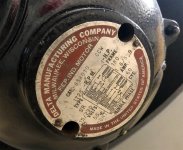
motor.jpg

I wired it to run on 230 as instructed by the original owner's manual and a 12awg cord with a NEMA 6-15 15a/250v plug.

From there, I turned my attention to the power source. I have an outlet that was originally intended as an extra 240 outlet for my welder. It's protected by two 30amp fuses that are tied together.

So, I removed the wall receptacle and replaced it with a 20a-250v receptacle. I then plugged in my saw... She started and ran perfectly, so I'm not too worried about that.

What I need to know from you guys is if this is all cool or not? Am I breaking some safety code with my wiring?

I hate electricity. It's magic to me.
 
To avoid these ads, REGISTER NOW!

Stuart in MN

Well-known member
Joined
Sep 8, 2005
Messages
23,365
Location
Minneapolis
Nice find on the saw. I assume it's a circuit breaker and not fuses in your panel, since your building is pretty new, and it does need to be changed to 20 amps to match the receptacle. It should be easy enough to do - assuming your panel is a name brand, any decent big box store should have the correct two pole circuit breaker. You just disconnect the wires, pop the old one out and put the new one in, reconnect the wires and you're done. Of course, turn off the main breaker first.
 
OP
R

Ryan

Administrator
Staff member
Joined
Jan 26, 2006
Messages
5,750
Location
Texas/Hawaii
Nice find on the saw. I assume it's a circuit breaker and not fuses in your panel, since your building is pretty new, and it does need to be changed to 20 amps to match the receptacle. It should be easy enough to do - assuming your panel is a name brand, any decent big box store should have the correct two pole circuit breaker. You just disconnect the wires, pop the old one out and put the new one in, reconnect the wires and you're done. Of course, turn off the main breaker first.

Yeah... Circuit breakers. Sorry. Told you I was stupid.

Anyway... I was under the impression that the fuses... **** sorry, BREAKERS... were actually there to protect the wires in route to the receptacle. Given that, aren't the present 30 amp breakers fine?

And if not, I would assume that I would need to replace the two 30 amp breakers that are tied together with a single 20 amp - correct?

And thanks man.
 

Norcal

Well-known member
Joined
Mar 16, 2008
Messages
13,790
A 20A receptacle can have 20A fuses or circuit breaker, BTW, “stupid” is knowingly leaving higher then allowed overcurrent protection, your asking so that is not being stupid. Nice find on the Unisaw, have three of them but 2 are rescues that need to be rehomed or parted out.
 

wyliesdiesels

Well-known member
Joined
Aug 14, 2012
Messages
20,219
Location
Modesto, CA
Yeah... Circuit breakers. Sorry. Told you I was stupid.

Anyway... I was under the impression that the fuses... **** sorry, BREAKERS... were actually there to protect the wires in route to the receptacle. Given that, aren't the present 30 amp breakers fine?

And if not, I would assume that I would need to replace the two 30 amp breakers that are tied together with a single 20 amp - correct?

And thanks man.

yes replace the double pole 30a breaker with a double pole 20a breaker that is listed for your panel. in other words, the same brand and correct model as called for on panel label.
 

Zeke

Well-known member
Joined
Aug 13, 2009
Messages
17,176
Location
Long Beach CA, the sewer by the sea.
Off topic, but a 1 HP 1750 RPM motor on a table saw is not any better than the one you already have — an old CM IIRC. Before you downsize the breaker you might look into upgrading the motor to 3 HP 3450 RPM. The pulley sizes will change so look into putting a larger pulley on the arbor. The small dia pulleys on many saws makes the belt(s) have to turn a very tight radius. You need a link belt to make that turn and not vibrate. Bigger is better even with the link belt.
 
OP
R

Ryan

Administrator
Staff member
Joined
Jan 26, 2006
Messages
5,750
Location
Texas/Hawaii
Off topic, but a 1 HP 1750 RPM motor on a table saw is not any better than the one you already have — an old CM IIRC. Before you downsize the breaker you might look into upgrading the motor to 3 HP 3450 RPM. The pulley sizes will change so look into putting a larger pulley on the arbor. The small dia pulleys on many saws makes the belt(s) have to turn a very tight radius. You need a link belt to make that turn and not vibrate. Bigger is better even with the link belt.

This is actually a repulsion start/induction run bullet motor. It's rated at 1hp, but they are sort of famous for making a lot more. Plus, they have a ton of momentum torque. And thus far, I can say it makes more than double the 3/4 hp vintage motor I have on my old delta contractor saw. I just tore through a 2" piece of hickory like it wasn't there.

It rips.

Thanks for you help guys!
 
Last edited:

rlitman

Well-known member
Joined
Oct 18, 2010
Messages
24,748
Location
Long Island
...The pulley sizes will change so look into putting a larger pulley on the arbor...

Not on a tablesaw. The arbor pulley is what limits the maximum blade height.

Those old repulsion induction motors were famously good. They're supposed to have a flatter torque/speed curve than regular induction motors.

edit:
I'm not sure how their cooling works, but I think it may be ODP, so you cannot seal up that cabinet side for dust collection.
 
Last edited:

rlitman

Well-known member
Joined
Oct 18, 2010
Messages
24,748
Location
Long Island
Oh. Here's a shot of her in all her glory:

saw.jpg

WOW that's a beautiful saw! I love how the side tables taper. Some old tools really had a great aesthetic back in the day. I remember a Walker Turner from my high school that looked a lot like this.
 
Last edited:

cstmg8

Well-known member
Joined
Apr 7, 2018
Messages
519
Location
Pickerington, oh
Beautiful, love it! Get that double pole 20 amp breaker in there and enjoy your saw!

Sent from my Pixel 2 XL using Tapatalk
 

Norcal

Well-known member
Joined
Mar 16, 2008
Messages
13,790
Not on a tablesaw. The arbor pulley is what limits the maximum blade height.

Those old repulsion induction motors were famously good. They're supposed to have a flatter torque/speed curve than regular induction motors.

edit:
I'm not sure how their cooling works, but I think it may be ODP, so you cannot seal up that cabinet side for dust collection.

A option for the Unisaw from ‘39 to the late 60’s was a oval cast iron “goose egg” motor cover, they are somewhat rare but eBay did have some nonmetallic reproductions at one time.
 
OP
R

Ryan

Administrator
Staff member
Joined
Jan 26, 2006
Messages
5,750
Location
Texas/Hawaii
A option for the Unisaw from ‘39 to the late 60’s was a oval cast iron “goose egg” motor cover, they are somewhat rare but eBay did have some nonmetallic reproductions at one time.

Yeah, you can see my goose egg laying on the left side of the saw. I'm getting ready to put new belts on the saw so it's not on at the moment...

But yeah, you can get decent (but not great) dust collection with mods. I'll give it a shot once I have a dust collector.
 
To avoid these ads, REGISTER NOW!

rlitman

Well-known member
Joined
Oct 18, 2010
Messages
24,748
Location
Long Island
A option for the Unisaw from ‘39 to the late 60’s was a oval cast iron “goose egg” motor cover, they are somewhat rare but eBay did have some nonmetallic reproductions at one time.

I get that you can cover the hole, and that goose egg only adds to the great lines on this saw (my PM66 has a blatantly ugly rectangular cover), but I'd be worried about how the brushes would take the even dustier environment inside the closed cabinet. That's where TEFC really rules the roost.

Or maybe I'm just overthinking this.
 

teamextreme

Well-known member
Joined
Aug 10, 2013
Messages
867
Location
Lakewood, CO
The saw vintage matches the car in the background.
But really, how good can that saw be, there's no laser beams on it! /sarcasm
 

Norcal

Well-known member
Joined
Mar 16, 2008
Messages
13,790
I get that you can cover the hole, and that goose egg only adds to the great lines on this saw (my PM66 has a blatantly ugly rectangular cover), but I'd be worried about how the brushes would take the even dustier environment inside the closed cabinet. That's where TEFC really rules the roost.

Or maybe I'm just overthinking this.

To put a TEFC motor in those saws you have to hack up the cabinet to allow for it to tilt, my saws all have the square opening, & have 3 HP 1Ø TEFC motors.
 

Stuart in MN

Well-known member
Joined
Sep 8, 2005
Messages
23,365
Location
Minneapolis
I'd be worried about how the brushes would take the even dustier environment inside the closed cabinet.

OK guys, so I just got a really neat 1953 Unisaw.

It's lasted 65 years so far, I wouldn't worry too much about it myself. :) Besides, Ryan has that neat Festool vacuum system; I would imagine he's going to figure out how to hook it up to the saw for dust collection.
 

exranger06

Well-known member
Joined
Aug 9, 2015
Messages
1,686
Location
CT
OP never mentioned which gauge wire he has running to the receptacle. Welders can have undersized wiring, so he doesn't necessarily have #10 wire. He needs to make sure he has #12 or larger wire.
 

Zeke

Well-known member
Joined
Aug 13, 2009
Messages
17,176
Location
Long Beach CA, the sewer by the sea.
Not on a tablesaw. The arbor pulley is what limits the maximum blade height.

Those old repulsion induction motors were famously good. They're supposed to have a flatter torque/speed curve than regular induction motors.

edit:
I'm not sure how their cooling works, but I think it may be ODP, so you cannot seal up that cabinet side for dust collection.
True on the limit for the arbor pulley but I run an 8" blade on my Unisaw almost all the time. Having a 10" blade at full height is not the best of safety practices.

I'll make 2 shallow cuts on anything thicker than 2". So I stand by my recommendation. Ryan should check the blade speed and know his cutting speeds in inches per minute. When I install the 8" my IPM slows but the torque is multiplied.
 

rlitman

Well-known member
Joined
Oct 18, 2010
Messages
24,748
Location
Long Island
True on the limit for the arbor pulley but I run an 8" blade on my Unisaw almost all the time. Having a 10" blade at full height is not the best of safety practices.

I'll make 2 shallow cuts on anything thicker than 2". So I stand by my recommendation. Ryan should check the blade speed and know his cutting speeds in inches per minute. When I install the 8" my IPM slows but the torque is multiplied.

That raises an interesting point. Larger blades are more likely to tear out at the ends of cuts, which is partly why the big commercial saws (like ones that take 14" blades) often have small scoring blades, and which is also one reason why dado blades are generally reduced diameter (well that, plus the reduced power requirements to make up for the increased kerf). But reducing your blade rim speed increases your likelihood of tearout, so I don't see any advantage to putting an 8" blade on a 10" saw, except to buy cheaper blades (that have a proportionately shorter longevity, so the savings is only short term).

I'll stick to my 10" full kerf blades, and reserve smaller stuff for getting more performance from severely under-powered saws.

As for having my 10" blade at full height. That doesn't often come into play, but it is useful to be able to raise it up high, and isn't necessarily dangerous. That extra inch of height can mean a lot on a tenoning jig for example.
 

DSMR

Active member
Joined
May 24, 2015
Messages
42
Oh. Here's a shot of her in all her glory:

saw.jpg

Check that switch to see if it has built in over current protection and heaters. Some of them do and some don't. If it does, you can leave 30A breakers or fuses (fuses are my preference) in place and change your plug to a 30A unit with the appropriate wire. This would give you more flexibility.
 

Norcal

Well-known member
Joined
Mar 16, 2008
Messages
13,790
Check that switch to see if it has built in over current protection and heaters. Some of them do and some don't. If it does, you can leave 30A breakers or fuses (fuses are my preference) in place and change your plug to a 30A unit with the appropriate wire. This would give you more flexibility.

The switch is simply a toggle switch, no overload protection.
 

Bert_

Well-known member
Joined
Dec 24, 2016
Messages
9,865
Location
NW Iowa
If it doesn't have overload protection I would want to add some. Especially with a saw as nice and original as this. Not that I'd expect to damage the motor with home use but still they aren't making anymore of those IR motors.

Could be a manual motor starter or as simple as a ~7.5A time delay fuse.
 

Slupie

Well-known member
Joined
Dec 19, 2010
Messages
162
Location
Bartlett, IL
Oh. Here's a shot of her in all her glory:

saw.jpg

That's a beautiful saw. It will last you a lifetime, if not more.

I just noticed that you even got the elusive goose egg motor cover. Those things go for as much as the saw.
 
Last edited:

Zeke

Well-known member
Joined
Aug 13, 2009
Messages
17,176
Location
Long Beach CA, the sewer by the sea.
That raises an interesting point. Larger blades are more likely to tear out at the ends of cuts, which is partly why the big commercial saws (like ones that take 14" blades) often have small scoring blades, and which is also one reason why dado blades are generally reduced diameter (well that, plus the reduced power requirements to make up for the increased kerf). But reducing your blade rim speed increases your likelihood of tearout, so I don't see any advantage to putting an 8" blade on a 10" saw, except to buy cheaper blades (that have a proportionately shorter longevity, so the savings is only short term).

I'll stick to my 10" full kerf blades, and reserve smaller stuff for getting more performance from severely under-powered saws.

As for having my 10" blade at full height. That doesn't often come into play, but it is useful to be able to raise it up high, and isn't necessarily dangerous. That extra inch of height can mean a lot on a tenoning jig for example.
I know this thread is not about table saws themselves but we have this new dialog. Mr. Rlitman, I have nothing but the highest respect for anything you post but I'm not completely following here.

FOA, I don't seem to have a problem with tear out. I use thin kerf blades and I use stabilizers on the 10" unless I need to run it high. I did say that the 8" blade did run slower at rim speed, as you call it, but at the same time I get more torque. What I am trying to understand is this,

"Larger blades are more likely to tear out at the ends of cuts, ..... But reducing your blade rim speed increases your likelihood of tearout...."

If you meant by the first part tearout on the vertical back side of the wood dimension, a scoring blade does not address that.

BTW, I have an old school 1/8th kerf combi blade that is pretty custom (read $$$) vs off-the-shelf versions but it makes a ton of sawdust and uses quite a bit of more power. I don't see a need for it.
 

TMcCay

Well-known member
Joined
Jun 5, 2011
Messages
1,063
Location
SW. Oklahoma
Love your saw Ryan! I would love to have one like that in my shop one day. It is probably the only way I would consider getting rid of my old Rockwell contractor saw that has served me well for years.
 
To avoid these ads, REGISTER NOW!
Top Bottom