To avoid these ads, REGISTER NOW!

I'm your fitting guy.....

andyvh1959

Well-known member
Joined
Feb 15, 2020
Messages
2,590
Location
Green Bay WI
for hydraulic connections, both port and hose/tube connections. SAE (pipe, flare/JIC, port/O-ring), BSPP/BSPT, ISO/DIN, JIS, GAZ, inch standard, metric standard, etc. I just retired from Parker Hannifin after 30 years in the hydraulic fluid connector market. I've plumbed plows, ZTR's, skid-steers, combines, cranes, military, AG, construction, hydrostatics and simple jack lines. About the only hydraulic connections I've not actually worked on are GAZ and JIS. So if anyone needs help identifying a threaded hydraulic connection, PM me and I can help.

Oh, and to clarify, for hydraulic connections many people say "fittings and adapters" as the same meaning, but:

ADAPTERS: "adapters" are the parts that connect a hose or hard tube to a device like a pump, motor, valve, cylinder, manifold, etc. The adapter is needed to connect a hose assembly or hard tube to a port function.

FITTINGS: "fittings" for hydraulics are the hose end or tube end parts that connect to the port adapter. For hydraulic hose or hard tube, some form of fitting is required to make the threaded connection. For hydraulic hose the fitting is swaged or crimped to the hose.

Now, for pneumatics, air systems, low pressure systems, a "fitting" can also be a steel or brass part that allows a hose connection like a bead or barb to connect to a port.

There are some specific hose end fittings that can be crimped onto a hose and directly connected into a function port. Such as a hose end with rigid male pipe thread, so the entire hose assembly has to be "turned" into the port. There is even a SAE O-ring rigid straight thread hose end that will turn directly into a port. In either case the other end of the hose assembly requires some form of swivel threaded connection to install the hose assembly.
 
Last edited:
To avoid these ads, REGISTER NOW!
OP
A

andyvh1959

Well-known member
Joined
Feb 15, 2020
Messages
2,590
Location
Green Bay WI
Thanks! I recommend it for everyone,....its very,....liberating. My wife is already threatening to limit my many online forums time in order to "get chit done" around the house that I have always decided to take on myself rather than hire it out, when I can. Man has to recognize his limits.
 

PowerWagonBuilder

Well-known member
Joined
Jan 21, 2025
Messages
82
Location
NW of Richmond, Va
Congrats on the retirement.
I bought a box of ORB to ORFS adapters recently, and in it were some other misc fittings and such...
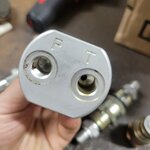
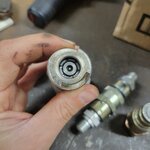
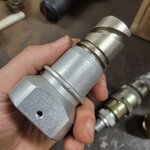
What would this funky thing be identified as and more importantly... use and any value?
Also, do you still have a source for obtaining fittings and adapters? I build and rebuild a few hydraulic goodies per year, just on my own personal stuff. Getting ready to plumb and run hoses for an excavator tilt bucket attachment and also a hydraulic tree shear. Years ago I purchased an old Gates Mobile crimp station and a bucket or two of fittings came with it. I had been purchasing from Blake over at Discount Hydraulic Hose but 3 times in a row now they have goofed up my adapters and sent me things that weren't even close, were one size wrong, or they had swapped the male and female sizes from what the part was spec'd as and what they actually sent over.

What dis?

20241004_195045.jpg

20241004_195048.jpg

20241004_195051.jpg
 

nadogail

Well-known member
Joined
Jan 23, 2009
Messages
31,928
Location
Coronado, CA
Welcome to the Forum.
We are lucky in San to have several reliable sources of Hydraulic and Pneumatic fittings and hoses.
 
OP
A

andyvh1959

Well-known member
Joined
Feb 15, 2020
Messages
2,590
Location
Green Bay WI
Congrats on the retirement.
I bought a box of ORB to ORFS adapters recently, and in it were some other misc fittings and such...
What would this funky thing be identified as and more importantly... use and any value?
Also, do you still have a source for obtaining fittings and adapters? I build and rebuild a few hydraulic goodies per year, just on my own personal stuff. Getting ready to plumb and run hoses for an excavator tilt bucket attachment and also a hydraulic tree shear. Years ago I purchased an old Gates Mobile crimp station and a bucket or two of fittings came with it. I had been purchasing from Blake over at Discount Hydraulic Hose but 3 times in a row now they have goofed up my adapters and sent me things that weren't even close, were one size wrong, or they had swapped the male and female sizes from what the part was spec'd as and what they actually sent over.

What dis?

20241004_195045.jpg

20241004_195048.jpg

20241004_195051.jpg

That's a CEJN brand of multi-coupler, P for pressure side and T for tank (return). The part with the P and T looks like the male half one of the coupler. So if you have the female side you have an accessory coupler. Now that I am retired from Parker I have to source my hydraulic stuffs like all the rest of us. But, I do know what to buy, so Ebay, Graniger, McMaster Carr are decent sources.

The old Gates crimper is a basic simple device, like the Parker Karrykrimp I have in my shop. I can make hose assemblies up to 1" 5,000 psi if I have the hose and end fittings. For reference, Parker has crimpsource.com which does reference Gates crimpers that can make Parker crimps. I have made 1,000s of hose assemblies over 30 years.


For adapters, use the Parker Fitting Finder app (free). It allows you to "build" the adapter configuration you need by style, end connections and size, and material. If you build your adapter on the app you can show that to your supplier and avoid the many possible wrong configurations. When it comes to Parker adapters, the logic is the hose or tube connection is the "1st" end and the port connection is the "2nd" end, so a 4-6 C5OLO-S is a -4 ORFS to -6 ORB steel adapter. But, some adapter brands reverse that logic, so you could end up with the issue you describe, or the parts counter guy messed it up or didn't know why it matters.


RonRock

Well-known member
Joined
Oct 6, 2007
Messages
1,171
Location
Iowa, USA
I recently received a 1.8 ton Chinese Mini Excavator. I have found that the larger size hydraulic fittings are DIN Light. But I am unable to identify this style. This particular end is on a small diameter hose, looks like 1/4 inch ID or whatever the chinese hose is. The hose is YUANGOOD EN853-1SN-6.3 AWP 30 MPa GB/3683-2023 MT/T98-2006 MEE240203 LF01 YUANGU RUBBER CO. LTD. I'll have to figure out how to decipher the hose information, and if I can buy fittings and hose in the USA. I plan to do some rerouting of the spaghetti mess they made in production.
 

Attachments

  • 20251006_095444.jpg
    20251006_095444.jpg
    395.5 KB · Views: 8

Firebrick43

Well-known member
Joined
May 12, 2015
Messages
14,004
Location
West central Indiana
I recently received a 1.8 ton Chinese Mini Excavator. I have found that the larger size hydraulic fittings are DIN Light. But I am unable to identify this style. This particular end is on a small diameter hose, looks like 1/4 inch ID or whatever the chinese hose is. The hose is YUANGOOD EN853-1SN-6.3 AWP 30 MPa GB/3683-2023 MT/T98-2006 MEE240203 LF01 YUANGU RUBBER CO. LTD. I'll have to figure out how to decipher the hose information, and if I can buy fittings and hose in the USA. I plan to do some rerouting of the spaghetti mess they made in production.
That is a DIN or EO fitting as well.

Page 112

IMG_1472.png

6.3 on the hose is the diameter which is 1/4”

30mpa is the pressure, 4500psi.

So you need to pick the size of fitting in the catalog and the corresponding compatible series of hose below and to the right of the fittings, and make sure the series of hose meets the specs for pressure, and bend radius you need
 
To avoid these ads, REGISTER NOW!

RonRock

Well-known member
Joined
Oct 6, 2007
Messages
1,171
Location
Iowa, USA
Thank You, Firebrick43. Very helpful now at least I have a starting point. I usually use Discount Hydraulics as my supplier, I didn't see anything with an Oring. I do see that they show the 24* cone. I'll have to dig deeper to find a supplier for these fittings.
Also helpful hose information.

Cheers,
Ron


Firebrick43

Well-known member
Joined
May 12, 2015
Messages
14,004
Location
West central Indiana
Thank You, Firebrick43. Very helpful now at least I have a starting point. I usually use Discount Hydraulics as my supplier, I didn't see anything with an Oring. I do see that they show the 24* cone. I'll have to dig deeper to find a supplier for these fittings.
Also helpful hose information.

Cheers,
Ron

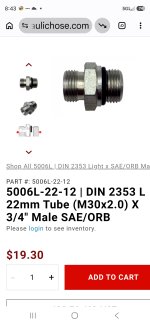
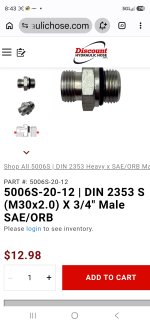
I went to look at discount hydraulics page and yes, i doesn’t show an oring as the picture shows the nut pulled down. It also doesn’t talk about it in the description. You could email or call their customer service number.

I all my years of working on German CNC machines that pretty much exclusively use EO fitting I never saw a hose end fitting that the cone didn’t have an oring/oring groove across the line of LL, L, or S series fittings

The original hardline Ermeto EO progressive rings were metal against metal and would sometimes seep, but even that was corrected years ago with EO2 which has a rubber seal ahead of the bite ring
 

RonRock

Well-known member
Joined
Oct 6, 2007
Messages
1,171
Location
Iowa, USA
I can imagine a couple benefits of an oring seal. Oring seal as opposed to metal to metal, less torque and chance of distortion.

Appreciate your help.
 
OP
A

andyvh1959

Well-known member
Joined
Feb 15, 2020
Messages
2,590
Location
Green Bay WI
"Less torque" to make an o-ring seal only applies to the initial compression of the o-ring. Conpression of the seal is only 0.015" max, so yes making a seal is easy. We tested -16 O-ring face seal fittings to just hand tight and 4000 psi and they held, no leak. But, the proper torque must be applied to make a durable connection to hold against hydraulic and mechanical forces, and in some cases the torque required can be quite high.

The proper torque values for all O-ring face seal connections is higher than the equivalent size JIC Flare connections. But difference is the o-ring seal is made with quick/direct torque feel like a regular bolr. But a JIC connection can "feel" tight but not near the needed torque value for sizes -12 and up. Also for JIC -10 and smaller it can be very easy to WAY over-torque the connection and yeild the metal. Tighten, leak, tighten, leak. JIC must be properly assembled to make a durable connection.

Some installers say the o-ring failed because it got crushed. No, you cannot "crush" an o-ring that is properly seated in the groove or into the port. Once the initial compression of the o-ring is acheived, it is all metal to metal like the underside of a bolt into a threaded hole.
 
Last edited:

RonRock

Well-known member
Joined
Oct 6, 2007
Messages
1,171
Location
Iowa, USA
It seems that my unit is DIN light fittings. Can I use DIN heavy fittings? How do I choose for 1/4" crimped hose fittings, and hose? I see DIN 2353, DIN 3865, and ISO 12151-2. The ISO number seems to correspond to the DIN3865, but IDK.
 
OP
A

andyvh1959

Well-known member
Joined
Feb 15, 2020
Messages
2,590
Location
Green Bay WI
It seems that my unit is DIN light fittings. Can I use DIN heavy fittings? How do I choose for 1/4" crimped hose fittings, and hose? I see DIN 2353, DIN 3865, and ISO 12151-2. The ISO number seems to correspond to the DIN3865, but IDK.
If the connection style and size are the same you can certainly use DIN Heavy in place of DIN light. The difference is in the tube wall thickness which also determines the pressure range for each. DIN 2353 is a metal to metal seal connection. DIN 3865 is also metal to metal but with an o-ring inset into the 24 degree cone face. It can get murky trying to make sense of the multiple standards appllicable to hydraulic connections. ISO is the international standard, DIN is the German standard. In many cases the ISO and DIN standards are equivalent.
 

RonRock

Well-known member
Joined
Oct 6, 2007
Messages
1,171
Location
Iowa, USA
If the connection style and size are the same you can certainly use DIN Heavy in place of DIN light. The difference is in the tube wall thickness which also determines the pressure range for each. DIN 2353 is a metal to metal seal connection. DIN 3865 is also metal to metal but with an o-ring inset into the 24 degree cone face. It can get murky trying to make sense of the multiple standards appllicable to hydraulic connections. ISO is the international standard, DIN is the German standard. In many cases the ISO and DIN standards are equivalent.

Thank you, It is helpful to know the difference between the DIN 2353 and DIN3865. Also good to hear that DIN light and DIN heavy are interchangeable, as far as fitting size is concerned. I am setting up to work on my import mini excavator, and from what I have seen so far 2,500-2,800psi is the operating pressure. I'm pretty sure that the China hydraulics are DIN light. But from what I have been able to find in the USA is DIN heavy. So if I have to use DIN heavy fittings and hose at least it should be compatible with the existing hydraulics. Although probably oversized. Which is also a concern.

Yes it is very "murky" when you are not dealing with this daily. Seems much more difficult than needs to be. But also fun to learn.
 
OP
A

andyvh1959

Well-known member
Joined
Feb 15, 2020
Messages
2,590
Location
Green Bay WI
Glad to help. The Technical Section of the Parker HPD catalog is a good source to figure out the DIN and ISO specs as they to what we commonly use.
 
To avoid these ads, REGISTER NOW!
Top Bottom