To avoid these ads, REGISTER NOW!

Improving Floor Heat System

Gentle_Ben

Well-known member
Joined
Nov 10, 2012
Messages
530
Location
Manitoba, Canada
I finished my detached garage in 2014, and went with a heating system that my contractor uses in all the garage's he builds.

It uses a circulating pump hooked to a small hot water tank. The pump is controlled by a thermostat that sits 12 inches above the floor.

The system works well enough in the other garage's he has installed it in, but mine is the largest garage he has put this system into (700sf) and definitely has the largest amount of air volume since I have a 12ft high ceiling.

If the temperature outside remains stable (cold but no big swings), and if there isn't a lot of wind, then the system works very very well, it actually hardly runs, just for a while in the morning each day. However if we get a big drop in temperature then the system just starts running constantly until eventually it catches up, and if it is very windy then the system basically runs until the wind stops.

From my understanding and the research I've done since building my garage, it sounds like this hot water tank setup is taking too long to heat incoming water and just runs and runs b/c it can't get the thermostat to hit the target temperature until the temperature outside stabilizes or the wind dies down.

Would I be better off replacing this system with an electric micro boiler setup? I want to have a more efficient system that can lower my monthly utility costs for heating my garage.

image.jpeg
 
To avoid these ads, REGISTER NOW!

73RR

Blank Email
Joined
Dec 13, 2016
Messages
300
Location
Central Ory-Gun
I'm sure that the radiant experts will opine but if the system works well most of the time and only struggles with demand then it would seem that a larger tank with two heating elements would suffice.....
Can you offer photos of the piping?
 

kd3pc

Well-known member
Joined
Aug 10, 2013
Messages
3,630
Location
Northern Neck
I'm sure that the radiant experts will opine but if the system works well most of the time and only struggles with demand then it would seem that a larger tank with two heating elements would suffice.....
Can you offer photos of the piping?

two small tanks will work better
 

theoldwizard1

Well-known member
Joined
Feb 22, 2011
Messages
43,102
Location
SE MI
... if we get a big drop in temperature then the system just starts running constantly until eventually it catches up, and if it is very windy then the system basically runs until the wind stops.

You have insufficient energy input and either insufficient insulation or poorly "sealed" building or both.

A "real" boiler will get you up to temp quicker and likely will require less energy.


Those small water heaters usually have only one heating element. Larger water heaters have 2 elements and require 240V. What is the model # on your water heater.
 
Last edited:

Jackfre

Well-known member
Joined
Dec 26, 2010
Messages
4,406
Location
N CA
What is the wattage on that tank. 3500Watts?. 1000 watts = 3414 btu. You will get better performance on cold days with either a larger tank or an electric boiler of sufficient size to carry the load. You will not get better economy however. You are working on straight electric resistance heating. Do you have slab edge insulation? If not, you need it. I think I would try to seal up the space better first. Your may be able to bring the load back to the capacity of your system as it sits. I know that hydro rates are climbing in Canada. BC for sure. Manitoba I'm not sure of but you should probably do some energy comparisons between your elec and LP/NG/oil to kinda head you in the warm direction.
 
OP
G

Gentle_Ben

Well-known member
Joined
Nov 10, 2012
Messages
530
Location
Manitoba, Canada
Thanks for the responses so far.

A bit more information on my system.

The water tank has a single 6000w element, and its a 30 gallon tank. It came with a 4500w element but it couldn't keep up.

My building is sealed and insulated really well. 2x6 walls, with Roxul insulation, with R75 blow in insulation in the ceiling. Slab has a foil and air bubble style thermal break beneath it with 2" closed cell foam insulation around the perimeter.

IMG_2513.jpg


I have large doors, two 10x10, I bought the best sealing and highest R-Value I could find. I also ordered extra heavy duty door seals, as well as a two stage bottom seal. The doors do leak a bit of air if there is enough wind load on them, but that's only in extreme situations.
 
Last edited:
OP
G

Gentle_Ben

Well-known member
Joined
Nov 10, 2012
Messages
530
Location
Manitoba, Canada
I'm sure that the radiant experts will opine but if the system works well most of the time and only struggles with demand then it would seem that a larger tank with two heating elements would suffice.....
Can you offer photos of the piping?

IMG_2523.jpg


IMG_2529.jpg


IMG_2547.jpg


IMG_2917.jpg
 

Randy in Maine

Well-known member
Joined
Nov 21, 2010
Messages
2,176
Location
The Beach
I am pretty impressed that set pretty much works for you (even in Manitoba).

I don't know what temp you are trying to maintain, but even adding in a small 1500 watt ceramic heater might get your though on the really cold days.

I leave my floor heat at about 11º C or 51º F and that stays pretty comfy for me.
 
OP
G

Gentle_Ben

Well-known member
Joined
Nov 10, 2012
Messages
530
Location
Manitoba, Canada
I am pretty impressed that set pretty much works for you (even in Manitoba).

I don't know what temp you are trying to maintain, but even adding in a small 1500 watt ceramic heater might get your though on the really cold days.

I leave my floor heat at about 11º C or 51º F and that stays pretty comfy for me.

I set my floor heat thermostat to 11-12 degrees celcius, its not the most accurate thing in the world, its just an old fashioned style line voltage thermostat for a baseboard heater. My actual air temperature measured with a thermometer hovers anywhere between 14 and 17 degrees celcius depending on what the weather is doing outside.

I was thinking of adding some sort of supplementary heating system just to take the load off the floor heat for the super cold days as you mentioned, but I didn't know if that would get me any further ahead since I'd be using the same fuel source (electricity) to maintain temperature.
 

kj_mustang

Well-known member
Joined
Feb 9, 2011
Messages
1,213
Location
Harrisonburg, VA
My building is sealed and insulated really well. 2x6 walls, with Roxul insulation, with R75 blow in insulation in the ceiling. Slab has a foil and air bubble style thermal break beneath it with 2" closed cell foam insulation around the perimeter.
That slab is not "insulted really well". It needed the 2" foam under it too. You are pumping btus into the ground.
 

theoldwizard1

Well-known member
Joined
Feb 22, 2011
Messages
43,102
Location
SE MI
The water tank has a single 6000w element, and its a 30 gallon tank. It came with a 4500w element but it couldn't keep up.
Where did you get a 6000W heating element ? They biggest that manufacturer installs is 4500W.

You really need inlet and outlet temps from the tank. Larger tanks usually have 2 heating elements, so you could (in theory) have 12,000W of heating (I would hate to see THAT heating bill) ! This would require new wiring.

Someone smarter than I will have to say if a micro boiler is really more efficient than a water heater.
 
Last edited:

theoldwizard1

Well-known member
Joined
Feb 22, 2011
Messages
43,102
Location
SE MI
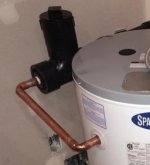
What is this bit of plumbing ? Isn't that the hole where the pressure/temperature relief vales normally goes ?
 

Attachments

  • image.jpg
    image.jpg
    8.5 KB · Views: 87
OP
G

Gentle_Ben

Well-known member
Joined
Nov 10, 2012
Messages
530
Location
Manitoba, Canada
That slab is not "insulted really well". It needed the 2" foam under it too. You are pumping btus into the ground.

My contractor does all his heated slabs this way, he built my dads shop too and has the same outside perimeter foam and thermal break beneath the slab and had really good results with it. He also built an award winning ultra energy efficient home for a family friend and use this same method as well.

He does phenomenal work, so I trusted his knowledge on the subject since I had none.
 
OP
G

Gentle_Ben

Well-known member
Joined
Nov 10, 2012
Messages
530
Location
Manitoba, Canada
Where did you get a 6000W heating element ? They biggest that manufacturer installs is 4500W.

You really need inlet and outlet temps from the tank. Larger tanks usually have 2 heating elements, so you could (in theory) have 12,000W of heating (I would hate to see THAT heating bill) ! This would require new wiring.

Someone smarter than I will have to say if a micro boiler is really more efficient than a water heater.

There is a guy in Winnipeg, MB who custom makes heating elements for all sorts of applications.

I don't have room for a larger hot water tank at this point, my system is hidden inside custom cabinetry.

My system is affordable for now, using my best estimates I think its costing me $200 per month in the coldest months of the year (Dec, Jan, Feb) to heat the garage. With rising electricity bills looming I am just thinking about the future.
 
OP
G

Gentle_Ben

Well-known member
Joined
Nov 10, 2012
Messages
530
Location
Manitoba, Canada
What is this bit of plumbing ? Isn't that the hole where the pressure/temperature relief vales normally goes ?

That's the expansion chamber. It has a relief valve built into it. When the system is running that chamber is empty, but once the system stops running and the tank has a chance to get up to full temperature again that chamber is full.
 

Radiantec Guy

Active member
Joined
Jul 8, 2011
Messages
30
I finished my detached garage in 2014, and went with a heating system that my contractor uses in all the garage's he builds.

It uses a circulating pump hooked to a small hot water tank. The pump is controlled by a thermostat that sits 12 inches above the floor.

The system works well enough in the other garage's he has installed it in, but mine is the largest garage he has put this system into (700sf) and definitely has the largest amount of air volume since I have a 12ft high ceiling.

If the temperature outside remains stable (cold but no big swings), and if there isn't a lot of wind, then the system works very very well, it actually hardly runs, just for a while in the morning each day. However if we get a big drop in temperature then the system just starts running constantly until eventually it catches up, and if it is very windy then the system basically runs until the wind stops.

From my understanding and the research I've done since building my garage, it sounds like this hot water tank setup is taking too long to heat incoming water and just runs and runs b/c it can't get the thermostat to hit the target temperature until the temperature outside stabilizes or the wind dies down.

Would I be better off replacing this system with an electric micro boiler setup? I want to have a more efficient system that can lower my monthly utility costs for heating my garage.

image.jpeg
Hi Ben, based on what you've mentioned, the heater is too small on cold days in my opinion. I roughly calculate your required btu's to be about 23,000 btu/hour on a day that's 0 F. The heater, if it has a 6,000 watt element, puts out about 20k btu/hour. The best way to tell is to monitor your supply and return temps. Your supply or outgoing temp should always be roughly the same temp as the heater setpoint if the heater is size appropriately. The only exclusion to this might be when the system is at cold start.

As someone mentioned, you can simply run a supplemental heater on cold days or put in an additional small heater. I prefer putting in the right sized heater(s) because you don't want the system working harder than it has to. Also, there are electric boilers on the market that you can get in any size like these We don't ship these to Canada but you may be able to call the company and find a local dealer or find something similar.

Also, it is a misnomer that if an electric water heater has 2 elements that you have 2x the output (2-4500 watt elements = 9,000 watts of output). This isn't the case. Electric water heaters have alternating elements and only 1 is on at any given point. As the water in the bottom is heated it rises to the top of the tank where the upper element will take over. I've seen people wire them together so that they both come on at the same time but this isn't a practice I would recommend! :) Good luck with your project.
 
Last edited:

theoldwizard1

Well-known member
Joined
Feb 22, 2011
Messages
43,102
Location
SE MI
. Electric water heaters have alternating elements and only 1 is on at any given point. As the water in the bottom is heated it rises to the top of the tank where the upper element will take over.
Excuse my ignorance, but can you explain why they work this way ?

I've seen people wire them together so that they both come on at the same time but this isn't a practice I would recommend! :)
Assuming you have the proper size wiring, what is wrong with this ?
 
Last edited:

Jackfre

Well-known member
Joined
Dec 26, 2010
Messages
4,406
Location
N CA
Any chance he can make a 9000W element ?

You might have to change the power feed for a monster like that !

Yeah, and get the special high torque electric meter so it doesn't spin off its shaft;)

Here in the States many of the low-boy water heaters are NLA after 4/15 when the energy regs changed. Just an FYI for the future.
 
To avoid these ads, REGISTER NOW!
OP
G

Gentle_Ben

Well-known member
Joined
Nov 10, 2012
Messages
530
Location
Manitoba, Canada
Hi Ben, based on what you've mentioned, the heater is too small on cold days in my opinion. I roughly calculate your required btu's to be about 23,000 btu/hour on a day that's 0 F. The heater, if it has a 6,000 watt element, puts out about 20k btu/hour. The best way to tell is to monitor your supply and return temps. Your supply or outgoing temp should always be roughly the same temp as the heater setpoint if the heater is size appropriately. The only exclusion to this might be when the system is at cold start.

Thanks very much for your response. Would the BTU requirement in your calculation change if you were basing it on an outside temperature of -22F which is not uncommon here?

Would I need to buy a boiler that is numerically close to my BTU/hour needs or should I be buying the next size up?
 

jvitez

Well-known member
Joined
Nov 30, 2009
Messages
2,429
Location
Big Sky Country, Canada
Can you clarify two things please?

1. You said in your original post that your system runs constantly on very cold or windy days. Does the air temp inside the garage drop during these conditions or is the temp maintained, just that the system runs constantly to be able to maintain the inside air temp?

2. You also said " I want to have a more efficient system that can lower my monthly utility costs for heating my garage." Is your main issue the monthly cost for heating, a drop in inside air temp during cold conditions, or both?
 

theoldwizard1

Well-known member
Joined
Feb 22, 2011
Messages
43,102
Location
SE MI
I want to have a more efficient system that can lower my monthly utility costs for heating my garage.

Electric resistance heat is about as close to 100% efficient as you can get.

Heat pumps are actually more than 100% efficient, because they are just moving heat from one place to another. Your only chance at beating your current electrical consumption is a ground water heat pump.

This another BUYER BEWARE situation ! The installation cost will be very high so it will take years for it to pay back. Beware of "ground loop" systems (compared to wells). Many people have bought them only to find out that in extreme weather they are freezing the soil and the inlet water temperature is near freezing or below (IHMO, it should never be below 40-50F).


The easiest solution is to install a second water heater (controlled by a separate thermostat/relay that turns it on when the inside temp is below 60-65F), or perhaps a Rinnai LP Direct Vent Wall Furnaces for auxiliary heat.
 
Last edited:

Northislander

Well-known member
Joined
Dec 7, 2016
Messages
479
Location
Vancouver Island
Electric resistance heat is about as close to 100% efficient as you can get.

Heat pumps are actually more than 100% efficient, because they are just moving heat from one place to another. Your only chance at beating your current electrical consumption is a ground water heat pump.

This another BUYER BEWARE situation ! The installation cost will be very high so it will take years for it to pay back. Beware of "ground loop" systems (compared to wells). Many people have bought them only to find out that in extreme weather they are freezing the soil and the inlet water temperature is near freezing or below (IHMO, it should never be below 40-50F).

Quote:
Originally Posted by theoldwizard1 View Post
Not for the "faint of heart" ... a multi-zone mini-split, with a refrigerant to water heat exchanger.

The loft can be heated and cooled by a regular air handler. Air handlers could be added to the shop for cooling (even after the install). These could also be used to help bring the area up to temp quicker.

This is not truly a "custom" system. Mitsubishi sells this exact system outside of the US ! The heat exchanger is an "off the shelf" item. You should be able to use a "standard" thermostat (except when heating the floor and the shop air - those 2 thermostat might not play nice together).


If you are going geothermal, do NOT use ground loops ! Wells may cost you more to install, but if the return water temp is too low (<50F), you can always drill another well.

I have read some other boards where HVAC techs have built their own geothermal, radiant heat, air cooling systems from available parts. Lots of parts, valves, copper pipe, heat exchangeres, etc. If you have the skill and know how to shop for parts, it is probably a good deal.
Wizard curious when not knowing the OP's ground conditions you would steer him away from a ground loop? In my opinion if he's willing to spend the dollars geo would be the most economical option in the long run.
Horizontal loop or vertical is determined by the ground conditions.


The easiest solution is to install a second water heater (controlled by a separate thermostat/relay that turns it on when the inside temp is below 60-65F), or perhaps a Rinnai LP Direct Vent Wall Furnaces for auxiliary heat.

Hi Wizard I pasted a previous thread where you steered the OP away from Ground source, i'm still curious why you don't like it not knowing anything of the op's ground conditions. I agree there have been a lot of poorly designed and installed ground loop systems but i have seen the same poor designs with wells and pond loops i have personally installed numerous ground loops in the right conditions that have been performing well for over15 years.
Did you have a bad personal experience? Or do you have shares in a well drilling company?
Op sorry to kind of hijack the thread as i'm sure your not even interested in a ground or air to water heat pump I'm just curious why the wiz keeps steering people away
 

theoldwizard1

Well-known member
Joined
Feb 22, 2011
Messages
43,102
Location
SE MI
Hi Wizard I pasted a previous thread where you steered the OP away from Ground source, i'm still curious why you don't like it not knowing anything of the op's ground conditions. I agree there have been a lot of poorly designed and installed ground loop systems but i have seen the same poor designs with wells and pond loops i have personally installed numerous ground loops in the right conditions that have been performing well for over15 years.

Actually, I very much LIKE ground sourced heat pumps ! Sizing the heat sink/source is not an exact science, but too many were installed with IMHO are undersized ground loops.

Once they are installed and you discover the inlet back to the the heat pump is too cold (<40F) you are SCREWED ! At least with wells, you can drill another well (at substantial cost).

You should RUN AWAY from any one trying to sell you ground sourced heat pump system that has a resistance heat strip.
 

Northislander

Well-known member
Joined
Dec 7, 2016
Messages
479
Location
Vancouver Island
Actually, I very much LIKE ground sourced heat pumps ! Sizing the heat sink/source is not an exact science, but too many were installed with IMHO are undersized ground loops.

Once they are installed and you discover the inlet back to the the heat pump is too cold (<40F) you are SCREWED ! At least with wells, you can drill another well (at substantial cost).

You should RUN AWAY from any one trying to sell you ground sourced heat pump system that has a resistance heat strip.

Either way if the system is poorly designed and or installed and not working. Most systems can be improved at "substantial cost". In most cases a fully landscaped yard is going to be destroyed whether your redoing a ground loop or drilling a new well or wells. And what is to cold i have lake loops that have a lake temp. of 39F 3 months of the year that work fine and by the way not one of the geo systems i have installed has elec. back-up yes most have gas or wood stoves for backup when the elec. grid is down
 

theoldwizard1

Well-known member
Joined
Feb 22, 2011
Messages
43,102
Location
SE MI
And what is to cold i have lake loops that have a lake temp. of 39F 3 months of the year that work fine and by the way not one of the geo systems i have installed has elec. back-up yes most have gas or wood stoves for backup when the elec. grid is down

"Cold" is when the heat pump can not move enough heat out of the heat source to heat the building without auxiliary input. 39F is pretty cold for most "typical" heat pumps. ! Many people were sold "water furnace" with ground loops in cold climates. Their heat pump water inlet temps were very close to freezing.

Backup for grid down is a different issue.
 
Last edited:
OP
G

Gentle_Ben

Well-known member
Joined
Nov 10, 2012
Messages
530
Location
Manitoba, Canada
Can you clarify two things please?

1. You said in your original post that your system runs constantly on very cold or windy days. Does the air temp inside the garage drop during these conditions or is the temp maintained, just that the system runs constantly to be able to maintain the inside air temp?

Air temperature drops a bit, depends on how long the wind or cold spell lasts for. Its never usually more than 1-3 degrees Celsius. Its more of a concern of how much my system is running vs. any air temperature concerns.

2. You also said " I want to have a more efficient system that can lower my monthly utility costs for heating my garage." Is your main issue the monthly cost for heating, a drop in inside air temp during cold conditions, or both?

My issue is the cost of heating, I have no temperature concerns whatsoever in the garage. My theory was that maybe a micro boiler that wouldn't run constantly and wouldn't have to sit there heating 30 gallons of water all the time even when it isn't needed might be more efficient in the long run.

I have spoken to a couple people who have made the switch from a hot water tank system like mine (with lower watt elements) in their shops to a micro boiler and have claimed their monthly heating bills have dropped, but they weren't able to provide me with any real data, and there were too many variables like colder vs. warmer winters that come into account.
 
OP
G

Gentle_Ben

Well-known member
Joined
Nov 10, 2012
Messages
530
Location
Manitoba, Canada
The easiest solution is to install a second water heater (controlled by a separate thermostat/relay that turns it on when the inside temp is below 60-65F), or perhaps a Rinnai LP Direct Vent Wall Furnaces for auxiliary heat.

I don't have the room for a second hot water tank unfortunately. From my rudimentary knowledge it seems as though I need to be able to heat the water cycling in my system faster. Would a micro boiler not accomplish this?

I really want to avoid adding a secondary heating system if I can. My garage was very carefully designed and I don't have much room to play with. I guess if the general opinion is that a micro boiler really won't help me achieve my goal of a system that doesn't consume as much electricity then I will probably just leave the system as is and just have to accept it.
 

Radiantec Guy

Active member
Joined
Jul 8, 2011
Messages
30
Hi Jackfre, here is a good article explaining why they work that way. Better to get it straight from the horse's mouth!

As for wiring both of them together, I'm sure this would void the warranty and you could possible overheat the water since at times water in the bottom of the tank is cold (which is what turns on the lower element) while the top of the tank is warm/hot but it would also turn on that element. I know people that have done it and it seems to work fine although it isn't a practice I would recommend.
 

Jackfre

Well-known member
Joined
Dec 26, 2010
Messages
4,406
Location
N CA
Uhh, I didn't ask the question, but good info.
To the OP, Regardless of what method you use, the tank or an electric boiler the actual heating costs are going to be very close to the same as it is still resistant heat. The boiler would improve the performance comfort wise due to increased capacity. If you aren't heating the place all the time you could throw the breaker on the tank and run its operation manually. You would see some savings, but with the low capacity of your current system it will take a loooong time to heat up the mass of the slab.
 

theoldwizard1

Well-known member
Joined
Feb 22, 2011
Messages
43,102
Location
SE MI
My issue is the cost of heating, I have no temperature concerns whatsoever in the garage. My theory was that maybe a micro boiler that wouldn't run constantly and wouldn't have to sit there heating 30 gallons of water all the time even when it isn't needed might be more efficient in the long run.
Watts = Watts or, in your case, Watts = BTUs. I would be surprised if there was a significant difference in monthly cost between what you have now ad what a small electric boiler would be. The boiler will recover your heat faster and not let the temp drop off.

Gas fired water heater do not do well in radiant heating because the run much longer and wear out faster.


The only way you are going to cut your monthly bill is with a ground source heat pump. Installation will be BIG !
 

Beau_Skee

Member
Joined
Mar 7, 2017
Messages
8
Location
Minocqua, WI
Your pump should return the water full cycle within 15° of starting temp. Less the boiler has to make up, constant floor temp all throughout the layout.
Just remember, you buy a boiler system and the first step is to throw that pump out. (not literally, but you won't use it)
The chances of a pump being shipped from the factory that fits your needs is extremely unlikely. Match a pump to your specs and you're golden.

Sent from my SM-N920V using Tapatalk
 

jvitez

Well-known member
Joined
Nov 30, 2009
Messages
2,429
Location
Big Sky Country, Canada
Air temperature drops a bit, depends on how long the wind or cold spell lasts for. Its never usually more than 1-3 degrees Celsius. Its more of a concern of how much my system is running vs. any air temperature concerns.


My issue is the cost of heating, I have no temperature concerns whatsoever in the garage. My theory was that maybe a micro boiler that wouldn't run constantly and wouldn't have to sit there heating 30 gallons of water all the time even when it isn't needed might be more efficient in the long run.

I have spoken to a couple people who have made the switch from a hot water tank system like mine (with lower watt elements) in their shops to a micro boiler and have claimed their monthly heating bills have dropped, but they weren't able to provide me with any real data, and there were too many variables like colder vs. warmer winters that come into account.

Thanks for the clarification. As others have said so well there won't be any operating cost savings from going with an electric boiler. You monthly bill may actually go up as it would keep the garage at a higher temperature.

To really save money you'd need to go to a NG system. Do you have NG available?

I know where you're coming from though. The planned doubling of electric rates over the next 2 decades throws a major monkey wrench into heating system planning. (Thank you Gary Doer and global warming eco-pagans...........) NG is cheap now, but I've read some analyses that predict a tripling of the price as more coal electric plants shut down.

For a few hundred bucks a winter for an awesome, comfortable garage, I think your best bet is leave things as is.
 

UpstateNY

Well-known member
Joined
Jan 2, 2012
Messages
662
Gas fired water heater do not do well in radiant heating because the run much longer and wear out faster.

I must disagree, my GFWH radiant system has been running for years. If one installs mineral-free distilled water (and anti-freeze) then there are no abrasive contaminants to swirl in the tank and wear away the glass lining. It's my understanding that's typically what makes WH's fail. I've had house WH's last 20 + years by draining them periodically. I fully expect to get 20 + years out of my GFWH in my radiant-heated shop.

My $.02
 

Gooch

Well-known member
Joined
May 30, 2009
Messages
676
Location
Petersberg, IA
I must disagree, my GFWH radiant system has been running for years. If one installs mineral-free distilled water (and anti-freeze) then there are no abrasive contaminants to swirl in the tank and wear away the glass lining. It's my understanding that's typically what makes WH's fail. I've had house WH's last 20 + years by draining them periodically. I fully expect to get 20 + years out of my GFWH in my radiant-heated shop.

My $.02

The issue with GFWH in radiant systems is the extended and more frequent run times and the added condensation rotting the flue out
 

yeldogt

Well-known member
Joined
Jan 2, 2012
Messages
18,184
I'm surprised they use that bubble stuff in such a cold climate? While it's giving you a thermal separation ... it's not much.. There has to be heat going in to the ground -- especially at the those cold temps.

And the building must be leaking as the wind it telling you something.

In the mid Atlantic states -- geothermal is already not cost effective even with rebates. Air to Air has improved to a point that the numbers don't work .. with foam the payback is forever.
 

NC357

Banned
Joined
Jan 12, 2017
Messages
99
Those small water heaters usually have only one heating element. Larger water heaters have 2 elements and require 240V. What is the model # on your water heater.

Most water heaters with 2 elements are designed so that only one element at a time is running. Some can be converted to run both elements, but you need to read the information on your water heater. Also, most are limited to 4500w max per element, even if you can find a bigger one.

If you want a water heater with twin 6000w elements burning, you're looking for something commercial.
 
OP
G

Gentle_Ben

Well-known member
Joined
Nov 10, 2012
Messages
530
Location
Manitoba, Canada
I'm surprised they use that bubble stuff in such a cold climate? While it's giving you a thermal separation ... it's not much.. There has to be heat going in to the ground -- especially at the those cold temps.

And the building must be leaking as the wind it telling you something.

I questioned the bubble and foil thermal break vs. using closed cell foam, but my contractor had his reasons for not doing it and its hard to argue with a guy who has 40+ years of experience and is a close family friend.

You are right about the building leaking in strong winds, its the two 10x10 doors that face north (it was the only way they could be oriented unfortunately). I have the best door seals money can buy but its impossible to keep at least some air from coming in with overhead doors.

My thermostat is near my electrical panel which is near the door, so I think that's what is throwing my system off. For next winter I am going to relocate the thermostat to an area where the air will be more stable and give a more accurate reading.
 

HoosierBuddy

Well-known member
Joined
May 9, 2006
Messages
2,918
Location
Southern Indiana
To the OP. I agree with the others that changing to a different resistance heating method is futile, if the goal is cost savings. It would work better...but it would (in theory) use more electricity to do so.

If gas is available, let us know as more/better options would be available.

If you seriously look at a high-dollar item like ground source, you might be better off putting that system in your home rather than your garage, as your home is going to use it more...which would increase payback.

If you're stuck with what you have, I'd say "insulate, insulate, insulate".

Phil
 
To avoid these ads, REGISTER NOW!
Top Bottom