
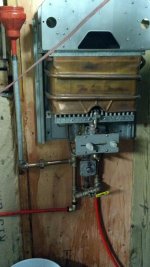
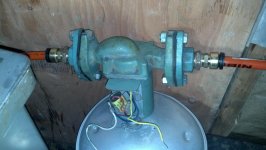
OK so this is my setup I have a blow off valve that goes in place of the funnel. The pex coming in on the left comes from the pump....The valve is there just for another way to control the heat.
1. should the pump be before or after the heater?
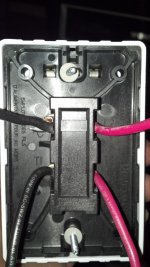
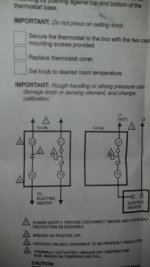
2. Im not understanding how to wire the thermostat to the pump?
3. Is there any certain way my pump should hang?
Attached Thumbnails
anthony666
Senior Member
Quote:
Originally Posted by scrapart View Post
1. should the pump be before or after the heater?
2. Im not understanding how to wire the thermostat to the pump?
3. Is there any certain way my pump should hang?
1. after
2. that's a 220v t-stat .. get one for 110v to match the pump
3. it shouldn't 'hang' .. the wiring shouldn't be where it can get wet if the pump leaks and the motor should not be oriented so that it's an air trap
good lord that's ugly sir
scrapart
I know its ugly not going for looks Im going for function its not complete yet.
The T-stat is for 120, 208 or 240 volt
anthony666
Senior Member
use the diagram on the right then, substitute 'pump' for heater
meanwhile, what turns on the wall kettle ?? does it have a flow switch, an internal tstat or maybe a 't t' input ???
anthony666 is online now Report Post
scrapart
Member
Water flow turns on the propane tankless heater... Ok do I hook it to the yellow wire or white wire?
scrapart is online now Report Post
anthony666
it doesn't matter with those taco pumps, they don't have a L & N like a grundfos
anthony666 is online now Report Post
anthony666's Avatar
you need a few more components .. what are you doing about air elimination and thermal expansion ??
scrapart
Member
I have a longer piece of pipe and at top I have a 75psi air valve that goes in place of the funnel. Never thought of a tank for expansion
scrapart
Member
Is there really that much expansion?
scrapart
Member
The guy at Menard's (Home improvement store) said there isent really a need for a tank seeing I have one 150' loop. Just keep an eye on the air valve if I start leaking then I might want to think about a tank.
anthony666
Senior Member
there's a reason your menards guy makes $10 a hour working at a box store .. because he knows **** about hydronics
i'm willing to wager that 75 psi valve is a t&p valve, not an air eliminator, and 75 psi is way too much for a radiant system, 30 psi is gold .. a t&p is a safety valve .. if you get too much temperature (the t in t&p) or pressure (the p) your system becomes a bomb firing scalding water and hunks of boiler about the general vicinity .. a t&p vents water until the desired pressure is achieved .. please change it to a 30 psi valve at your earliest possible opportunity
yes, you need a thermal expansion tank, it helps stop the above t&p explosions
yes, you need an air eliminator .. water is made up of gases, hydrogen and oxygen, plus water gases it managed to absorb along the way as it rushes through the city water supply, or through your well .. as soon as you put it into your system it stops rushing around and starts undissolving the gases and some of it's oxygen .. three things combined cause corrosion; heat, water and air .. we need the water and the heat, so we get rid of the air
scrapart
Member
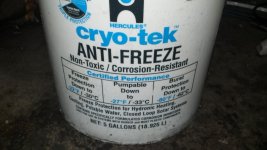
not connected to a water supply... Im using the antifreeze for in floor heat.
anthony666
you can't use straight anti freeze
dude .. start another thread .. we'll get you back on track
1. should the pump be before or after the heater?
2. Im not understanding how to wire the thermostat to the pump?
3. Is there any certain way my pump should hang?
Attached Thumbnails
anthony666
Senior Member
Quote:
Originally Posted by scrapart View Post
1. should the pump be before or after the heater?
2. Im not understanding how to wire the thermostat to the pump?
3. Is there any certain way my pump should hang?
1. after
2. that's a 220v t-stat .. get one for 110v to match the pump
3. it shouldn't 'hang' .. the wiring shouldn't be where it can get wet if the pump leaks and the motor should not be oriented so that it's an air trap
good lord that's ugly sir
scrapart
I know its ugly not going for looks Im going for function its not complete yet.
The T-stat is for 120, 208 or 240 volt
anthony666
Senior Member
use the diagram on the right then, substitute 'pump' for heater
meanwhile, what turns on the wall kettle ?? does it have a flow switch, an internal tstat or maybe a 't t' input ???
anthony666 is online now Report Post
scrapart
Member
Water flow turns on the propane tankless heater... Ok do I hook it to the yellow wire or white wire?
scrapart is online now Report Post
anthony666
it doesn't matter with those taco pumps, they don't have a L & N like a grundfos
anthony666 is online now Report Post
anthony666's Avatar
you need a few more components .. what are you doing about air elimination and thermal expansion ??
scrapart
Member
I have a longer piece of pipe and at top I have a 75psi air valve that goes in place of the funnel. Never thought of a tank for expansion
scrapart
Member
Is there really that much expansion?
scrapart
Member
The guy at Menard's (Home improvement store) said there isent really a need for a tank seeing I have one 150' loop. Just keep an eye on the air valve if I start leaking then I might want to think about a tank.
anthony666
Senior Member
there's a reason your menards guy makes $10 a hour working at a box store .. because he knows **** about hydronics
i'm willing to wager that 75 psi valve is a t&p valve, not an air eliminator, and 75 psi is way too much for a radiant system, 30 psi is gold .. a t&p is a safety valve .. if you get too much temperature (the t in t&p) or pressure (the p) your system becomes a bomb firing scalding water and hunks of boiler about the general vicinity .. a t&p vents water until the desired pressure is achieved .. please change it to a 30 psi valve at your earliest possible opportunity
yes, you need a thermal expansion tank, it helps stop the above t&p explosions
yes, you need an air eliminator .. water is made up of gases, hydrogen and oxygen, plus water gases it managed to absorb along the way as it rushes through the city water supply, or through your well .. as soon as you put it into your system it stops rushing around and starts undissolving the gases and some of it's oxygen .. three things combined cause corrosion; heat, water and air .. we need the water and the heat, so we get rid of the air
scrapart
Member
not connected to a water supply... Im using the antifreeze for in floor heat.
anthony666
you can't use straight anti freeze
dude .. start another thread .. we'll get you back on track
Attachments
-
 IMG_20140111_200435_459.jpg146.6 KB · Views: 134
 -
 IMG_20140111_200758_095.jpg139 KB · Views: 101
 -
 IMG_20140111_200819_873.jpg144.1 KB · Views: 80
 -
 IMG_20140111_203249_712.jpg144.5 KB · Views: 75
 -
 IMG_20140111_203320_720.jpg127.9 KB · Views: 64
 -
 IMG_20140111_211736_053.jpg134.2 KB · Views: 56
 -
 IMG_20140111_230624_337.jpg133.9 KB · Views: 62


