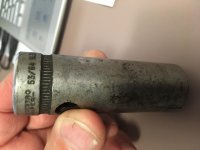
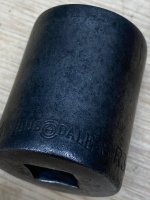
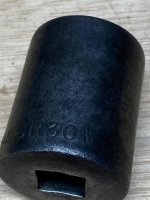
It seems like they are likely the size stamped on them, despite being advertised as Whitworth sockets, they are not really Whitworth dimensions.
Also, as far as I know there is no formula to convert Whitworth sizes to Inch or mm dimensions, and one must reference a table with approximate values. Is this accurate, no formula actually exists?
We know that
1 " = 25.4 mm
This is the exact conversion formula, but no such formula exists for Whitworth?
I think I know what you mean, but you're talking about Whitworth like it's a
unit of measure. It's not analogous to 'Imperial' (your 1" citation) or 'Metric' (your 25.4mm citation). It was a standard for interchangeable mechanical fasteners, in terms of
thread specs. Whitworth is analogous to
other mechanical fastener standards, such as A.L.A.M (obsolete), U.S. Standard (U.S.S.)(obsolete), S.A.E., and, (after 1948), UTS. It may seem odd to lead with this, and hopefully not pedantic or trite, but it helps to put it in that perspective to respond more fully to you.
The other thing that seems to be getting in the way a little here is the unfortunate byproduct of this weird misleading conflation that modern mechanics like to make equating 'S.A.E' (a boltage standard) to 'Imperial' (a unit of measure). I don't know if it's just laziness or a misunderstanding of history, but it matters to the topic.
Everyone wants to talk about how Whitworth is weird because it is identified by
bolt sizes (i.e., the diameter of the threaded bolt, in fractional or decimal inches), but prior to everything in the US being standardized on S.A.E., ALL nuts, bolts, AND wrenches were ALSO specified
by bolt sizes, in fractional inches, in A.L.A.M., U.S.S., Hex Cap, etc standards, just like Whitworth. And for the longest time, well up to the 1930's, these bolt sizes in various standards (U.S.S., Hex Cap, etc) were actually
forged or stamped on wrenches,
not the milled opening sizes. Just like Whitworth! And, to continue, and bring this point home, nuts and bolt heads of the
same bolt size had
different AF sizes depending on whether they were Heavy (U.S.S.) or Light (S.A.E.) standard. It's not just a nutty British car thing. Working on antique and prewar vintage American cars will make you toss a wrench or two across the garage, too, especially if you don't have a good Boltage Chart.
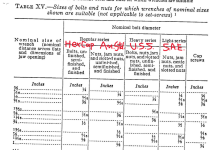
For example, you CANNOT turn a 3/8" U.S.S. bolt and a 3/8" S.A.E. bolt with the same wrench! They had different size AF nuts and heads. Same
bolt size!
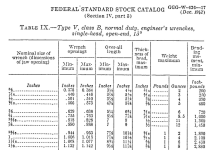
See chart from 1941!

Why did I go through that?
Because it's the same thing going on with Whitworth. The AF sizes of Whitworth nuts and bolt heads are not random. They are arbitrary and they
can be measured in Imperial (fractional or decimal) or Metric units of measure. They just don't line up
exactly, on a tidy graduation, for wrenches made with either one. Unless you have tools made to Whitworth standards - which will, in turn, frustrate the fudge out of you on hardware of other standards!
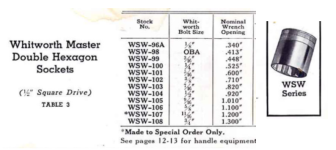
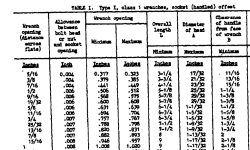
If you go back and look at the Blackhawk catalog excerpt, Blackhawk is saying those opening sizes are their broaching solution to match the AF size of the nuts and bolt heads for Whitworth
bolt sizes listed next to each one. Why Hinsdale was using slightly different openings, I don't know, but probably different interpretations of min/max. If that's what you mean by "approximation," yeah, they weren't re-tool-and-die-ing. I DO know that Blackhawk was selling loads of Whitworth tools in England in the late 1930's, into the prewar Cash-and-Carry and Lend-Lease programs, and throughout WWII, because my WWII collecting colleagues have them. If you hang out up on the General Tools Discussion forum you probably know Dave455. He has some, too. His grandpop's, if I recall correctly. He occasionally ventures down here and I remember he and I discussing them on the Blackhawk thread.
Besides Blackhawk and Hinsdale, are there other manufacturers that sold Whitworth sockets, that were actually SAE sizes that are approximately Whitworth sizes and not actually Whitworth sizes?
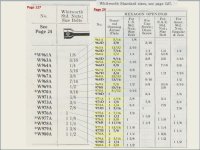
Here's a composite I made (two separate pages) for how Williams handled Whitworth in 1941 -

EDITED: Instead of adding another column for "Whitworth Std" to their 'Wrench Openings to Hex Bolt Standards' table on p.24, they added a page for Whitworth in the back (p.127). That table reuses the regular P/N's with a W prefix. It does NOT show opening sizes, though. The implication is the broaching would be to Whitworth Std.
Note that they did not do a similar table for 1/2-inch drive detachable socketry, but they did include a notation on that page saying, "
Whitworth Standard sizes also; details on request." I'm 100% positive it would follow the same scheme as the tables above for fixed Tee and Offset handle socket wrenches.
If you compare the Hinsdale and Blackhawk, you will see that there is not much agreement among them. But if you studied it, I'd be surprised if it wasn't within min/max. Williams unknown.
Sloppy? Or best practical course of action at the time?
Make of all this what you will.
You seem to have a wealth of knowledge on vintage tools,...
Nah. Honestly, I'm just a nerd and a bookworm. The real wealth of knowledge is inside the catalogs of the major hand tool manufacturers or vintage editions of
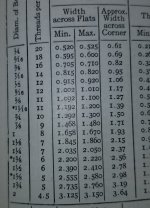
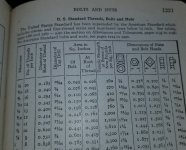
Machinery's Handbook. Pages like this from the 12th Edition (1943), which is what the guys at Hinsdale, Blackhawk, and Williams were probably using as a reference.