To avoid these ads, REGISTER NOW!

Industrial Sewing - school me please

kirkkw

Well-known member
Joined
Mar 13, 2011
Messages
115
Location
Leander (Austin) Tx
100_3168.jpg


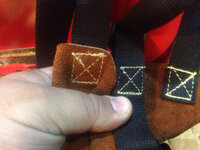
I am investigating how to produce the stitching in this picture. I have no sewing knowledge, but may have a business opportunity sewing this stitch.

I assume the material is polyester webbing and is 1 7/8" wide and 1.2mm thick.

The stitch is a square box with an X sew diagonally. Also the left and right sides of the box are double stitched.

What kind of machine, brand, model etc should I be looking at to produce 2,400 to 6,000 of these stitches per month?

Any and all recommendations are welcome and greatly appreciated.
 
To avoid these ads, REGISTER NOW!

1foxracing

Well-known member
Joined
May 14, 2014
Messages
1,086
Location
Tuscarawas Co, Ohio
I manufacture cargo parachutes and run industrial sewing machines every day. I have a similar Juki that is a bar tacking machine but I use it to attach shroud lines on smaller parachutes.
Juki is the leader in industrial sewing machines bar none and yes they are more expensive but they are all totally worth it. Stay away from ANY Singer made in the last 35 years, they are all garbage.
Here is a little youtube clip of me running the Juki LH1900AHS, these can be found new for around $5,500. Don't be afraid of a used Juki though, they will go the distance.
 

cgrutt

Well-known member
Joined
Mar 4, 2016
Messages
8,271
That machine is awesome!

At 2,500 to 6,000 pieces a month, the Juki should pay itself off in no time...
 

Toxictom

Well-known member
Joined
Nov 27, 2012
Messages
318
Location
Anchorage, AK
Find a used old sewing machine at a thrift store and see if it will accomplish what you are trying to sew. The really old machines had metal gears and can sew through some tough stuff. I used my old Singer to sew together PVC fabric for a skin-on-frame kayak.
 

rlitman

Well-known member
Joined
Oct 18, 2010
Messages
24,609
Location
Long Island
That machine is awesome!

At 2,500 to 6,000 pieces a month, the Juki should pay itself off in no time...

At 170 work hours per month on average (assuming the machine gets as much time off as the workers, which isn't necessarily reasonable), and 15 seconds a pop, that machine should be making at least 40,800 of those stitches in a month.

If I had a month to put to it, I'm pretty sure I could get 2500 of those made with my Brother, and that's not a commercial machine (though it would probably be worn out at the end of the first month). Though they'd look like ****, being all hand done.
 
To avoid these ads, REGISTER NOW!

jrcampbe

Well-known member
Joined
Sep 13, 2014
Messages
100
My mom was a professional seamstress and she had an industrial machine as part of her collection. Hers was a Comet. It replaced a Brother industrial. Both of those are good units. You can get used industrial sewing machines for under $2000. She actually did some similar work making climbing harnesses for a while. If this is safety rigging of some kind, you need a machine capable of handing heavy polyester or nylon thread and dealing with thick webbing. She taught me how to sew. It is not difficult. An hour of practice and you could be making that particular stitch.

At the time she did the rigging gear, she had a Brother industrial machine like this one ($500):

http://www.ebay.com/itm/brother-ind...856641?hash=item3d214f6601:g:vQ4AAOSwanRXh9C1

That's all you need. In fact, it's way more than you need. It's pretty bad *** and really fast. It will take some time to learn how to control it for that little one inch square pattern you have.

Jim
 
Last edited:

jrcampbe

Well-known member
Joined
Sep 13, 2014
Messages
100
This is a newer one that will automatically "tack back" the stitch.

http://www.ebay.com/itm/BROTHER-DB2...497529?hash=item1a05905ff9:g:oqwAAOSwT6pV6JyH

When she did the harness stuff, the requirement was that the webbing broke before the stitching. She had to go over it repeatedly to make the stitching very strong. You "knot" the beginning of the stitch by going back over it. This machine does that automatically, which is going to save you a ton of time in a repetitive process (you do not need to stop, engage reverse, then stop, then go forward again). You want one that lifts the "foot" with a leg pedal, as this will also save you a lot of time.

Last thing to say is that all you need for the project in your photo is a "straight stitch" machine.
 

Rocket1

Well-known member
Joined
Nov 12, 2009
Messages
387
Location
Arlington, TX
My father does upholstery and I bought him a Pfaff sewing machine so he could stat working at home. I'm not sure what the model number is but the machine is a beast. The sewing machine head weighs a ton. He has the same brand machine at work and it's probably over 30 years old.

It may not be the correct type of machine for what you're doing… I would t really know since that's not my area of knowledge
 

vpd66

Well-known member
Joined
Mar 1, 2010
Messages
709
Location
Central Wisconsin
I have a 1950s vintage Singer 111W155 walking foot machine that would sew that without a sweat. I bought it for $285.00 complete with table. If you are handy and do some research you can find an old industrial walking foot machine that will sew that for less then $500. I see them pop up on Craigslist all the time. The key is knowing how to identify a compound walking foot machine.
 

rlitman

Well-known member
Joined
Oct 18, 2010
Messages
24,609
Location
Long Island
...

Last thing to say is that all you need for the project in your photo is a "straight stitch" machine.


Looking at my Tillman leather apron last night, the irregularity of the stitching makes me pretty sure these were done on a straight stitch machine.

b0d2c50baa301749f7590303aaee8d6a.jpg
 

Toxictom

Well-known member
Joined
Nov 27, 2012
Messages
318
Location
Anchorage, AK
Thinking out loud here. I wonder if one of those embroidery machines could be programmed for the pattern. It might make for some really nice looking uniform stitches and piecework.
 

Danglerb

Well-known member
Joined
Sep 6, 2007
Messages
9,736
Location
SoCal
I wouldn't even think of using a general purpose sewing machine for a task like this other than to maybe slowly and carefully make a few samples.

Keep in mind buy a good industrial machine used and you should be able to sell it for about the same price when you are done with it.
 

rlitman

Well-known member
Joined
Oct 18, 2010
Messages
24,609
Location
Long Island
I wouldn't even think of using a general purpose sewing machine for a task like this other than to maybe slowly and carefully make a few samples.


Tillman is no small manufacturer, and they clearly thought that a straight stitch machine was fine. That's why I included the picture.

I will say though that my apron was made in China. With US labor costs, an automated machine makes more sense.
 

justme-

Well-known member
Joined
May 24, 2014
Messages
787
Location
Boston suburbs
Embroidery machines are not made for tough jobs like those pictured in the thread. Embroidery on a commercial scale is done on t shirts, sarin jackets, denim hats, the heaviest it will ever see is a heavyweight sweatshirt.
In another former life I worked in a garment factory and they bought one of those machines to bring it in-house. If any of you all daughters went to a dance studio there's a 90% chance her recital costume and studio jacket came from one of 2 companies...it's one of those.
 

vpd66

Well-known member
Joined
Mar 1, 2010
Messages
709
Location
Central Wisconsin
Like I said. An industrial compound walking foot sewing machine is what is needed to sew that strapping. An old Singer or similar style machine will sew that no problem and can be found for under $500 used and resold for about the same money when done with it. Research "compound walking foot sewing machine" you will see the difference.
 
To avoid these ads, REGISTER NOW!
Top Bottom